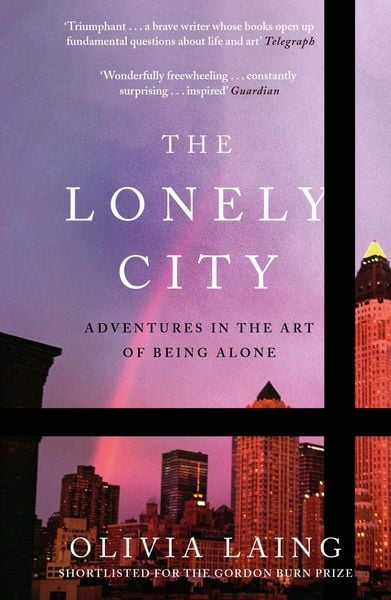
I ordered this book because my idol had read it and I was fascinated by how beautiful it was. The way the author described scenes was wonderful and you felt understood especially in times like these. I really needed this book and it was a good experience. I usually read novels but i absolutely don't regret this exception.
Bewertung
5/5
28.03.2020
Buch (Taschenbuch)
The Nightmarish Topic of the Day
“If you’re lonely, this one’s for you” says the dedication preceding this book. Who on earth would want to read about loneliness in the days of prescribed world-wide social distancing and self-isolation? In trying times like these, perhaps people crave upbeat stories rather than heavy stuff, and would rather escape reality with literature on the lighter side. But still. This is an invitation to the darker side, first published in 2016. Uncanny in its concurrence to what is happening in the world right now, it’s the nightmarish topic of the day.///
This book is not what it seems to be at first sight. It is not, like one might expect, the author’s sole experience or viewpoint about the predicament of being (or feeling) truly alone. The author doesn’t put herself in the centre. Instead, she stays on the edge. But she doesn’t hide the fact that she is able to relate and therefore vulnerable. She is also learning to adapt. The way she almost discretely maintains her part as an important co-player while portraying and focusing on the artists in question with such amazing intensity is nothing short of brilliant. ///
For this is predominatly a book about art. At the same time it’s a fascinating story about underground New York. When Laing writes about her first few weeks after arriving from the UK, one cannot help but think of Paul Auster’s writings and city-mapping. Interestingly, the actress Greta Garbo, also featured here, took long meandering walks in the city, claiming it was her “greatest pleasure.” ///
“I wanted very much not to be where I was,” Laing writes. “In fact, part of the trouble seemed to be that where I was wasn’t anywhere at all. My life felt empty and unreal and I was embarrassed about its thinness, the way one might be embarrassed about wearing a stained or threadbare piece of clothing. I felt like I was in danger of vanishing…” ///
There are numerous lessons on loneliness here; what it does to a person, the shame and the longing, the rage even, how it “accelerates ageing and weakens the immune system and acts as a precursor to cognitive decline.” The book acknowledges how incommunicable loneliness is, how stressful, how loneliness obstructs feelings of empathy from others, how there is “a tendency to see the rejection of lonely people as justified, or to assume they have brought the condition on themselves by being too timid or unattractive, too self-pitying or self-absorbed.” Research claims that it’s contagious; “it is literally repulsive, inhibiting contact at just the moment when contact is most required” - the prime example of a vicious circle. The artists in this book shared a deep sense of “the loneliness of difference, the loneliness of undesirability, the loneliness of not being admitted into the magic circles of connection and acceptance…”///
The first artist portrayed is Edward Hopper. His urban scenes replicate “the central experiences of being lonely: the way a feeling of separation, of being walled off or penned in”, combined with “a sense of near-unbearable exposure.” Lo and behold – the Guardian published an article just yesterday (March 27, 2020) asking the question whether we are all Edward Hopper paintings now: “We choose modern loneliness because we want to be free. But now the art of Hopper poses a tough question: when the freedoms of modern life are removed, what’s left but loneliness?” ///
Andy Warhol loved the distancing quality of technology to keep people “at a slight remove” – when technology consisted of not much more than polaroids, TV and a tape recorder that Warhol called “his wife”. Technology today serves to satisfy people's longing for contact and attention, at the same time allowing their fear of intimacy to be kept at bay.///
Does anyone remember when Michael Jackson was wearing his surgical masks? Laing explains the connection between masks and loneliness: “Masks amplify the way in which skin is a barrier or wall, acting as a marker of separation, singularity, distance. They are protective, yes, but a masked face is also frightening.” David Wojnarowicz, a loner, an artist with a legacy of abuse and neglect, created a series of photographs called “Rimbaud in New York”, featuring a mask of 19th century poet Rimbaud on a string of anonymous figures. In attempts to override bad feelings, escaping the self, his was a world without inhibitions, acted out in reckless encounters at the infamous “piers”, which make the Berlin Berghain look like a Disneyesque playpen, although they, too, long since have been gentrified.///
Another outsider artist on the very margin of society was Henry Darger. He had no intention to show, promote or even talk about his work, and after reading about the story of his life, about the social isolation, cruelty and damage he experienced in early childhood, resulting in his creation of an explicitly violent otherworld, the “Realms of the Unreal”, you will know why. ///
Does anyone remember Klaus Nomi in his alien outfits and his “Kabuki stare (the gaze that can cure epidemics)”? This is where the other viral disease comes in, which, assumably because of the stigma, isn’t being referred to half as much as the Spanish flu these days. “Between 1981 and 1996, when combination therapy became available, over 66,000 people died of AIDS in New York City alone, many of them gay men, in conditons of the most horrifying isolation.” Untouchable, monstrous bodies that had to be quarantined. “Fear is contagious”, writes Laing, “converting latent prejudice into something more dangerous.” “Poisonous currents of paranoia” were running through the city. Wojnarowicz died in 1992. That year alone, 194,746 people died from AIDS-related infections in America. Susan Sontag wrote in 1989: “AIDS exposed the alarming realities of the global village, the world in which everything is in perpetual circulation, the goods and the garbage, the plastic sucky-cup in London washing up in Japan, or trapped in the squalid gyre of the Pacific trash vortex, breaking down into pelagic plastics that are themselves eaten by sea turtles and albatross. Information, people, illnesses: everything is on the move. No one is separate, every element is constantly morphing into something else.” And 30 years later, we are still immune to the lessons.///
Loss is the cousin of loneliness. Warhol’s extinction silkscreens are mementos of “the unimaginable loneliness of being left behind in the world we have despoiled.”
Es ist ein Problem aufgetreten. Bitte laden Sie die Seite neu und versuchen es noch einmal.
5/5
30.03.2025
Buch (Taschenbuch)
“Loneliness is personal, and it is also political.”
In her distinctive und unique voice Olivia Laing writes in “The Lonely City – Adventures in the Art of Being Alone” about the feeling of longing, belonging, disappearing and simply trying to be, without being engulfed into the densely populated and glimmering shadow of New York. She found herself alone and lonely in the city in her mid-thirties, after a break-up, unsure where to go from there. Day after day the cloudy feeling of loneliness crept upon her until she decided to look directly at it – in this city, by way of art. She writes about the experiences of artists that went through it (Klaus Nomi, David Wojnarowicz, Valerie Solanas, Andy Warhol and mroe), their stories and art, their struggles and New York in the 1960 to 2010+. What the people and city went through (the horrible loss that came with AIDS) and the feelings that came with the starting of a “second self”, the rise of the internet and social media in its early stages. What does it mean to be lonely, what does it mean to be alone?
“[…] the fact that loneliness, longing, does not mean one has failed, but simply that one is alive.”
I adore Olivia Laing’s writing and can not get enough of her words, this book is a must read.
Kurze Frage zu unserer Seite
Vielen Dank für Ihr Feedback
Wir nutzen Ihr Feedback, um unsere Produktseiten zu verbessern. Bitte haben Sie Verständnis, dass wir Ihnen keine Rückmeldung geben können. Falls Sie Kontakt mit uns aufnehmen möchten, können Sie sich aber gerne an unseren Kund*innenservice wenden.