
• Produktbild: Algorithmic Learning Theory
  • Produktbild: Algorithmic Learning Theory

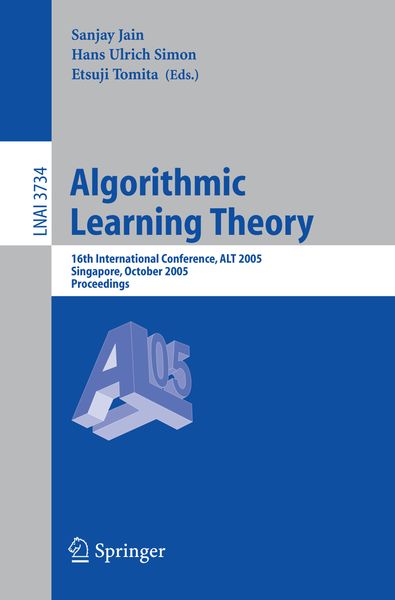
Algorithmic Learning Theory 16th International Conference, ALT 2005, Singapore, October 8-11, 2005, Proceedings

51,99 €

inkl. gesetzl. MwSt., Versandkostenfrei


Beschreibung

Produktdetails

Einband

Taschenbuch

Erscheinungsdatum

26.09.2005

Herausgeber

Sanjay Jain + weitere

Verlag

Springer Berlin

Seitenzahl

491

Maße (L/B/H)

23,5/15,5/2,8 cm

Gewicht

708 g

Auflage

2005

Sprache

Englisch

ISBN

978-3-540-29242-5

Beschreibung

Produktdetails

Einband

Taschenbuch

Erscheinungsdatum

26.09.2005

Herausgeber

Verlag

Springer Berlin

Seitenzahl

491

Maße (L/B/H)

23,5/15,5/2,8 cm

Gewicht

708 g

Auflage

2005

Sprache

Englisch

ISBN

978-3-540-29242-5

Herstelleradresse

Springer-Verlag KG
Sachsenplatz 4-6
1201 Wien
AT

Email: GPSR Kontakt

Noch keine Bewertungen vorhanden

Verfassen Sie die erste Bewertung zu diesem Artikel

Helfen Sie anderen Kundinnen und Kunden durch Ihre Meinung.

Kundinnen und Kunden meinen

Bewertungen (0)

  • Produktbild: Algorithmic Learning Theory
  • Produktbild: Algorithmic Learning Theory
  • Editors’ Introduction.- Editors’ Introduction.- Invited Papers.- Invention and Artificial Intelligence.- The Arrowsmith Project: 2005 Status Report.- The Robot Scientist Project.- Algorithms and Software for Collaborative Discovery from Autonomous, Semantically Heterogeneous, Distributed Information Sources.- Training Support Vector Machines via SMO-Type Decomposition Methods.- Kernel-Based Learning.- Measuring Statistical Dependence with Hilbert-Schmidt Norms.- An Analysis of the Anti-learning Phenomenon for the Class Symmetric Polyhedron.- Learning Causal Structures Based on Markov Equivalence Class.- Stochastic Complexity for Mixture of Exponential Families in Variational Bayes.- ACME: An Associative Classifier Based on Maximum Entropy Principle.- Constructing Multiclass Learners from Binary Learners: A Simple Black-Box Analysis of the Generalization Errors.- On Computability of Pattern Recognition Problems.- PAC-Learnability of Probabilistic Deterministic Finite State Automata in Terms of Variation Distance.- Learnability of Probabilistic Automata via Oracles.- Learning Attribute-Efficiently with Corrupt Oracles.- Learning DNF by Statistical and Proper Distance Queries Under the Uniform Distribution.- Learning of Elementary Formal Systems with Two Clauses Using Queries.- Gold-Style and Query Learning Under Various Constraints on the Target Class.- Non U-Shaped Vacillatory and Team Learning.- Learning Multiple Languages in Groups.- Inferring Unions of the Pattern Languages by the Most Fitting Covers.- Identification in the Limit of Substitutable Context-Free Languages.- Algorithms for Learning Regular Expressions.- A Class of Prolog Programs with Non-linear Outputs Inferable from Positive Data.- Absolute Versus Probabilistic Classification in a Logical Setting.- Online Allocation with Risk Information.- Defensive Universal Learning with Experts.- On Following the Perturbed Leader in the Bandit Setting.- Mixture of Vector Experts.- On-line Learning with Delayed Label Feedback.- Monotone Conditional Complexity Bounds on Future Prediction Errors.- Non-asymptotic Calibration and Resolution.- Defensive Prediction with Expert Advice.- Defensive Forecasting for Linear Protocols.- Teaching Learners with Restricted Mind Changes.