KI-Beratung Beta

Gutscheinbedingungen

**Gültig bis 30.11.2026 auf Spielzeug, Schreibwaren, Filme, Geschenke & Trends, Musik, tolino eReader & Zubehör, Hörbücher und Hörbuch-Downloads, nicht preisgebundene Bücher und Kalender online auf thalia.at und in der Thalia App. Einzelne Artikel können ausgeschlossen sein. Aufgrund der Buchpreisbindung sind deutschsprachige Bücher und eBooks ausgenommen. Zusätzlich ausgenommen sind Abos & Flatrates, Games, Geschenkkarten/-boxen, Shelfies, Software, Zeitschriften sowie einzelne Artikel von tonies®. Pro Einkauf einmal einlösbar. Nur gültig mit im Onlineshop hinterlegter Bonuscard. Click & Collect nur bei Onlinevorabzahlung möglich. Keine Barauszahlung. Nicht kombinierbar mit anderen Aktionen und Gutscheinen. Gutschein wird auf max. 500€ Bestellwert angerechnet. Nicht gültig für Versandkosten und Services.

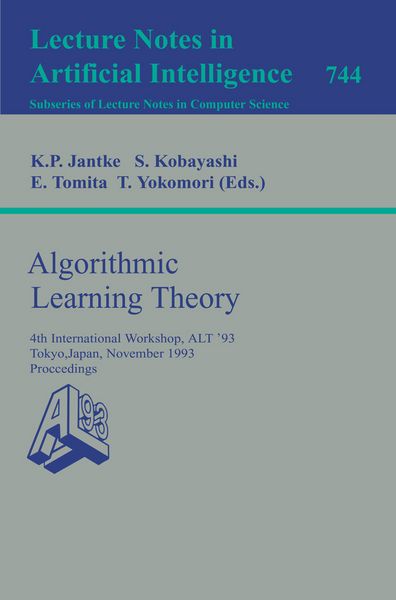
  • Produktbild: Algorithmic Learning Theory
  • Produktbild: Algorithmic Learning Theory
Band 744

Algorithmic Learning Theory 4th International Workshop, ALT '93, Tokyo, Japan, November 8-10, 1993. Proceedings

51,99 €

inkl. gesetzl. MwSt., Versandkostenfrei


Beschreibung

This volume contains all the papers that were presented atthe Fourth Workshop on Algorithmic Learning Theory, held inTokyo in November 1993. In addition to 3 invited papers, 29papers were selected from 47 submitted extended abstracts.The workshop was the fourth in a series of ALT workshops,whose focus...

Beschreibung

This volume contains all the papers that were presented atthe Fourth Workshop on Algorithmic Learning Theory, held inTokyo in November 1993. In addition to 3 invited papers, 29papers were selected from 47 submitted extended abstracts.The workshop was the fourth in a series of ALT workshops,whose focus is on theories of machine learning and theapplication of such theories to real-world learningproblems. The ALT workshops have been held annually since1990, sponsored by the Japanese Society for ArtificialIntelligence. The volume is organized into parts oninductive logic and inference, inductive inference,approximate learning, query learning, explanation-basedlearning, and new learning paradigms.

Produktdetails

Einband

Taschenbuch

Erscheinungsdatum

20.10.1993

Abbildungen

XI, 428 p.

Herausgeber Klaus P. Jantke + weitere

Produktdetails

Einband

Taschenbuch

Erscheinungsdatum

20.10.1993

Abbildungen

XI, 428 p.

Herausgeber
Verlag Springer Berlin
Seitenzahl

428

Maße (L/B/H)

23,5/15,5/2,4 cm

Gewicht

668 g

Auflage

1993

Sprache

Englisch

ISBN

978-3-540-57370-8

Herstelleradresse

Springer-Verlag KG
Sachsenplatz 4-6
1201 Wien
AT

Email: ProductSafety@springernature.com

Noch keine Bewertungen vorhanden

Verfassen Sie die erste Bewertung zu diesem Artikel

Helfen Sie anderen Kundinnen und Kunden durch Ihre Meinung.

Kundinnen und Kunden meinen

Bewertungen (0)

  • Produktbild: Algorithmic Learning Theory
  • Produktbild: Algorithmic Learning Theory
  • Identifying and using patterns in sequential data.- Learning theory toward Genome Informatics.- Optimal layered learning: A PAC approach to incremental sampling.- Reformulation of explanation by linear logic toward logic for explanation.- Towards efficient inductive synthesis of expressions from input/output examples.- A typed ?-calculus for proving-by-example and bottom-up generalization procedure.- Case-based representation and learning of pattern languages.- Inductive resolution.- Generalized unification as background knowledge in learning logic programs.- Inductive inference machines that can refute hypothesis spaces.- On the duality between mechanistic learners and what it is they learn.- On aggregating teams of learning machines.- Learning with growing quality.- Use of reduction arguments in determining Popperian FIN-type learning capabilities.- Properties of language classes with finite elasticity.- Uniform characterizations of various kinds of language learning.- How to invent characterizable inference methods for regular languages.- Neural Discriminant Analysis.- A new algorithm for automatic configuration of Hidden Markov Models.- On the VC-dimension of depth four threshold circuits and the complexity of Boolean-valued functions.- On the sample complexity of consistent learning with one-sided error.- Complexity of computing Vapnik-Chervonenkis dimension.- ?-approximations of k-label spaces.- Exact learning of linear combinations of monotone terms from function value queries.- Thue systems and DNA — A learning algorithm for a subclass.- The VC-dimensions of finite automata with n states.- Unifying learning methods by colored digraphs.- A perceptual criterion for visually controlling learning.- Learning strategies using decision lists.- A decomposition basedinduction model for discovering concept clusters from databases.- Algebraic structure of some learning systems.- Induction of probabilistic rules based on rough set theory.