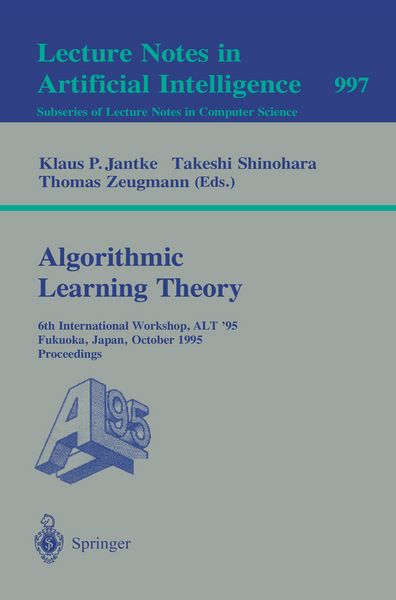
Algorithmic Learning Theory 6th International Workshop, ALT '95, Fukuoka, Japan, October 18 - 20, 1995. Proceedings
-
- Taschenbuch ausgewählt
- eBook
-
Sprache:Englisch
-
Verlag:Springer Berlin
- Springer 51,99 €
- Springer Berlin 51,99 € ausgewählt
51,99 €
inkl. gesetzl. MwSt.,
Beschreibung
Produktdetails
Einband
Taschenbuch
Erscheinungsdatum
05.10.1995
Abbildungen
XV, 324 p.
Herausgeber
Klaus P. Jantke + weitereVerlag
Springer BerlinSeitenzahl
324
Maße (L/B/H)
23,5/15,5/1,9 cm
Gewicht
522 g
Auflage
1995
Sprache
Englisch
ISBN
978-3-540-60454-9
This book constitutes the refereed proceedings of the 6th International Workshop on Algorithmic Learning Theory, ALT '95, held in Fukuoka, Japan, in October 1995.
The book contains 21 revised full papers selected from 46 submissions together with three invited contributions. It covers all current areas related to algorithmic learning theory, in particular the theory of machine learning, design and analysis of learning algorithms, computational logic aspects, inductive inference, learning via queries, artificial and biologicial neural network learning, pattern recognition, learning by analogy, statistical learning, inductive logic programming, robot learning, and gene analysis.
Noch keine Bewertungen vorhanden
Verfassen Sie die erste Bewertung zu diesem Artikel
Helfen Sie anderen Kundinnen und Kunden durch Ihre Meinung.
Kurze Frage zu unserer Seite
Vielen Dank für Ihr Feedback
Wir nutzen Ihr Feedback, um unsere Produktseiten zu verbessern. Bitte haben Sie Verständnis, dass wir Ihnen keine Rückmeldung geben können. Falls Sie Kontakt mit uns aufnehmen möchten, können Sie sich aber gerne an unseren Kund*innenservice wenden.
zum Kundenservice