Gutscheinbedingungen

**Gültig bis 14.09.2026 auf Spielzeug, Schreibwaren, Filme, Geschenke & Trends, Musik, tolino eReader & Zubehör, Hörbücher, nicht preisgebundene Bücher und Kalender in der Thalia App. Einzelne Artikel können ausgeschlossen sein. Aufgrund der Buchpreisbindung sind deutschsprachige Bücher und eBooks ausgenommen. Zusätzlich ausgenommen sind Abos & Flatrates, Games, Geschenkkarten/-boxen, Shelfies, Software, Zeitschriften sowie einzelne Artikel von tonies®. Pro Einkauf einmal einlösbar. Nur gültig mit im Onlineshop hinterlegter Bonuscard. Click & Collect nur bei Onlinevorabzahlung möglich. Keine Barauszahlung. Nicht kombinierbar mit anderen Aktionen und Gutscheinen. Gutschein wird auf max. 500€ Bestellwert angerechnet. Nicht gültig für Versandkosten und Services.

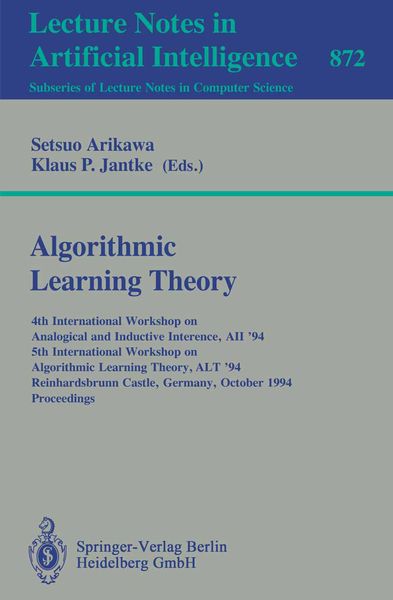
  • Produktbild: Algorithmic Learning Theory
  • Produktbild: Algorithmic Learning Theory
Band 872

Algorithmic Learning Theory 4th International Workshop on Analogical and Inductive Inference, AII '94, 5th International Workshop on Algorithmic Learning Theory, ALT '94, Reinhardsbrunn Castle, Germany, October 10 - 15, 1994. Proceedings

51,99 €

inkl. gesetzl. MwSt., Versandkostenfrei


Beschreibung

Produktdetails

Einband

Taschenbuch

Erscheinungsdatum

28.09.1994

Abbildungen

XV, 581 p.

Herausgeber

Setsuo Arikawa + weitere

Verlag

Springer Berlin

Seitenzahl

581

Maße (L/B/H)

23,5/15,5/3,2 cm

Gewicht

890 g

Auflage

1994

Sprache

Englisch

ISBN

978-3-540-58520-6

Beschreibung

Produktdetails

Einband

Taschenbuch

Erscheinungsdatum

28.09.1994

Abbildungen

XV, 581 p.

Herausgeber

Verlag

Springer Berlin

Seitenzahl

581

Maße (L/B/H)

23,5/15,5/3,2 cm

Gewicht

890 g

Auflage

1994

Sprache

Englisch

ISBN

978-3-540-58520-6

Herstelleradresse

Springer-Verlag KG
Sachsenplatz 4-6
1201 Wien
AT

Email: ProductSafety@springernature.com

Noch keine Bewertungen vorhanden

Verfassen Sie die erste Bewertung zu diesem Artikel

Helfen Sie anderen Kundinnen und Kunden durch Ihre Meinung.

Kundinnen und Kunden meinen

Bewertungen (0)

  • Produktbild: Algorithmic Learning Theory
  • Produktbild: Algorithmic Learning Theory
  • Towards efficient inductive synthesis from input/output examples.- Deductive plan generation.- From specifications to programs: Induction in the service of synthesis.- Average case analysis of pattern language learning algorithms.- Enumerable classes of total recursive functions: Complexity of inductive inference.- Derived sets and inductive inference.- Therapy plan generation as program synthesis.- A calculus for logical clustering.- Learning with higher order additional information.- Efficient learning of regular expressions from good examples.- Identifying nearly minimal Gödel numbers from additional information.- Co-learnability and FIN-identifiability of enumerable classes of total recursive functions.- On case-based represent ability and learnability of languages.- Rule-generating abduction for recursive prolog.- Fuzzy analogy based reasoning and classification of fuzzy analogies.- Explanation-based reuse of prolog programs.- Constructive induction for recursive programs.- Training digraphs.- Towards realistic theories of learning.- A unified approach to inductive logic and case-based reasoning.- Three decades of team learning.- On-line learning with malicious noise and the closure algorithm.- Learnability with restricted focus of attention guarantees noise-tolerance.- Efficient algorithm for learning simple regular expressions from noisy examples.- A note on learning DNF formulas using equivalence and incomplete membership queries.- Identifying regular languages over partially-commutative monoids.- Classification using information.- Learning from examples with typed equational programming.- Finding tree patterns consistent with positive and negative examples using queries.- Program synthesis in the presence of infinite number of inaccuracies.- On monotonicstrategies for learning r.e. languages.- Language learning under various types of constraint combinations.- Synthesis algorithm for recursive processes by ?-calculus.- Monotonicity versus efficiency for learning languages from texts.- Learning concatenations of locally testable languages from positive data.- Language learning from good examples.- Machine discovery in the presence of incomplete or ambiguous data.- Set-driven and rearrangement-independent learning of recursive languages.- Refutably probably approximately correct learning.- Inductive inference of an approximate concept from positive data.- Efficient distribution-free population learning of simple concepts.- Constructing predicate mappings for Goal-Dependent Abstraction.- Learning languages by collecting cases and tuning parameters.- Mutual information gaining algorithm and its relation to PAC-learning algorithm.- Inductive inference of monogenic pure context-free languages.