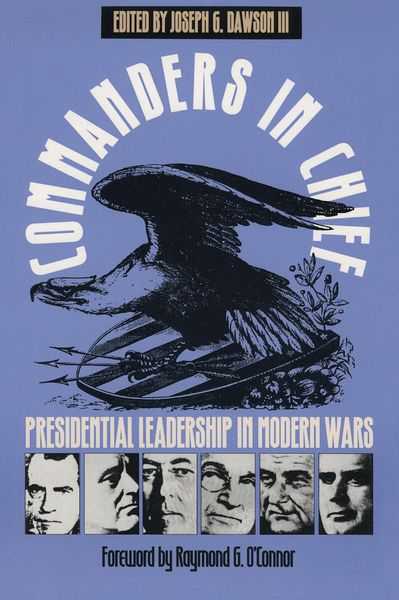
Commanders in Chief Presidential Leadership in Modern Wars
-
- Einzelkauf Download ausgewählt
-
Sprache:Englisch
-
Verlag:University Press Of Kansas
30,90 €
inkl. gesetzl. MwSt.Beschreibung
Produktdetails
Format
ePUB
Kopierschutz
Nein
Family Sharing
Nein
Text-to-Speech
Ja
Erscheinungsdatum
12.04.1993
Herausgeber
Joseph G. Dawson IiiVerlag
University Press Of KansasSeitenzahl
248 (Printausgabe)
Dateigröße
2183 KB
Sprache
Englisch
EAN
9780700639106
Since 1798, when Congress authorized John Adams to employ the navy to capture armed French vessels preying on American shipping on the Atlantic coast, U.S. presidents have grappled with the crucible of war. Some have dealt with it skillfully while others have tended toward the inept. Some have wanted to exert their war powers while others have shied away from them. Some have been successful while others have not.
Never having had their authority clearly defined, the presidents, as commanders in chief, have been allowed to interpret the scope of their involvement in wartime decision making. The question of whether a president can order forces into combat against another nation has never been resolved and precedent supports both sides. Essentially, says Raymond O'Connor, the president can do whatever he can get away with.
Commanders in Chief, offering an enlightening look at the president's constitutional and political roles during wartime, brings together the work of prominent historians. These experts analyze the war powers of the presidency as well as the wartime leadership of six presidentsWilliam McKinley, Woodrow Wilson, Franklin Roosevelt, Harry Truman, Lyndon Johnson, and Richard Nixon.
Two of the authors take provocative revisionist views of their subjects. Lewis Gould asserts that McKinley delivered able and talented leadership during the Spanish-American War, while Robert Ferrell sharply criticizes Wilson's leadership during World War I. On the other hand, Warren Kimball emphatically confirms the high ranking by most scholars of Roosevelt as the most gifted wartime chief executive of the twentieth century, and Clayton James substantiates Truman's feisty and pragmatic leadership in two conflicts. In Frank Vandiver's essay on Johnson and Stephen Ambrose's on Nixon, the authors emphasize the diversity of challenges the two presidents faced during the controversial Vietnam War.
Revising and updating earlier studies, including The Ultimate Decision: The President as Commander in Chief, the 1960 classic collection edited by Ernest May, this book offers a thoughtful and thought-provoking critique of the character and capabilities of America's modern commanders in chief and presents fresh insight into an issue that affects us all.
Noch keine Bewertungen vorhanden
Verfassen Sie die erste Bewertung zu diesem Artikel
Helfen Sie anderen Kundinnen und Kunden durch Ihre Meinung.
Kurze Frage zu unserer Seite
Vielen Dank für Ihr Feedback
Wir nutzen Ihr Feedback, um unsere Produktseiten zu verbessern. Bitte haben Sie Verständnis, dass wir Ihnen keine Rückmeldung geben können. Falls Sie Kontakt mit uns aufnehmen möchten, können Sie sich aber gerne an unseren Kund*innenservice wenden.
zum Kundenservice