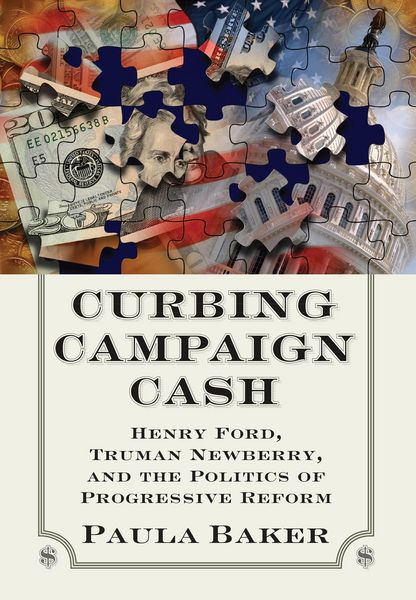
Curbing Campaign Cash Henry Ford, Truman Newberry, and the Politics of Progressive Reform
-
- Einzelkauf Download ausgewählt
-
Sprache:Englisch
-
Verlag:University Press Of Kansas
34,00 €
inkl. gesetzl. MwSt.Beschreibung
Produktdetails
Format
ePUB
Kopierschutz
Nein
Family Sharing
Nein
Text-to-Speech
Ja
Erscheinungsdatum
24.10.2012
Verlag
University Press Of KansasSeitenzahl
200 (Printausgabe)
Dateigröße
3473 KB
Sprache
Englisch
EAN
9780700639151
Choice Outstanding Title
In the 1918 Michigan race for the U.S. Senate, auto tycoon Henry Ford faced off against a less well-known industrialist, Truman Newberry. Bent on countering Ford's fame and endorsement from President Wilson, Newberry's campaign spent an extravagant amount, in fact much more than the law seemed to allow. This led to his conviction under the Federal Corrupt Practices Actbut also to his eventual exoneration in the first campaign finance case to be decided by the U.S. Supreme Court. In Newberry v. United States the Court ruled that Congress had no jurisdiction to regulate primary elections, a controversial decision that allowed southern states to create whites-only primaries and stalled campaign finance reform.
In the first book in eight decades on this initial test of federal campaign finance regulations, Paula Baker examines this case study of state and local campaign spending to describe how politicians found their footing in an environment created by progressive reform and invented modern campaigns. Through this seminal election, she pries apart two persistent strains in American political culture: suspicion of money in politics and suspicion of politics itself.
In reexamining the story of the 1918 election, Baker takes a broad view of the history of the political reform to probe some of the foundational arguments about why money in politics sometimes seems so corrupt. She follows the controversy as it unfoldedbeginning with progressive reform of politics and the remaking of campaignsthen takes readers through the shifting scenes, from Detroit to Washington, where the Ford-Newberry conflict played out.
Baker reexamines the political divisions between conservatives and progressive reformers to reveal contradictions in how Progressive Era federal finance regulations worked, with efforts to weaken the power of political parties and democratize politics actually making campaigns more expensive. And although the law opened the door to partisan prosecutions for spending, Congress remained unwilling to craft legislation that actually curbed spending.
While legislation in recent decades largely has aimed at contributions rather than spending and the Supreme Court has weighed whether specific limits abridge free speech, Progressive Era ideas about money and politics continue to guide campaign finance reform. Curbing Campaign Cash provides a compelling account of a key chapter in the history of this issue.
Noch keine Bewertungen vorhanden
Verfassen Sie die erste Bewertung zu diesem Artikel
Helfen Sie anderen Kundinnen und Kunden durch Ihre Meinung.
Kurze Frage zu unserer Seite
Vielen Dank für Ihr Feedback
Wir nutzen Ihr Feedback, um unsere Produktseiten zu verbessern. Bitte haben Sie Verständnis, dass wir Ihnen keine Rückmeldung geben können. Falls Sie Kontakt mit uns aufnehmen möchten, können Sie sich aber gerne an unseren Kund*innenservice wenden.
zum Kundenservice