Gutscheinbedingungen

**Gültig bis 12.08.2026 auf fremdsprachige Bücher online auf thalia.at und in der Thalia App. Einzelne Artikel können ausgeschlossen sein. Ausgenommen sind preisgebundene Artikel & eBooks. Pro Einkauf einmal einlösbar. Click & Collect nur bei Onlinevorabzahlung möglich. Keine Barauszahlung. Nicht kombinierbar mit anderen Aktionen und Gutscheinen. Gutschein wird auf max. 500€ Bestellwert angerechnet. Nicht gültig für Geschenkkarten, Versandkosten und Services.

Produktbild: Product-Focused Software Process Improvement
Band 16361 - 11%

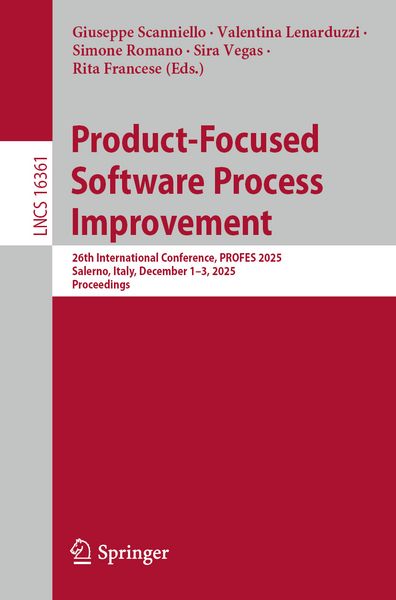
Product-Focused Software Process Improvement 26th International Conference, PROFES 2025, Salerno, Italy, December 1–3, 2025, Proceedings

11% sparen

71,99 € UVP 81,39 €

inkl. gesetzl. MwSt., Versandkostenfrei


Beschreibung

Produktdetails

Einband

Taschenbuch

Erscheinungsdatum

20.11.2025

Abbildungen

XVII, 132 illus., 110 illus. in color., farbige Illustrationen, schwarz-weiss Illustrationen

Herausgeber

Giuseppe Scanniello + weitere

Verlag

Springer

Seitenzahl

583

Maße (L/B/H)

23,5/15,5/3,3 cm

Gewicht

902 g

Sprache

Englisch

ISBN

978-3-032-12088-5

Beschreibung

Produktdetails

Einband

Taschenbuch

Erscheinungsdatum

20.11.2025

Abbildungen

XVII, 132 illus., 110 illus. in color., farbige Illustrationen, schwarz-weiss Illustrationen

Herausgeber

Verlag

Springer

Seitenzahl

583

Maße (L/B/H)

23,5/15,5/3,3 cm

Gewicht

902 g

Sprache

Englisch

ISBN

978-3-032-12088-5

Herstelleradresse

Springer-Verlag GmbH
Tiergartenstr. 17
69121 Heidelberg
DE

Email: GPSR Kontakt

Noch keine Bewertungen vorhanden

Verfassen Sie die erste Bewertung zu diesem Artikel

Helfen Sie anderen Kundinnen und Kunden durch Ihre Meinung.

Kundinnen und Kunden meinen

Bewertungen (0)

  • Produktbild: Product-Focused Software Process Improvement
  • Full Research Papers.- Coverage Isn’t Enough: SBFL-Driven Insights into Manually Created vs. Automatically Generated Tests.- AI Alignment for Ethical Compliance and Risk Mitigation in Industrial Applications.- In-House Experimentation Platforms - Motivations, Implementation Characteristics and Challenges.- Writing Aids for Agile Requirements Engineering - A Comparative Study Between Natural Language Processing and Machine Learning.- A Robust LSTM-based Test Selection Method for Self-Driving Cars.- FOSS-chain: Using Blockchain for Open Source Software License Compliance.- Improving the Writing Quality of User Stories: A Canonical Action Research Study.- From Machine Learning Documentation to Requirements: Bridging Processes with Requirements Languages.- Enhancing Python Code Maintainability through Large Language Model-Based Approaches.- Large Language Models for Code Maintainability Improvement: An Exploratory Study.- An Investigation of Low-Code Development Adoption in a Finnish IT Consulting Firm.- Serverless Adoption in Practice: A Socio-Technical Investigation of Motivations, Challenges, and Strategies.- Generative AI in Simulation-Based Test Environments for Large-Scale Cyber-Physical Systems: An Industrial Study.- Pipelines Under Pressure: An Empirical Study of Security Misconfigurations of GitHub Workflows.- Towards Effective Automation of Issue–Commit Link Recovery: An Empirical Investigation.- Policy-driven Software Bill of Materials on GitHub: An Empirical Study.- Generating Business Process Models with Open Source Large Language Models using Instruction Tuning.- Temporal Evolution of Architectural Complexity and Technical Debt in Microservices: An Exploratory Case Study.- Improving Behavior-Driven Development Scenarios: Empirical Evaluation of a Quality Assement Framework.- Application of Large Language Models in Product Management: A Systematic Literature Review.- Detecting Technical Debt in Source Code Changes using Large Language Models.- Towards Understanding Team Congestion in Large-Scale Software Development.- Influence of LLM Prioritizations on Human Decisions in Requirements Engineering.- Short Research Papers.- Lab Package Development as a Means for Educating Software Engineering Students.- A Model-Driven Engineering Method for the Development of Digital Twins.- LLM-based Multi-Agent System for Intelligent Refactoring of Haskell Code.- Learning Observability Tracing Through Experiential Learning.- Privacy-Enhanced Software Design: Purpose-Aware UML Diagrams.- Requirements Communication at the Intersection between RE and UX.- Architecture Degradation at Scale: Challenges and Insights from Practice.- From Scenario Selection to Simulation: Safety Testing of an Automated Driving System.- Prompts as Software Engineering Artifacts: A Research Agenda and Preliminary Findings.- An Application of Program Mutations For Generating Negative Test Scripts Mimicking Human Errors on Web Applications.- MAPS-AI – A Tool for AI-Assisted Model-Driven Generation of IT Project Plan and Scope.- Ticket-Augmented Just-in-Time Defect Prediction.- How Well Small Language Models Can Be Adapted for Software Maintenance and Refactoring Tasks.- Cost of Artificial Intelligence in Finnish Software Companies: A Survey.- Exploring the Performance of ML Model Size for Classification in Relation to Energy Consumption.- Towards Understanding the Developer Experience in Quantum Software Development.- On the Use of Agentic Coding Manifests: An Empirical Study of Claude Code.- Detecting and Characterizing Low and No Functionality Packages in the NPM Ecosystem.- PostItFlow: An Early Study on Agentic Workflow for Enhancing and Visualizing User Stories.- An Empirical Study of Security-Policy Related Issues in Open Source Projects.