Gutscheinbedingungen

**Gültig bis 17.08.2026 auf Schreibwaren & Office-Artikel online auf thalia.at, in der Thalia App und in teilnehmenden Thalia Buchhandlungen in Österreich mit Schulsortiment. In den Buchhandlungen nur gültig auf lagernde Ware. Einzelne Artikel können ausgeschlossen sein. Ausgenommen sind preisgebundene Artikel. Pro Einkauf einmal einlösbar. Nur gültig gegen Vorlage oder im Onlineshop hinterlegter Bonuscard. Infos zur Einlösung in der Buchhandlung sind auf der Bonuscard-Vorteilspreisseite zu finden. Click & Collect nur bei Onlinevorabzahlung möglich. Keine Einlösung bei Scan & Go-Bezahlung. Keine Barauszahlung. Nicht kombinierbar mit anderen Aktionen und Gutscheinen. Gutschein wird auf max. 500€ Bestellwert angerechnet. Nicht gültig für Geschenkkarten, Versandkosten und Services.

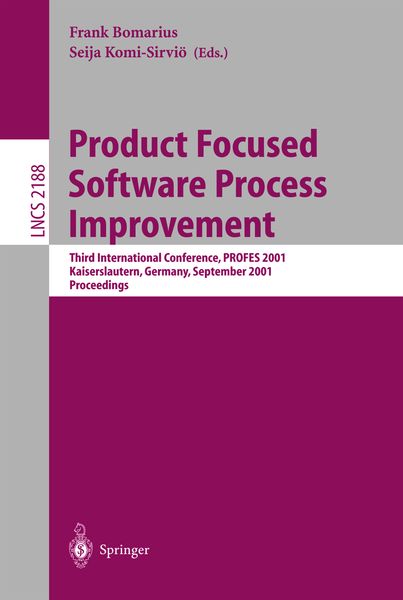
  • Produktbild: Product Focused Software Process Improvement
  • Produktbild: Product Focused Software Process Improvement
Band 2188

Product Focused Software Process Improvement Third International Conference, PROFES 2001, Kaiserslautern, Germany, September 10-13, 2001. Proceedings

51,99 €

inkl. gesetzl. MwSt., Versandkostenfrei


Beschreibung

Produktdetails

Einband

Taschenbuch

Erscheinungsdatum

03.09.2001

Herausgeber

Frank Bomarius + weitere

Verlag

Springer Berlin

Seitenzahl

388

Maße (L/B/H)

23,5/15,5/2,2 cm

Gewicht

604 g

Auflage

2001

Sprache

Englisch

ISBN

978-3-540-42571-7

Beschreibung

Produktdetails

Einband

Taschenbuch

Erscheinungsdatum

03.09.2001

Herausgeber

Verlag

Springer Berlin

Seitenzahl

388

Maße (L/B/H)

23,5/15,5/2,2 cm

Gewicht

604 g

Auflage

2001

Sprache

Englisch

ISBN

978-3-540-42571-7

Herstelleradresse

Springer-Verlag KG
Sachsenplatz 4-6
1201 Wien
AT

Email: GPSR Kontakt

Noch keine Bewertungen vorhanden

Verfassen Sie die erste Bewertung zu diesem Artikel

Helfen Sie anderen Kundinnen und Kunden durch Ihre Meinung.

Kundinnen und Kunden meinen

Bewertungen (0)

  • Produktbild: Product Focused Software Process Improvement
  • Produktbild: Product Focused Software Process Improvement
  • Keynote Address.- Guaranteed Software Quality.- Building an Experience Base for Software Engineering: A Report on the First CeBASE eWorkshop.- A Contingency Approach to Software Development.- Career-Long Education for Software Professionals: A US View of the Educational Challenges in a Rapidly-Changing Technology.- Quality of Software.- Cognitive Structures of Software Evaluation: A Means-End Chain Analysis of Quality.- Requirements Evolution From Process to Product Oriented Management.- Software Process Assessment and Improvement.- A Case Study on Scenario-based Process Flexibility Assessment for Risk Reduction.- Contexts of KM Based SPI: The Case of Software Design Experience Reuse.- Models and Success Factors of Process Change.- Process Improvement in Turbulent Times — Is CMM Still an Answer?.- Assessment of Maintenance Maturity in IT Departments of Public Entities: Two Case Studies.- Evaluating a Usability Capability Assessment.- Organizational Learning and Experience Factory.- Building an Experience Base for Software Engineering: A Report on the First CeBASE eWorkshop.- Experience Magnets Attracting Experiences, Not Just Storing Them.- Improving Knowledge Management in Software Reuse Process.- Processes and Knowledge Management: A Symbiosis.- Augmenting Experience Reports with Lightweight Postmortem Reviews.- A Tool for Managing Software Development Knowledge.- Industrial Experiences and Case Studies.- Starting Improvement of Requirements Engineering Processes: An Experience Report.- A Family-Oriented Software Development Process for Engine Controllers.- Enabling Local SPI in a Multi-National Company.- Project Improvement as Start-up.- Software and Process Modeling.- LIPE:A Lightweight Process for E-Business Startup Companies Based on Extreme Programming.- Evaluation of the E3 Process Modelling Language and Tool for the Purpose of Model Creation.- Describing Fractal Processes with UML.- Extending the Software Process Culture - An Approach Based on Groupware and Workflow.- Towards Systematic Knowledge Elicitation for Descriptive Software Process Modeling.- Modular Process Patterns Supporting an Evolutionary Software Development Process.- Empirical Software Engineering.- A Classification Scheme for Studies on Fault-Prone Components.- Program Understanding Behavior During Estimation of Enhancement Effort on Small Java Programs.- Evaluation of a Business Application Framework Using Complexity and Functionality Metrics.