Gutscheinbedingungen

**Gültig bis 04.08.2026 ab einem Mindestbestellwert von 30€ auf Spielzeug, Schreibwaren, Filme, Geschenke & Trends, Musik, tolino eReader & Zubehör, Hörbücher und Hörbuch-Downloads (außer Abo), nicht preisgebundene Bücher und Kalender online auf thalia.at und in der Thalia App. Einzelne Artikel können ausgeschlossen sein. Aufgrund der Buchpreisbindung sind deutschsprachige Bücher und eBooks ausgenommen. Zusätzlich ausgenommen sind preisgebundene Artikel, Abos & Flatrates, eBooks, Games, Geschenkkarten/-boxen, Shelfies, Software, Zeitschriften sowie einzelne Artikel von tonies®. Pro Einkauf einmal einlösbar. Click & Collect nur bei Onlinevorabzahlung möglich. Keine Barauszahlung. Nicht kombinierbar mit anderen Aktionen und Gutscheinen. Gutschein wird auf max. 500€ Bestellwert angerechnet. Nicht gültig für Versandkosten und Services. Preisgebundene Artikel sind vom Mindestbestellwert ausgeschlossen.

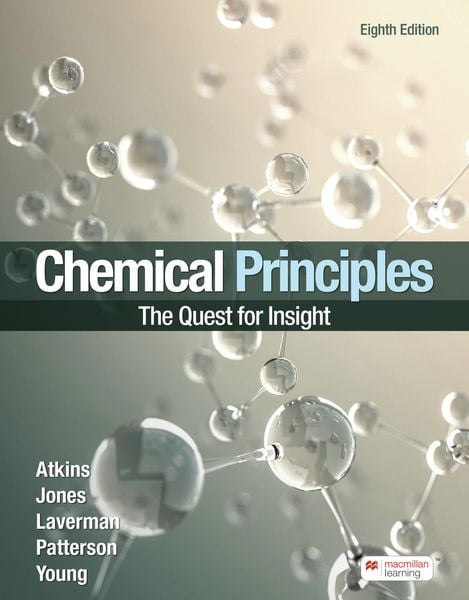
Produktbild: Chemical Principles

Chemical Principles The Quest for Insight

94,99 €

inkl. gesetzl. MwSt., Versandkostenfrei


Beschreibung

Produktdetails

Einband

Taschenbuch

Erscheinungsdatum

15.04.2023

Verlag

Macmillan Learning

Seitenzahl

912

Maße (L/B/H)

21,9/27,5/3,6 cm

Gewicht

2090 g

Auflage

8 Auflage Eighth Edition

Sprache

Englisch

ISBN

978-1-319-49849-8

Beschreibung

Produktdetails

Einband

Taschenbuch

Erscheinungsdatum

15.04.2023

Verlag

Macmillan Learning

Seitenzahl

912

Maße (L/B/H)

21,9/27,5/3,6 cm

Gewicht

2090 g

Auflage

8 Auflage Eighth Edition

Sprache

Englisch

ISBN

978-1-319-49849-8

Herstelleradresse

Libri GmbH
Europaallee 1
36244 Bad Hersfeld
DE

Email: GPSR Kontakt

Noch keine Bewertungen vorhanden

Verfassen Sie die erste Bewertung zu diesem Artikel

Helfen Sie anderen Kundinnen und Kunden durch Ihre Meinung.

Kundinnen und Kunden meinen

Bewertungen (0)

  • Produktbild: Chemical Principles
  • Fundamentals
    Introduction and orientation
    A Matter and energy
    B Elements and atoms
    C Compounds
    D Nomenclature
    E Moles and molar masses
    F The determination of composition
    G Mixtures and solutions
    H Chemical equations
    I Precipitation Reactions
    J Acids and bases
    K Redox reactions
    L Reaction stoichiometry
    M Limiting reactants

    Focus 1: Atoms
    1A Investigating atoms
    1B Quantum theory
    1C Wavefunctions and energy levels
    1D The hydrogen atom
    1E Many-electron atoms
    1F Periodicity
     
    Focus 2: Bonds Between Atoms
    2A Ionic bonding
    2B Covalent bonding
    2C Beyond the octet rule
    2D The properties of bonds
    2E The VSEPR Model
    2F Valence-Bond theory
    2G Molecular Orbital theory
     
    Focus 3: States of matter
    3A The nature of gasses
    3B The gas law in action
    3C Gases in mixtures and reactions
    3D Intermolecular forces
    3E Real gasses
    3F Liquids
    3G Solids
     
    Focus 4: Thermodynamics
    4A Internal Energy
    4B Work and Heat
    4C Enthalpy
    4D Thermochemistry
    4E Contributions to enthalpy
    4F Entropy
    4G The molecular interpretation of entropy
    4H Absolute entropies
    4I Global changes in entropy
    4J Gibbs free energy
     
    Focus 5: Equilibrium
    5A Vapor pressure
    5B Phase Equilibria of one-component systems
    5C Phase equilibria in two-component systems
    5D Solubility
    5E Colligative properties
    5F Chemical equilibrium
    5G Alternative forms of the equilibrium constant
    5H Equilibrium calculations
    5I The response of equilibria to changes in conditions

    Focus 6: Reactions
    6A The nature of acids and bases
    6B Autoprotolysis and pH
    6C Weak acids and bases
    6D The pH of aqueous solutions
    6E Polyprotic acids
    6F The pH of Very Dilute Solutions
    6G Buffers
    6H Acid-base titrations
    6I Solubility equilibria
    6J Precipitation
    6K Representing redox reactions
    6L Galvanic cells
    6M Standard potentials
    6N Applications of electrode potentials
    6O Electrolysis
     
    Focus 7: Kinetics
    7A Reaction rates
    7B Integrated rate laws
    7C Reaction mechanisms
    7D Models of reactions
    7E Catalysis
     
    Focus 8: Materials
    8A Periodic trends
    8B Hydrogen
    8C Group 1: The alkali metals
    8D Group 2: The alkaline Earth Metals
    8E Group 13: The boron family
    8F Group 14: The carbon family
    8G Group 15: The nitrogen family
    8H Group 16: The oxygen family
    8I Group 17: The halogens
    8J Group 18: The noble gases
    8K The d-Block Elements: A Survey
    8L Coordination Compounds
    8M The Electronic Structure of d-Metal Complexes

    Focus 9: Nuclear Chemistry
    10A Nuclear decay
    10B Radioactivity
    10C Nuclear energy
     
    Focus 10: Organic Chemistry
    11A Structures of aliphatic hydrocarbons
    11B Reactions of aliphatic hydrocarbons
    11C Aromatic compounds
    11D Common functional groups
    11E Polymers and biological macromolecules
     
    Major Techniques (Online Only)
    1 Infrared and microwave spectroscopy
    2 Ultraviolet and visible spectroscopy
    3 X-ray diffraction
    4 Chromatography
    5 Mass spectrometry
    6 Nuclear magnetic resonance
    7 Computation