KI-Beratung Beta

Gutscheinbedingungen

**Gültig am 27.11.2026 auf Spielzeug, Schreibwaren, Filme, Geschenke & Trends, Musik, tolino eReader & Zubehör, Hörbücher und Hörbuch-Downloads, nicht preisgebundene Bücher und Kalender online auf thalia.at und in der Thalia App. Einzelne Artikel können ausgeschlossen sein. Aufgrund der Buchpreisbindung sind deutschsprachige Bücher und eBooks ausgenommen. Zusätzlich ausgenommen sind Abos & Flatrates, Games, Geschenkkarten/-boxen, Shelfies, Software, Zeitschriften sowie einzelne Artikel von tonies®. Pro Einkauf einmal einlösbar. Click & Collect nur bei Onlinevorabzahlung möglich. Keine Barauszahlung. Nicht kombinierbar mit anderen Aktionen und Gutscheinen. Gutschein wird auf max. 500€ Bestellwert angerechnet. Nicht gültig für Versandkosten und Services.

  • Produktbild: Complexity Economics
  • Produktbild: Complexity Economics

Complexity Economics Building a New Approach to Ancient Economic History

138,99 €

inkl. gesetzl. MwSt., Versandkostenfrei


Beschreibung

Economic archaeology and ancient economic history have boomed the past decades. The former thanks to greatly enhanced techniques to identify, collect, and interpret material remains as proxies for economic interactions and performance; the latter by embracing the frameworks of new institutional economics....

Beschreibung

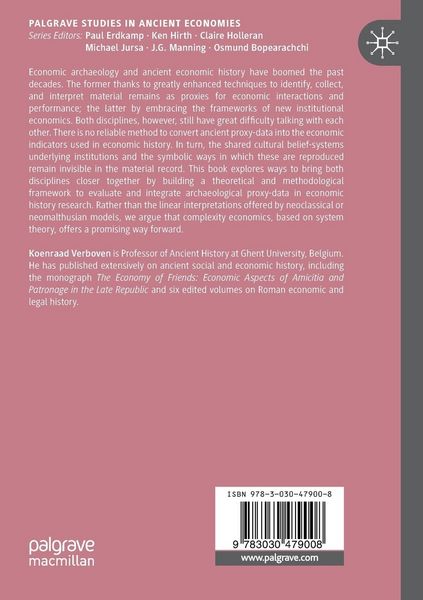
Economic archaeology and ancient economic history have boomed the past decades. The former thanks to greatly enhanced techniques to identify, collect, and interpret material remains as proxies for economic interactions and performance; the latter by embracing the frameworks of new institutional economics. Both disciplines, however, still have great difficulty talking with each other. There is no reliable method to convert ancient proxy-data into the economic indicators used in economic history. In turn, the shared cultural belief-systems underlying institutions and the symbolic ways in which these are reproduced remain invisible in the material record. This book explores ways to bring both disciplines closer together by building a theoretical and methodological framework to evaluate and integrate archaeological proxy-data in economic history research. Rather than the linear interpretations offered by neoclassical or neomalthusian models, we argue that complexity economics, based on system theory, offers a promising way forward. 


Portrait

Koenraad Verboven is Professor of Ancient History at Ghent University, Belgium. He has published extensively on ancient social and economic history, including the monograph The Economy of Friends: Economic Aspects of Amicitia and Patronage in the Late Republic  and six edited volumes on Roman economic and legal history.

Produktdetails

Einband

Taschenbuch

Erscheinungsdatum

27.11.2021

Herausgeber Koenraad Verboven
Verlag Springer

Produktdetails

Einband

Taschenbuch

Erscheinungsdatum

27.11.2021

Herausgeber Koenraad Verboven
Verlag Springer
Seitenzahl

363

Maße (L/B/H)

21/14,8/2,1 cm

Gewicht

496 g

Auflage

1st ed. 2021

Sprache

Englisch

ISBN

978-3-030-47900-8

Herstelleradresse

Springer-Verlag GmbH
Tiergartenstr. 17
69121 Heidelberg
DE

Email: ProductSafety@springernature.com

Noch keine Bewertungen vorhanden

Verfassen Sie die erste Bewertung zu diesem Artikel

Helfen Sie anderen Kundinnen und Kunden durch Ihre Meinung.

Kundinnen und Kunden meinen

Bewertungen (0)

  • Produktbild: Complexity Economics
  • Produktbild: Complexity Economics
  • Chapter 1: Introduction: Finding a new approach to ancient proxy data.- Part I- Theoretical Frameworks and Methodologies.- Chapter 2: Playing by whose rules? Institutional resilience, conflict and change in the Roman economy.- Chapter 3: Networks as Proxies: a relational approach towards economic complexity in the Roman period.- Chapter 4: Evaluating the potential of computational modelling for informing debates on Roman economic integration.- Chapter 5: Visualising Roman institutional environments for exchange as a complex system.- PART II- Urban Systems.- Chapter 6: Social complexity and complexity economics. Studying socio-economic systems at Düzen Tepe and Sagalassos (SW Turkey).-  Chapter 7: A method for estimating Roman population sizes from urban survey contexts: an application in central Adriatic Italy.-  Chapter 8: Complexity and urban hierarchy of ancient urbanism: the cities of Roman Asia Minor.- PART III-Epidemics.- Chapter 9: Disease proxies and the diagnosis of the late Antonine economy.- Chapter 10: Measuring and Comparing Economic Interaction Based on the Paths and Speed of Infections. The Case Study of the Spread of the Justinianic Plague and Black Death.