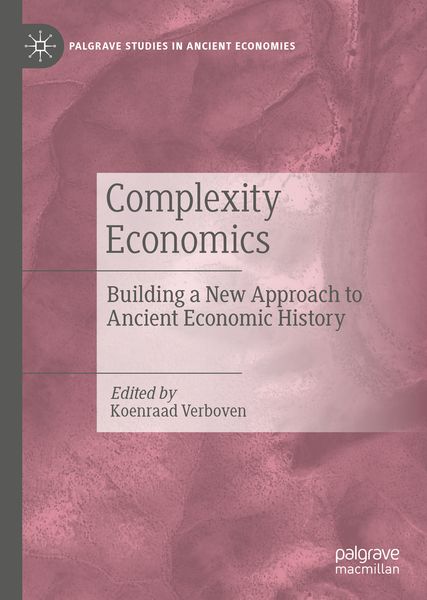
Complexity Economics Building a New Approach to Ancient Economic History
-
- Hardcover ausgewählt
- Taschenbuch
- eBook
-
Sprache:Englisch
139,99 €
inkl. gesetzl. MwSt.,
Beschreibung
Produktdetails
Einband
Gebundene Ausgabe
Erscheinungsdatum
26.11.2020
Herausgeber
Koenraad VerbovenVerlag
SpringerSeitenzahl
363
Maße (L/B/H)
21,6/15,3/2,6 cm
Gewicht
608 g
Auflage
1st ed. 2021
Sprache
Englisch
ISBN
978-3-030-47897-1
Economic archaeology and ancient economic history have boomed the past decades. The former thanks to greatly enhanced techniques to identify, collect, and interpret material remains as proxies for economic interactions and performance; the latter by embracing the frameworks of new institutional economics. Both disciplines, however, still have great difficulty talking with each other. There is no reliable method to convert ancient proxy-data into the economic indicators used in economic history. In turn, the shared cultural belief-systems underlying institutions and the symbolic ways in which these are reproduced remain invisible in the material record. This book explores ways to bring both disciplines closer together by building a theoretical and methodological framework to evaluate and integrate archaeological proxy-data in economic history research. Rather than the linear interpretations offered by neoclassical or neomalthusian models, we argue that complexity economics, based on system theory, offers a promising way forward.
Noch keine Bewertungen vorhanden
Verfassen Sie die erste Bewertung zu diesem Artikel
Helfen Sie anderen Kundinnen und Kunden durch Ihre Meinung.
Kurze Frage zu unserer Seite
Vielen Dank für Ihr Feedback
Wir nutzen Ihr Feedback, um unsere Produktseiten zu verbessern. Bitte haben Sie Verständnis, dass wir Ihnen keine Rückmeldung geben können. Falls Sie Kontakt mit uns aufnehmen möchten, können Sie sich aber gerne an unseren Kund*innenservice wenden.
zum Kundenservice