
Methods and Applications of Sample Size Calculation and Recalculation in Clinical Trials
-
- Hardcover
- Taschenbuch ausgewählt
- eBook
-
Sprache:Englisch
99,99 €
inkl. gesetzl. MwSt.,
Beschreibung
Produktdetails
Einband
Taschenbuch
Erscheinungsdatum
20.11.2021
Abbildungen
XIV, 396 p. 126 illus.
Verlag
SpringerSeitenzahl
396
Maße (L/B/H)
23,5/15,5/2,3 cm
Gewicht
622 g
Auflage
21001 Auflage 1st edition 2020
Sprache
Englisch
ISBN
978-3-030-49530-5
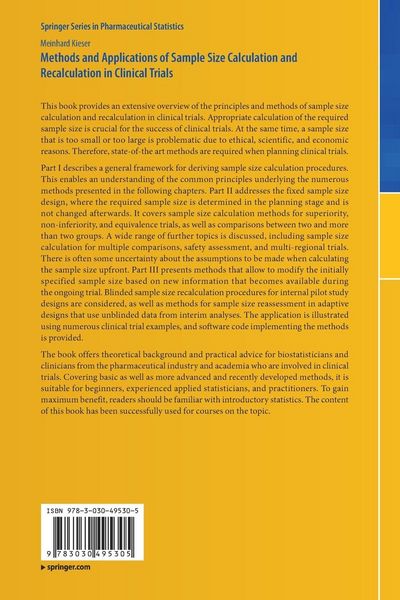
This book provides an extensive overview of the principles and methods of sample size calculation and recalculation in clinical trials. Appropriate calculation of the required sample size is crucial for the success of clinical trials. At the same time, a sample size that is too small or too large is problematic due to ethical, scientific, and economic reasons. Therefore, state-of-the art methods are required when planning clinical trials.
Part I describes a general framework for deriving sample size calculation procedures. This enables an understanding of the common principles underlying the numerous methods presented in the following chapters. Part II addresses the fixed sample size design, where the required sample size is determined in the planning stage and is not changed afterwards. It covers sample size calculation methods for superiority, non-inferiority, and equivalence trials, as well as comparisons between two and more than two groups. A wide range of further topics is discussed, including sample size calculation for multiple comparisons, safety assessment, and multi-regional trials. There is often some uncertainty about the assumptions to be made when calculating the sample size upfront. Part III presents methods that allow to modify the initially specified sample size based on new information that becomes available during the ongoing trial. Blinded sample size recalculation procedures for internal pilot study designs are considered, as well as methods for sample size reassessment in adaptive designs that use unblinded data from interim analyses. The application is illustrated using numerous clinical trial examples, and software code implementing the methods is provided.
The book offers theoretical background and practical advice for biostatisticians and clinicians from the pharmaceutical industry and academia who are involved in clinical trials. Covering basic as well as more advanced and recently developed methods, it is suitable forbeginners, experienced applied statisticians, and practitioners. To gain maximum benefit, readers should be familiar with introductory statistics. The content of this book has been successfully used for courses on the topic.
Noch keine Bewertungen vorhanden
Verfassen Sie die erste Bewertung zu diesem Artikel
Helfen Sie anderen Kundinnen und Kunden durch Ihre Meinung.
Kurze Frage zu unserer Seite
Vielen Dank für Ihr Feedback
Wir nutzen Ihr Feedback, um unsere Produktseiten zu verbessern. Bitte haben Sie Verständnis, dass wir Ihnen keine Rückmeldung geben können. Falls Sie Kontakt mit uns aufnehmen möchten, können Sie sich aber gerne an unseren Kund*innenservice wenden.
zum Kundenservice