KI-Beratung Beta

Gutscheinbedingungen

**Gültig am 20.11.2026 ab einem Mindestbestellwert von 30€ auf Spielzeug, Schreibwaren, Filme, Geschenke & Trends, Musik, tolino eReader & Zubehör, Hörbücher und Hörbuch-Downloads, nicht preisgebundene Bücher und Kalender online auf thalia.at und in der Thalia App. Einzelne Artikel können ausgeschlossen sein. Aufgrund der Buchpreisbindung sind deutschsprachige Bücher und eBooks ausgenommen. Zusätzlich ausgenommen sind Abos & Flatrates, Games, Geschenkkarten/-boxen, Shelfies, Software, Zeitschriften sowie einzelne Artikel von tonies®. Pro Einkauf einmal einlösbar. Click & Collect nur bei Onlinevorabzahlung möglich. Keine Barauszahlung. Nicht kombinierbar mit anderen Aktionen und Gutscheinen. Gutschein wird auf max. 500€ Bestellwert angerechnet. Nicht gültig für Versandkosten und Services. Preisgebundene Artikel sind vom Mindestbestellwert ausgeschlossen.

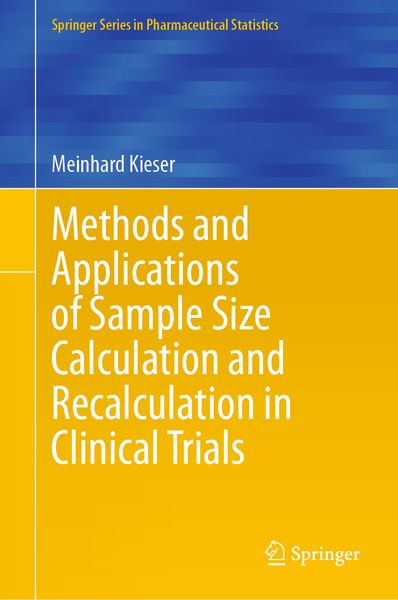
  • Produktbild: Methods and Applications of Sample Size Calculation and Recalculation in Clinical Trials
  • Produktbild: Methods and Applications of Sample Size Calculation and Recalculation in Clinical Trials
- 19%

Methods and Applications of Sample Size Calculation and Recalculation in Clinical Trials

19% sparen

88,99 € UVP 109,99 €

inkl. gesetzl. MwSt., Versandkostenfrei


Beschreibung

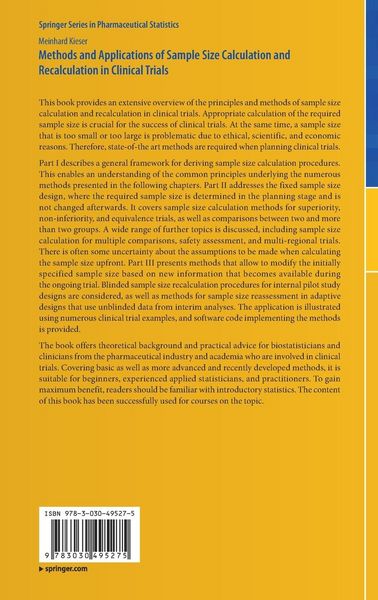
This book provides an extensive overview of the principles and methods of sample size calculation and recalculation in clinical trials. Appropriate calculation of the required sample size is crucial for the success of clinical trials. At the same time, a sample size that is too small or too large is...

Beschreibung

This book provides an extensive overview of the principles and methods of sample size calculation and recalculation in clinical trials. Appropriate calculation of the required sample size is crucial for the success of clinical trials. At the same time, a sample size that is too small or too large is problematic due to ethical, scientific, and economic reasons. Therefore, state-of-the art methods are required when planning clinical trials.


Part I describes a general framework for deriving sample size calculation procedures. This enables an understanding of the common principles underlying the numerous methods presented in the following chapters. Part II addresses the fixed sample size design, where the required sample size is determined in the planning stage and is not changed afterwards. It covers sample size calculation methods for superiority, non-inferiority, and equivalence trials, as well as comparisons between two and more than two groups. A wide range of further topics is discussed, including sample size calculation for multiple comparisons, safety assessment, and multi-regional trials. There is often some uncertainty about the assumptions to be made when calculating the sample size upfront. Part III presents methods that allow to modify the initially specified sample size based on new information that becomes available during the ongoing trial. Blinded sample size recalculation procedures for internal pilot study designs are considered, as well as methods for sample size reassessment in adaptive designs that use unblinded data from interim analyses. The application is illustrated using numerous clinical trial examples, and software code implementing the methods is provided.


The book offers theoretical background and practical advice for biostatisticians and clinicians from the pharmaceutical industry and academia who are involved in clinical trials. Covering basic as well as more advanced and recently developed methods, it is suitable forbeginners, experienced applied statisticians, and practitioners. To gain maximum benefit, readers should be familiar with introductory statistics. The content of this book has been successfully used for courses on the topic.


Rezension

“The R source code is shown by chapter, well-documented, and easy to find and follow as brief descriptions and necessary specifications for the function calls are given by means of comments. … a wide area of application fields is covered and exhaustive literature references for further reading are given. … The presentation of the material is very reader-friendly, easily accessible and pedagogical … . It is likewise highly recommended … . This is an effective and nicely written reference textbook.” (Oke Gerke, ISCB News, iscb.info, Vol. 72, December, 2021)

Produktdetails

Einband

Gebundene Ausgabe

Erscheinungsdatum

20.11.2020

Abbildungen

XIV, 396 p. 126 illus.

Verlag Springer

Produktdetails

Einband

Gebundene Ausgabe

Erscheinungsdatum

20.11.2020

Abbildungen

XIV, 396 p. 126 illus.

Verlag Springer
Seitenzahl

396

Maße (L/B/H)

24,1/16/2,8 cm

Gewicht

730 g

Auflage

20001 Auflage 1st edition 2020

Sprache

Englisch

ISBN

978-3-030-49527-5

Herstelleradresse

Springer-Verlag GmbH
Europaplatz 3
69115 Heidelberg
DE

Email: ProductSafety@springernature.com

Noch keine Bewertungen vorhanden

Verfassen Sie die erste Bewertung zu diesem Artikel

Helfen Sie anderen Kundinnen und Kunden durch Ihre Meinung.

Kundinnen und Kunden meinen

Bewertungen (0)

  • Produktbild: Methods and Applications of Sample Size Calculation and Recalculation in Clinical Trials
  • Produktbild: Methods and Applications of Sample Size Calculation and Recalculation in Clinical Trials

  • Part I: Basics
    .- Chapter 1- Introduction.- Chapter 2 - Statistical test and sample size calculation.-
    Part II : Sample size calculation
    .- Chapter 3 - Comparison of two groups for normally distributed outcomes and test for difference or superiority.-Chapter 4 - Comparison of two groups for continuous and ordered categorical outcomes and test for difference or superiority.- Chapter 5 - Comparison of two groups for binary outcomes and test for difference and superiority.- Chapter 6 - Comparison of two groups for time-to-event outcomes and test for differences or superiority.- Chapter 7 - Comparison of more than two groups and test for difference.- Chapter 8 - Comparison of two groups and test for non-inferiority.- Chapter 9 - Comparison of three groups in the gold standard non-inferiority design.- Chapter 10 - Comparison of two groups for normally distributed outcomes and test for equivalence.- Chapter 11 - Multiple comparisons.- Chapter 12 - Assessment of safety.- Chapter 13 - Cluster-randomized trials.- Chapter 14 - Multi-regional trials.- Chapter 15 - Integrated planning of phase II/III drug development programs.- Chapter 16 - Simulation-based sample size calculation.-
    Part III: Sample size recalculation
    .- Chapter 17 – Background.-
    Part IIIA: Blinded sample size recalculation in internal pilot study designs
    .- Chapter 18 - Background and notation.- Chapter 19 - A general approach for controlling the type I error rate for blinded sample size recalculation.-Chapter 20 - Comparison of two groups for normally distributed outcomes and test for difference or superiority.- Chapter 21 - Comparison of two groups for binary outcomes and test for difference or superiority.- Chapter 22 - Comparison of two groups for normally distributed outcomes and test for non-inferiority.- Chapter 23 - Comparison of two groups for binary outcomes and test for non-inferiority.- Chapter 24 - Comparison of two groups for normally distributed outcomes and test for equivalence.-Chapter 25 - Regulatory and operational aspects.- Chapter 26 - Concluding remarks.-
    Part IIIB: Unblinded sample size recalculation in adaptive designs
    .- Chapter 27 - Background and notation.- Chapter 28 - Sample size recalculation based on conditional power.- Chapter 29 - Sample size recalculation by optimization.- Chapter 30 - Regulatory and operational aspects.- Chapter 31 - Concluding remarks.