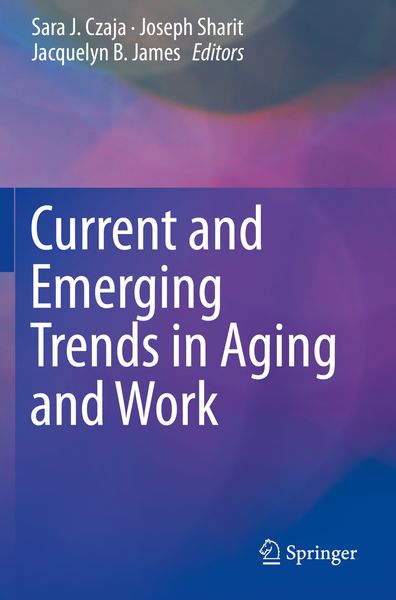
Current and Emerging Trends in Aging and Work
-
- Hardcover
- Taschenbuch ausgewählt
- eBook
-
Sprache:Englisch
99,99 €
inkl. gesetzl. MwSt.,
Beschreibung
Produktdetails
Einband
Taschenbuch
Erscheinungsdatum
24.09.2020
Abbildungen
XVIII, 463 p. 47 illus., 24 illus. in color.
Herausgeber
Sara J. Czaja + weitereVerlag
SpringerSeitenzahl
463
Maße (L/B/H)
23,5/15,5/2,7 cm
Gewicht
727 g
Auflage
1st ed. 2020
Sprache
Englisch
ISBN
978-3-030-24137-7
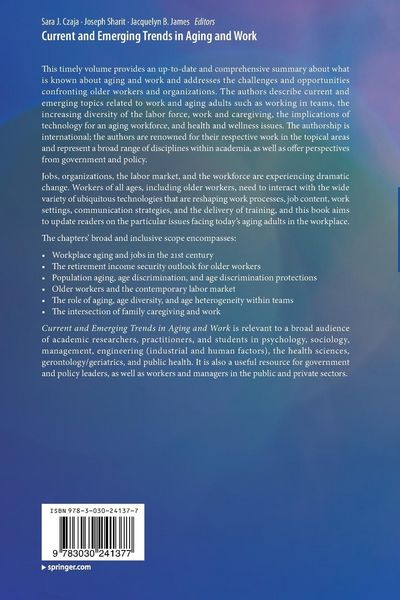
This timely volume provides an up-to-date and comprehensive summary about what is known about aging and work and addresses the challenges and opportunities confronting older workers and organizations. The authors describe current and emerging topics related to work and aging adults such as working in teams, the increasing diversity of the labor force, work and caregiving, the implications of technology for an aging workforce, and health and wellness issues. The authorship is international; the authors are renowned for their respective work in the topical areas and represent a broad range of disciplines within academia, as well as offer perspectives from government and policy.
Jobs, organizations, the labor market, and the workforce are experiencing dramatic change. Workers of all ages, including older workers, need to interact with the wide variety of ubiquitous technologies that are reshaping work processes, job content, work settings, communication strategies, and the delivery of training, and this book aims to update readers on the particular issues facing today’s aging adults in the workplace.
The chapters’ broad and inclusive scope encompasses:
- Workplace aging and jobs in the 21st century
- The retirement income security outlook for older workers
- Population aging, age discrimination, and age discrimination protections
- Older workers and the contemporary labor market
- The role of aging, age diversity, and age heterogeneity within teams
- The intersection of family caregiving and work
Current and Emerging Trends in Aging and Work
is relevant to a broad audience of academic researchers, practitioners, and students in psychology, sociology, management, engineering (industrial and human factors), the health sciences, gerontology/geriatrics, and public health. It is also a useful resource for government and policy leaders, as well as workers and managers in the public and private sectors.
Noch keine Bewertungen vorhanden
Verfassen Sie die erste Bewertung zu diesem Artikel
Helfen Sie anderen Kundinnen und Kunden durch Ihre Meinung.
Kurze Frage zu unserer Seite
Vielen Dank für Ihr Feedback
Wir nutzen Ihr Feedback, um unsere Produktseiten zu verbessern. Bitte haben Sie Verständnis, dass wir Ihnen keine Rückmeldung geben können. Falls Sie Kontakt mit uns aufnehmen möchten, können Sie sich aber gerne an unseren Kund*innenservice wenden.
zum Kundenservice