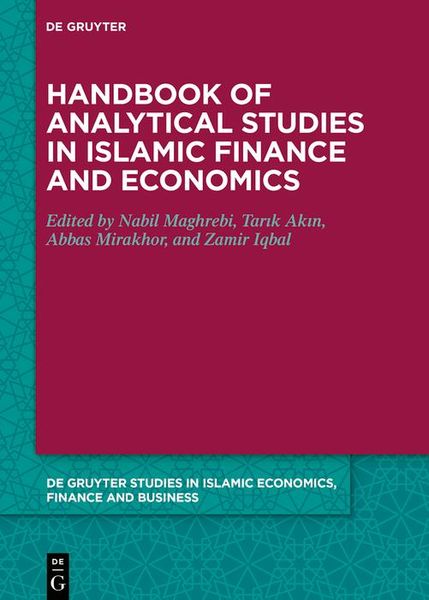
Handbook of Analytical Studies in Islamic Finance and Economics
-
Form:Einzelkauf Download
-
Sprache:Englisch
-
eBook Format:PDF
- PDF 184,95 € ausgewählt
- ePUB 184,95 €
184,95 €
inkl. gesetzl. MwSt.Beschreibung
Produktdetails
Format
Kopierschutz
Nein
Family Sharing
Nein
Text-to-Speech
Nein
Erscheinungsdatum
10.08.2020
Herausgeber
Zamir Iqbal + weitereVerlag
De Gruyter OldenbourgSeitenzahl
723 (Printausgabe)
Auflage
1. Auflage
Sprache
Englisch
EAN
9783110587920
This handbook offers a unique and original collection of analytical studies in Islamic economics and finance, and constitutes a humble addition to the literature on new economic thinking and global finance. The growing risks stemming from higher debt, slower growth, and limited room for policy maneuver raise concerns about the ability and propensity of modern economies to find effective solutions to chronic problems. It is important to understand the structural roots of inherent imbalance, persistence-in-error patterns, policy and governance failures, as well as moral and ethical failures.
Admittedly, finance and economics have their own failures, with abstract theory bearing little relation with the real economy, uncertainties and vicissitudes of economic life. Economic research has certainly become more empirical despite, or perhaps because of, the lack of guidance from theory. The analytics of Islamic economics and finance may not differ from standard frameworks, methods, and techniques used in conventional economics, but may offer new perspectives on the making of financial crises, nature of credit cycles, roots of financial system instability, and determinants of income disparities.
The focus is placed on the logical coherence of Islamic economics and finance, properties of Islamic capital markets, workings of Islamic banking, pricing of Islamic financial instruments, and limits of debt financing, fiscal stimulus and conventional monetary policies, inter alia. Readers with investment, regulatory, and academic interests will find the body of analytical evidence to span many areas of economic inquiry, refuting thereby the false argument that given its religious tenets, Islamic economics is intrinsically narrative, descriptive and not amenable to testable implications. Thus, the handbook may contribute toward a redefinition of a dismal science in search for an elusive balance between rationality, ethics and morality, and toward a remodeling of economies based on risk sharing and prosperity for all humanity
Noch keine Bewertungen vorhanden
Verfassen Sie die erste Bewertung zu diesem Artikel
Helfen Sie anderen Kundinnen und Kunden durch Ihre Meinung.
Kurze Frage zu unserer Seite
Vielen Dank für Ihr Feedback
Wir nutzen Ihr Feedback, um unsere Produktseiten zu verbessern. Bitte haben Sie Verständnis, dass wir Ihnen keine Rückmeldung geben können. Falls Sie Kontakt mit uns aufnehmen möchten, können Sie sich aber gerne an unseren Kund*innenservice wenden.
zum Kundenservice