Gutscheinbedingungen

**Gültig bis 06.07.2026 auf fremdsprachige Bücher online auf thalia.at, in der Thalia App ab einem Mindestbestellwert von 30€ und in allen Thalia Buchhandlungen in Österreich. In den Buchhandlungen nur gültig auf lagernde Ware. Einzelne Artikel können ausgeschlossen sein. Ausgenommen sind preisgebundene Artikel & eBooks. Pro Einkauf einmal einlösbar. Nur gültig gegen Vorlage oder im Onlineshop hinterlegter Bonuscard. Infos zur Einlösung in der Buchhandlung sind auf der Bonuscard-Vorteilspreisseite zu finden. Click & Collect nur bei Onlinevorabzahlung möglich. Keine Einlösung bei Scan & Go-Bezahlung. Keine Barauszahlung. Nicht kombinierbar mit anderen Aktionen und Gutscheinen. Gutschein wird auf max. 500€ Bestellwert angerechnet. Nicht gültig für Versandkosten und Services.

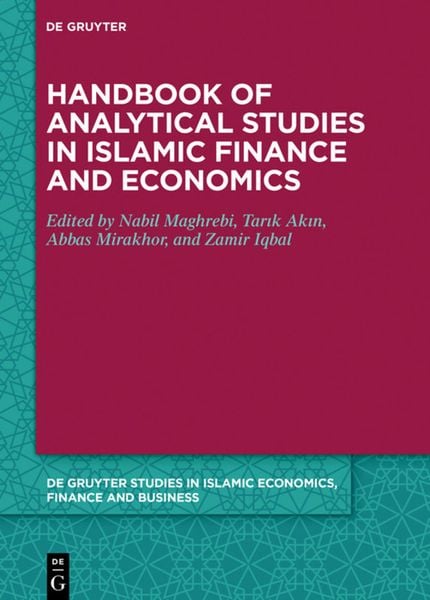
  • Produktbild: Handbook of Analytical Studies in Islamic Finance and Economics
  • Produktbild: Handbook of Analytical Studies in Islamic Finance and Economics
Band 4

Handbook of Analytical Studies in Islamic Finance and Economics

178,99 €

inkl. gesetzl. MwSt., Versandkostenfrei


Beschreibung

Produktdetails

Einband

Gebundene Ausgabe

Erscheinungsdatum

10.08.2020

Abbildungen

mit 85 Illustrationen, mit 107 tblättern

Herausgeber

Zamir Iqbal + weitere

Verlag

De Gruyter

Seitenzahl

685

Maße (L/B/H)

24,6/17,5/5 cm

Gewicht

1540 g

Auflage

1

Sprache

Englisch

ISBN

978-3-11-058508-7

Beschreibung

Portrait

Zamir Iqbal is currently serving as the Vice President, Finance and CFO of the Islamic Development Bank. Prior to joining the Islamic Development Bank, he served as head of the World Bank Global Islamic Finance Development Center in Istanbul. He has more than 25 years of experience of capital markets, asset management, risk management, and financial sector at the World Bank. Islamic finance has been his research focus and he has co-authored several articles and books on Islamic finance on the topics of banking risk, financial inclusion, economic development, financial stability, and risk-sharing. He played an instrumental role in the publication of World Bank and IsDB’s first Global Report on Islamic Finance. He earned his PhD in international finance from the George Washington University and served as Professional faculty at Carey Business School of Johns Hopkins University.

Tarik Akin is Head of the Department of Participation Finance at Finance Office, Presidency of Turkey.

His work experience also includes consultant positions at the United Nations Development Programme (UNDP), and Silatech-Qatar. He also worked as research assistant in the Center for International Development at Harvard University and INCEIF. Dr. Tarık has earned his bachelor’s degree in economics from Bilkent University, master’s degree in international development from Harvard University and PhD degree in Islamic finance from INCEIF. His research interests include Islamic capital markets, economics of inequality, redistribution policies, and SME finance.

Nabil El Maghrebi is currently serving as dean of the Faculty of Economics, and head of the Graduate School of Economics, Wakayama University, Japan. He is Professor of Finance at Wakayama University, visiting professor at the Center for Mathematical Modeling and Data Science, Osaka University. He is also associate editor of ISRA International Journal of Islamic Finance. He served as research fellow at the International Institute for Advanced Studies, Kyoto,visiting scholar at the International Centre for education in Islamic Finance, Kuala Lumpur, and visiting professor at the Center for International Financial and Economic Research, Loughborough University, United Kingdom. He has more than 25 years of experience in education and research in Japanese national universities. The focus of his research is placed on financial stability, asset pricing, market volatility, risk analysis, and Islamic finance. He developed the VXJ volatility index for the Japanese financial markets, and co-authored several articles on empirical finance and economics as well as the first analytical reference and textbook, Intermediate Islamic Finance. He graduated from Institut des Hautes Etudes Commerciales, IHEC-Carthage, Tunisia, and earned his PhD in Economics from Osaka University, Japan.

Abbas Mirakhor joined INCEIF in 2010 as Distinguished Scholar and the First Holder of INCEIF's Chair in Islamic Finance. His research interests include conventional and Islamic economics and finance. He is a graduate of the Kansas State University, USA, where he received his Bachelor, Master and PhD Degrees in Economics. In 1968, he started his academic career with University of Alabama, USA. Mirakhor has worked as a professor of economics at the University of Alabama, Alabama A&M University, and the Florida Institute of Technology. In 1984, he joined the IMF in Washington DC as an economist. He spent 24 years with the IMF, serving as the organisation's Executive Director and Dean of the Executive Board, retiring in 2008.

Produktdetails

Einband

Gebundene Ausgabe

Erscheinungsdatum

10.08.2020

Abbildungen

mit 85 Illustrationen, mit 107 tblättern

Herausgeber

Verlag

De Gruyter

Seitenzahl

685

Maße (L/B/H)

24,6/17,5/5 cm

Gewicht

1540 g

Auflage

1

Sprache

Englisch

ISBN

978-3-11-058508-7

Herstelleradresse

de Gruyter Mouton
Genthiner Straße 13
10785 Berlin
DE

Email: GPSR Kontakt

Noch keine Bewertungen vorhanden

Verfassen Sie die erste Bewertung zu diesem Artikel

Helfen Sie anderen Kundinnen und Kunden durch Ihre Meinung.

Kundinnen und Kunden meinen

Bewertungen (0)

Die Leseprobe wird geladen.
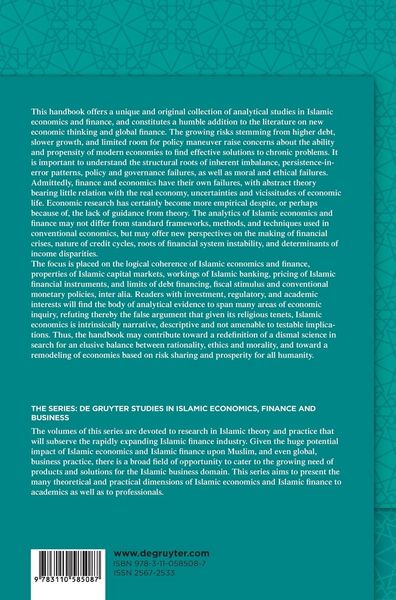
  • Produktbild: Handbook of Analytical Studies in Islamic Finance and Economics
  • Produktbild: Handbook of Analytical Studies in Islamic Finance and Economics