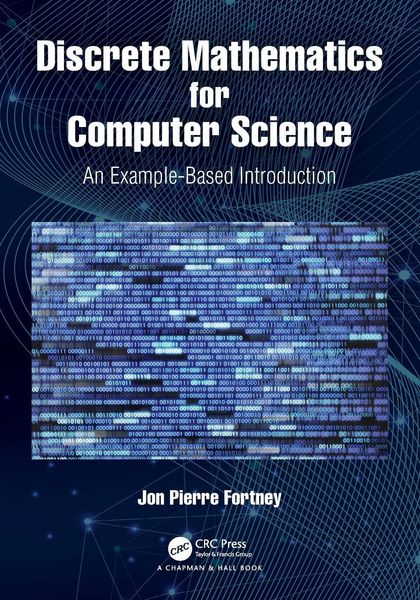
Discrete Mathematics for Computer Science An Example-Based Introduction
-
- Hardcover
- Taschenbuch ausgewählt
- eBook
-
Sprache:Englisch
78,99 €
inkl. gesetzl. MwSt.,
Beschreibung
Produktdetails
Einband
Taschenbuch
Erscheinungsdatum
24.12.2020
Abbildungen
34 SW-Abb.
Verlag
Taylor & FrancisSeitenzahl
270
Maße (L/B/H)
25,4/17,8/1,5 cm
Gewicht
514 g
Sprache
Englisch
ISBN
978-0-367-54989-3
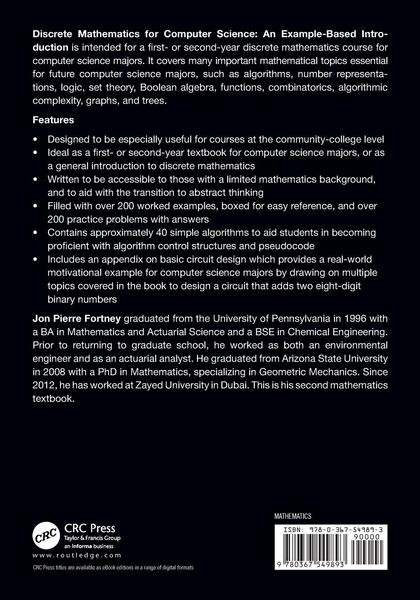
Discrete Mathematics for Computer Science: An Example-Based Introduction is intended for a first- or second-year discrete mathematics course for computer science majors. It covers many important mathematical topics essential for future computer science majors, such as algorithms, number representations, logic, set theory, Boolean algebra, functions, combinatorics, algorithmic complexity, graphs, and trees.
Features
- Designed to be especially useful for courses at the community-college level
- Ideal as a first- or second-year textbook for computer science majors, or as a general introduction to discrete mathematics
- Written to be accessible to those with a limited mathematics background, and to aid with the transition to abstract thinking
- Filled with over 200 worked examples, boxed for easy reference, and over 200 practice problems with answers
- Contains approximately 40 simple algorithms to aid students in becoming proficient with algorithm control structures and pseudocode
- Includes an appendix on basic circuit design which provides a real-world motivational example for computer science majors by drawing on multiple topics covered in the book to design a circuit that adds two eight-digit binary numbers
Jon Pierre Fortney graduated from the University of Pennsylvania in 1996 with a BA in Mathematics and Actuarial Science and a BSE in Chemical Engineering. Prior to returning to graduate school, he worked as both an environmental engineer and as an actuarial analyst. He graduated from Arizona State University in 2008 with a PhD in Mathematics, specializing in Geometric Mechanics. Since 2012, he has worked at Zayed University in Dubai. This is his second mathematics textbook.
Noch keine Bewertungen vorhanden
Verfassen Sie die erste Bewertung zu diesem Artikel
Helfen Sie anderen Kundinnen und Kunden durch Ihre Meinung.
Kurze Frage zu unserer Seite
Vielen Dank für Ihr Feedback
Wir nutzen Ihr Feedback, um unsere Produktseiten zu verbessern. Bitte haben Sie Verständnis, dass wir Ihnen keine Rückmeldung geben können. Falls Sie Kontakt mit uns aufnehmen möchten, können Sie sich aber gerne an unseren Kund*innenservice wenden.
zum Kundenservice