Rezension
"There is a saying, when you know better, you do better. The second edition of
Intersectionality & Higher Education
will help educators do better around identity development and understanding contexts and institutional power structures that press down upon those most affected by marginalization. The renowned scholars that contributed to this book give readers an accessible way to unpack intersectionality within higher education."—Bridget Turner Kelly, Associate Professor, College of Education, University of Maryland; Executive Editor,
Journal of Student Affairs Research and Practice
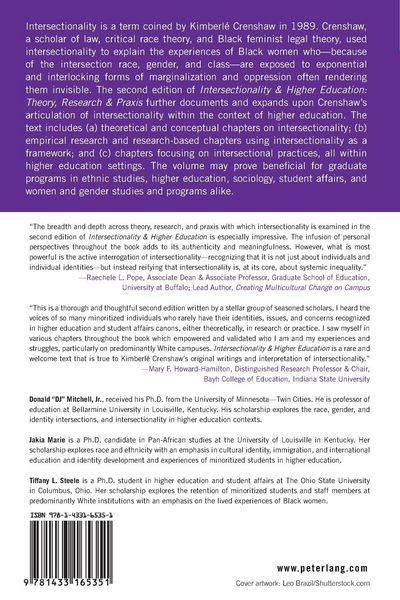
"The breadth and depth across theory, research, and praxis with which intersectionality is examined in the second edition of
Intersectionality & Higher Education
is especially impressive. The infusion of personal perspectives throughout the book adds to its authenticity and meaningfulness. However, what is most powerful is the active interrogation of intersectionality—recognizing that it is not just about individuals and individual identities—but instead reifying that intersectionality is, at its core, about systemic inequality."—Raechele L. Pope, Associate Dean & Associate Professor, Graduate School of Education, University at Buffalo; Lead Author,
Creating Multicultural Change on Campus
"This is a thorough and thoughtful second edition written by a stellar group of seasoned scholars. I heard the voices of so many minoritized individuals who rarely have their identities, issues, and concerns recognized in higher education and student affairs canons, either theoretically, in research or practice. I saw myself in various chapters throughout the book which empowered and validated who I am and my experiences and struggles, particularly on predominantly White campuses.
Intersectionality & Higher Education
is a rare and welcome text that is true to Kimberlé Crenshaw's original writings and interpretation of intersectionality."—Mary F. Howard-Hamilton, Distinguished Research Professor & Chair, Bayh College of Education, Indiana State University
“For those engaged in social justice work as well as those unfamiliar with the interwoven nature of identity and disparities that exacerbate oppression, and the nuances of multiple group memberships, intersectionality is essential in advancing justice and curbing inequities. Too often is the case that scholars, practitioners, and advocates for social justice fall short of illustrating identity markers that are not siloes but routinely converge in fueling prejudice, systemic discrimination, and oppressive conditions. However, the second edition of
Intersectionality & Higher Education
edited by Donald “DJ” Mitchell, Jr. and associates recognizes this constraint subsequently providing breadth and depth on intersectionality. Readers will be informed and enlightened with complex applied theoretical, methodological, and practical intersectional approaches.”—Eboni M. Zamani-Gallaher, Associate Dean & Professor, The Graduate College, University of Illinois at Urbana-Champaign
Portrait
Donald "DJ" Mitchell, Jr., received his Ph.D. from the University of Minnesota—Twin Cities. He is professor of education at Bellarmine University in Louisville, Kentucky. His scholarship explores the race, gender, and identity intersections, and intersectionality in higher education contexts. Jakia Marie is a Ph.D. candidate in Pan-African studies at the University of Louisville in Kentucky. Her scholarship explores race and ethnicity with an emphasis in cultural identity, immigration, and international education and identity development and experiences of minoritized students in higher education.Tiffany L. Steele is a Ph.D. student in higher education and student affairs at The Ohio State University in Columbus, Ohio. Her scholarship explores the retention of minoritized students and staff members at predominantly White institutions with an emphasis on the lived experiences of Black women.