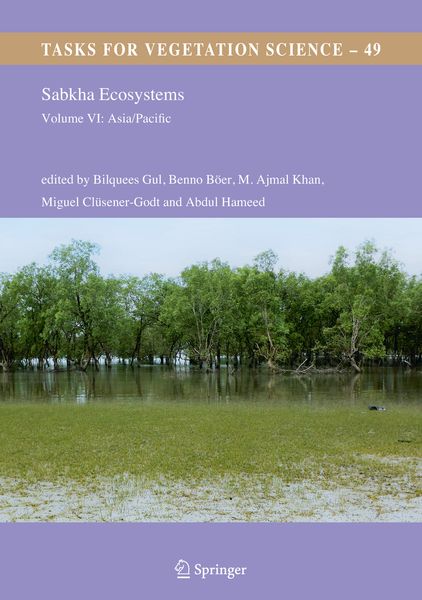
Produktbild: Sabkha Ecosystems
Band 49

Sabkha Ecosystems Volume VI: Asia/Pacific

149,99 €

inkl. gesetzl. MwSt., Versandkostenfrei


Beschreibung

Produktdetails

Einband

Gebundene Ausgabe

Erscheinungsdatum

21.08.2019

Abbildungen

XXVII, 184 illus., 117 illus. in color., farbige Illustrationen, schwarz-weiss Illustrationen

Herausgeber

Bilquees Gul + weitere

Verlag

Springer

Seitenzahl

511

Maße (L/B/H)

26/18,3/3,3 cm

Gewicht

1279 g

Auflage

1st ed. 2019

Sprache

Englisch

ISBN

978-3-030-04416-9

Beschreibung

Produktdetails

Einband

Gebundene Ausgabe

Erscheinungsdatum

21.08.2019

Abbildungen

XXVII, 184 illus., 117 illus. in color., farbige Illustrationen, schwarz-weiss Illustrationen

Herausgeber

Verlag

Springer

Seitenzahl

511

Maße (L/B/H)

26/18,3/3,3 cm

Gewicht

1279 g

Auflage

1st ed. 2019

Sprache

Englisch

ISBN

978-3-030-04416-9

Herstelleradresse

Springer-Verlag KG
Sachsenplatz 4-6
1201 Wien
AT

Email: GPSR Kontakt

Noch keine Bewertungen vorhanden

Verfassen Sie die erste Bewertung zu diesem Artikel

Helfen Sie anderen Kundinnen und Kunden durch Ihre Meinung.

Kundinnen und Kunden meinen

Bewertungen (0)

  • Produktbild: Sabkha Ecosystems
  • 1. Halophyte Research, Conservation & Development - The role of UNESCO Biosphere Reserves in Asia/Pacific

    2. Evidence for the role of salinity and alkalinity in plant diversification in Australia

    3. Aspects of the Abu Dhabi Sabkha

    4.Comparative seed germination ecology of sabkha and playa halophytes of Pakistan

    5. Plants of sabkha ecosystems of the Arabian Peninsula

    6. Desert Halophytes: Alleviating the Pressure on the Scarce Resources of Arable Soil and Fresh Water

    7. Drone-based vegetation assessment in arid ecosystems

    8.Salt-induced Changes in Growth and Damage-avoidance-mechanisms of Hydroponically Grown Chinese Kale (Brassica alboglabra L.)

    9. Growth dynamic of Tamarix chinensis plantations in coastal heavy saline land and its ecological effect

    10. Mechanisms of ion transport in halophytes, from roots to leaves

    11. Interpretation of Holocene Carbonate-Evaporites of Coastal and Inland Sabkhas of Abu Dhabi (United Arab Emirates) Using Landsat Satellite Images and Field Survey

    12. Climate change impacts on salt marsh vegetation ecophysiology

    13. Morphology and betalain characterization of ‘ice plants’ (Aizoaceae) from the coast of Wellington, New Zealand

    14. Salt-tolerance and potential uses for saline agriculture of halophytes from the Poaceae

    15. Phenotyping through Infra-Red Thermography in stress environment

    16. The Mangroves of Myanmar

    17. Potentially domesticable chenopodiacea halophytes of Iran

    18. Plant Growth Promoting Bacteria associated to the halophyte Suaeda maritima (L.) in Abbas, Iran

    19. Quinoa: A new crop for harsh environments

    20. Difference in antioxidant defense system between the halophytes and glycophytes to overcome the salinity stress

    21. Diversity and distribution of salt-tolerant plants of the United Arab Emirates: perspectives for sustainable utilization and future research

    22. Framework for rapid evaluation of a mangrove restoration site: A case study from Indian Sundarban

    23. Mangrove Biogeography of the Indo-Pacific

    24. Short Communications – Suggestions for Improving Science Communication for Halophyte Conservation, Research and Development

    25. Ligno-cellulosic biomass from sabkha native vegetation: a new potential source for fiber-based bioenergy production

    26. The Floristical, Ecological and Syntaxonomical Characteristics of Salt Marshes and Salt Steppes of Turkey

    27. Temporal variations in water and ion relations of coastal halophytes

    28. Mangrove Cover, Biodiversity and Carbon Storage of Mangrove Forests in Thailand

    29. Pollen morphology of the genus Tamarix in Israel

    30. Species distribution in different ecological zones and conservation strategy of Halophytes of Sundarbans Mangrove Forest of Bangladesh

    31. Cash Crop Holophytes of China

    32. Sabkha Ecosystems Vol VI - Asia Pacific: Summarizing the Story