Gutscheinbedingungen

**Gültig bis 12.08.2026 auf fremdsprachige Bücher online auf thalia.at und in der Thalia App. Einzelne Artikel können ausgeschlossen sein. Ausgenommen sind preisgebundene Artikel & eBooks. Pro Einkauf einmal einlösbar. Click & Collect nur bei Onlinevorabzahlung möglich. Keine Barauszahlung. Nicht kombinierbar mit anderen Aktionen und Gutscheinen. Gutschein wird auf max. 500€ Bestellwert angerechnet. Nicht gültig für Geschenkkarten, Versandkosten und Services.

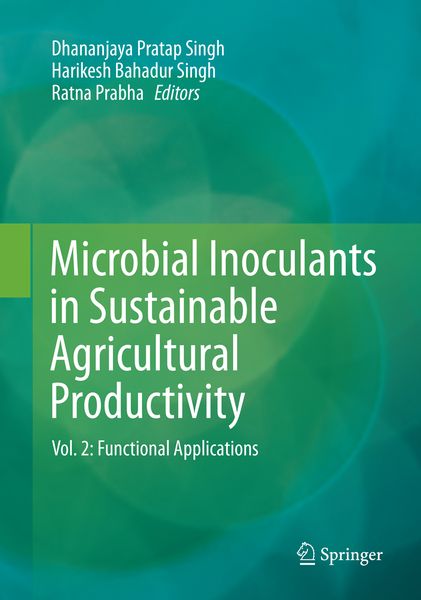
Produktbild: Microbial Inoculants in Sustainable Agricultural Productivity
- 12%

Microbial Inoculants in Sustainable Agricultural Productivity Vol. 2: Functional Applications

12% sparen

211,99 € UVP 241,99 €

inkl. gesetzl. MwSt., Versandkostenfrei


Beschreibung

Produktdetails

Einband

Taschenbuch

Erscheinungsdatum

25.04.2018

Abbildungen

XVI, 308 p. 29 illus., 12 illus. in color.

Herausgeber

Dhananjaya Pratap Singh + weitere

Verlag

Springer India

Seitenzahl

308

Maße (L/B/H)

25,4/17,8/1,7 cm

Gewicht

685 g

Auflage

1. Auflage

Sprache

Englisch

ISBN

978-81-322-3806-5

Beschreibung

Rezension

“This volume offered detailed information on mass production of efficient microbial inoculants from laboratory to industrial/commercial level, intellectual property rights required, registration processes, bio-safety and bio-security concerns, quality control, and their legal authenticity. Based on the above merits, we recommend this book to stakeholders engaged in working on microbial bioinoculants.” (Jay Prakash Verma, Frontiers in Microbiology, December, 2016)

Portrait

Dhananjaya P. Singh is presently Senior Scientist (Biotechnology) with ICAR-National Bureau of Agriculturally Important Microorganisms, Indian Council of Agricultural Research, India at Maunath Bhanjan, India. He did his Masters degree from G.B. Pant University of Agriculture & Technology, Pantnagar, India and Ph. D. in Biotechnology from Banaras Hindu University, India. His research interests lies in bioprospecting of metabolites, microbe-mediated stress management in plants, metabolomics-driven search for small molecules and bioinformatics. He has been engaged with the development of supercomputational infrastructure for agricultural bioinformatics at ICAR-NBAIM under National Agricultural Bioinformatics Grid project of ICAR. He has overall 112 publications including 60 research papers, two edited books, 22 book chapters, 20 popular articles, 15 reviews and one Indian Patent to his credit.

Harikesh B. Singh is presently Professor & Head, Department ofMycology and Plant Pathology at Institute of Agricultural Sciences, Banaras Hindu University. He served the State Agriculture University, Central University and CSIR Institute in teaching, research and extension roles. His major research focus is on bioinnoculats, biological control of plant pathogens and nano-biotechnology. In recognition of Prof. Singh’s scientific contributions and leadership in the field of plant pathology, he was honored;wi

th several prestigious awards, notable being CSIR Technology Prize for Biological Sciences, Vigyan Bharti Award, Prof. V.P. Bhide Memorial Award, Society for Plant Research, Scientist of Excellence Awards, BRSI Industrial Medal Award, Jyoti Sangam Award, Akshyavat Samman, Distinguish Scientist Award by Society for Research Development in Agriculture, Prof. Panchanan Maheshwari Medal by Indian Botanical Society,  Rashtriya Gaurav Award by IIFS, Plant Pathology Leader Award by IPS, CSIR Award for S&T Innovation for Rural Development (CAIRD), Environment Conservation Award, Vigyan Ratna by UP Council of Science and Technology. Dr. Singh has been the Fellow of National Academy of Agricultural Sciences. Professor Singh has written two books, several training modules/ manuals and more than 275 publications and has more than 18 US patents and 3 PCTs to his credit. 

Ratna Prabha has obtained her Master's degree in Bioinformatics from Banasthali Vidyapeeth, Rajasthan and Doctorate in Biotechnology from Mewar University, India. She is presently associated with ICAR- National Bureau of Agriculturally Important Microorganisms, India in Network Project for Agricultural Bioinformatics and Computational Biology of Indian Council of Agricultural Research. Dr Prabha has been engaged in developing various bioinformatics digital databases on plants and microbes, published 14 research papers in the journals of International repute and 06 book chapters. Her current research interest lies in microbe-mediated stress management in plants, database development, comparative microbial genome analysis, phylogenomics and pangenome analysis of prokaryotic genomes. She has completed several bioinformatics demonstration tasks at different National training programs on bioinformatics and computational biology.  

Produktdetails

Einband

Taschenbuch

Erscheinungsdatum

25.04.2018

Abbildungen

XVI, 308 p. 29 illus., 12 illus. in color.

Herausgeber

Verlag

Springer India

Seitenzahl

308

Maße (L/B/H)

25,4/17,8/1,7 cm

Gewicht

685 g

Auflage

1. Auflage

Sprache

Englisch

ISBN

978-81-322-3806-5

Herstelleradresse

Springer-Verlag KG
Sachsenplatz 4-6
1201 Wien
AT

Email: GPSR Kontakt

Noch keine Bewertungen vorhanden

Verfassen Sie die erste Bewertung zu diesem Artikel

Helfen Sie anderen Kundinnen und Kunden durch Ihre Meinung.

Kundinnen und Kunden meinen

Bewertungen (0)

  • Produktbild: Microbial Inoculants in Sustainable Agricultural Productivity
  • 1. Soil Microbes: The Invisible Managers of Soil Fertility.- 2. Efficacy of Biofertilizers: Challenges to Improve Crop Production.- 3. Revisiting Action of Bioinoculants: Their Impact on Rhizospheric Microbial Community Function.- 4. Phenazine-Producing Pseudomonas spp. as Biocontrol Agents of Plant Pathogens.- 5. Role of Non-pathogenic Fungi in Inducing Systemic Resistance in Crop Plants against Phytopathogens.- 6. Stress Management Practices in Plants by Microbes.- 7. Contribution of Microbial Inoculants in Soil Carbon Sequestration and Sustainable Agriculture.- 8. Remediation of Heavy Metals Contaminated Agricultural Soils using Microbes.- 9. Role of Microbial Inoculants in Nutrient Use Efficiency.- 10. Nutrient Management Strategies based on Microbial Functions.- 11. Organic Acids in the Rhizosphere- Their Role in Phosphate Dissolution.- 12. Formulations of Biofertilizers- Approaches and Advances.- 13. Delivery Systems for Introduction of Microbial Inoculants in the Field.- 14. Advances in Formulation Development Technologies.- 15. Formulations of Plant Growth-Promoting Microbes for Field Applications.- 16. A Novel Tool of Nanotechnology- Nanoparticle Mediated Control of Nematode Infection in Plants.- 17. Understanding the Role of Nanomaterials in Agriculture.- 18. Nanoparticles - The Next Generation Technology for Sustainable Agriculture.- 19. Challenges in Regulation and Registration of Biopesticides: An Overview.