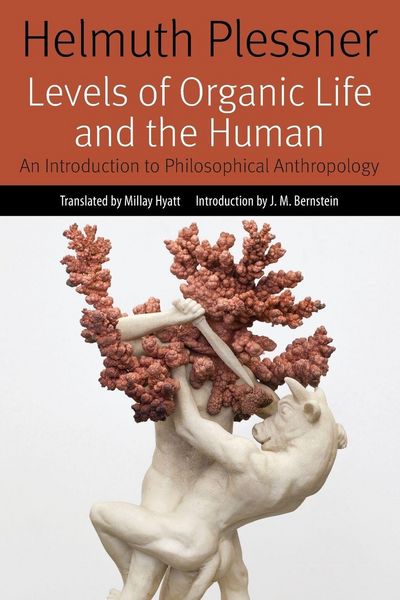
Levels of Organic Life and the Human An Introduction to Philosophical Anthropology
-
- Hardcover
- Taschenbuch ausgewählt
- eBook
-
Sprache:Englisch
48,99 €
inkl. gesetzl. MwSt.,
Beschreibung
Produktdetails
Einband
Taschenbuch
Erscheinungsdatum
02.07.2019
Abbildungen
4
Verlag
Fordham University PressSeitenzahl
450
Maße (L/B/H)
22,9/15,2/2,7 cm
Gewicht
726 g
Übersetzt von
Millay Hyatt
Sprache
Englisch
ISBN
978-0-8232-8398-9
The most important work by a key figure in German thought, Helmuth Plessner's Levels of Organic Life and the Human, originally published in 1928, appears here for the first time in English, accompanied by a substantial Introduction by J. M. Bernstein, after having served for decades as an influence on thinkers as diverse as Merleau-Ponty, Peter Berger, Habermas, and the new naturalists.
The Levels, as it has long been known, draws on phenomenological, biological, and social scientific sources as part of a systematic account of nature, life, and human existence. The book considers non-living nature, plants, non-human animals, and human beings in turn as a sequence of increasingly complex modes of boundary dynamics-simply put, interactions between a thing's insides and surrounding world. On Plessner's unique account, living things are classed and analyzed by their "positionality," or orientation to and within an environment. "Life" is thereby phenomenologically defined, and its universal yet internally variable features such as metabolism, reproduction, and death are explained.
The approach provides a foundation not only for philosophical biology but philosophical anthropology as well. According to Plessner's radical view, the human form of life is excentric-that is, the relation between body and environment is something to which humans themselves are positioned and can take a position. This "excentric positionality" enables human beings to take a stand outside the boundaries of their own body, a possibility with significant implications for knowledge, culture, religion, and technology.
Plessner studied zoology and philosophy with Hans Driesch in the 1910s before embarking on a highly productive philosophical career. His work was initially obscured by the superficially similar views of Max Scheler and Martin Heidegger and by his forced exile during World War II. Only in recent decades, as scholarship has moved more squarely into engagement with issues like animality, embodiment, human dignity, social theory, the philosophy of technology, and the philosophy of nature, has the originality and depth of Plessner's vision been appreciated.
A powerful and sophisticated account of embodiment, the Levels shows, with reference both to science and to philosophy, how life can be seen on its own terms to establish its own boundaries, and how, from the standpoint of life, the human establishes itself in relation to the nonhuman. As such, the book is not merely a historical monument but a source for invigorating a range of vital current conversations around the animal, posthumanism, the material turn, and the biology and sociology of cognition.
This modern philosophical classic, long-awaited in English translation, is a key book both historically and for today's interest in understanding philosophy and social theory together with science, without reducing the former to the latter.
Noch keine Bewertungen vorhanden
Verfassen Sie die erste Bewertung zu diesem Artikel
Helfen Sie anderen Kundinnen und Kunden durch Ihre Meinung.
Kurze Frage zu unserer Seite
Vielen Dank für Ihr Feedback
Wir nutzen Ihr Feedback, um unsere Produktseiten zu verbessern. Bitte haben Sie Verständnis, dass wir Ihnen keine Rückmeldung geben können. Falls Sie Kontakt mit uns aufnehmen möchten, können Sie sich aber gerne an unseren Kund*innenservice wenden.
zum Kundenservice