KI-Beratung Beta

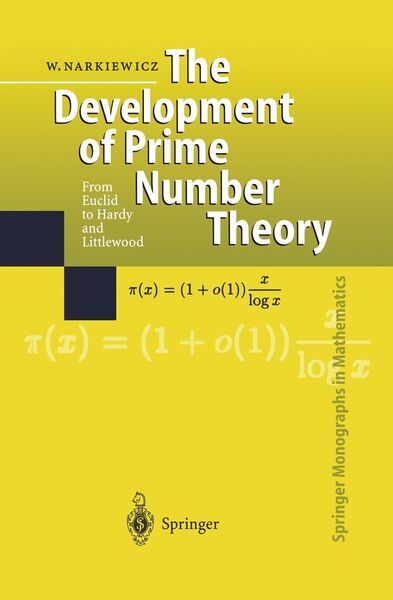
Produktbild: The Development of Prime Number Theory

The Development of Prime Number Theory From Euclid to Hardy and Littlewood

  • Form:Einzelkauf Download
  • Sprache:Englisch

164,99 €

inkl. gesetzl. MwSt.

Beschreibung

1. People were already interested in prime numbers in ancient times, and the first result concerning the distribution of primes appears in Euclid's Elemen­ ta, where we find a proof of their infinitude, now regarded as canonical. One feels that Euclid's argument has its place in The Book, often quoted...

Beschreibung

1. People were already interested in prime numbers in ancient times, and the first result concerning the distribution of primes appears in Euclid's Elemen­ ta, where we find a proof of their infinitude, now regarded as canonical. One feels that Euclid's argument has its place in The Book, often quoted by the late Paul ErdOs, where the ultimate forms of mathematical arguments are preserved. Proofs of most other results on prime number distribution seem to be still far away from their optimal form and the aim of this book is to present the development of methods with which such problems were attacked in the course of time. This is not a historical book since we refrain from giving biographical details of the people who have played a role in this development and we do not discuss the questions concerning why each particular person became in­ terested in primes, because, usually, exact answers to them are impossible to obtain. Our idea is to present the development of the theory of the distribu­ tion of prime numbers in the period starting in antiquity and concluding at the end of the first decade of the 20th century. We shall also present some later developments, mostly in short comments, although the reader will find certain exceptions to that rule. The period of the last 80 years was full of new ideas (we mention only the applications of trigonometrical sums or the advent of various sieve methods) and certainly demands a separate book.

Produktdetails

Format

PDF

Kopierschutz

Nein

Family Sharing

Nein

Text-to-Speech

Nein

Produktdetails

Format

PDF

Format

eBooks im PDF-Format haben eine festgelegte Seitengröße und eignen sich daher nur bedingt zum Lesen auf einem tolino eReader oder Smartphone. Für den vollen Lesegenuss empfehlen wir Ihnen bei PDF-eBooks die Verwendung eines Tablets oder Computers.

Kopierschutz

Nein

Kopierschutz

Dieses eBook können Sie uneingeschränkt auf allen Geräten der tolino Familie, allen sonstigen eReadern und am PC lesen. Das eBook ist nicht kopiergeschützt und kann ein personalisiertes Wasserzeichen enthalten. Weitere Hinweise zum Lesen von eBooks mit einem personalisierten Wasserzeichen finden Sie unter Hilfe/Downloads.

Family Sharing

Nein

Family Sharing

Mit Family Sharing können Sie eBooks innerhalb Ihrer Familie (max. sechs Mitglieder im gleichen Haushalt) teilen. Sie entscheiden selbst, welches Buch Sie mit welchem Familienmitglied teilen möchten. Auch das parallele Lesen durch verschiedene Familienmitglieder ist durch Family Sharing möglich. Um eBooks zu teilen oder geteilt zu bekommen, muss jedes Familienmitglied ein Konto bei Thalia oder einem anderen tolino-Buchhändler haben. Weitere Informationen finden Sie unter Hilfe/Family-Sharing.

Text-to-Speech

Nein

Text-to-Speech

Bedeutet Ihnen Stimme mehr als Text? Mit der Funktion Text-to-Speech können Sie sich im tolino webReader und in der aktuellen Thalia – Lesen & Hören App das eBook vorlesen lassen. Weitere Informationen finden Sie unter Hilfe/Text-to-Speech.

Erscheinungsdatum

14.03.2013

Verlag Springer
Seitenzahl

449 (Printausgabe)

Dateigröße

37114 KB

Sprache

Englisch

EAN

9783662131572

Barrierefreiheit
  • nicht oder eingeschränkt barrierefrei
  • keine Vorlesefunktionen des Lesesystems deaktiviert

Noch keine Bewertungen vorhanden

Verfassen Sie die erste Bewertung zu diesem Artikel

Helfen Sie anderen Kundinnen und Kunden durch Ihre Meinung.

Kundinnen und Kunden meinen

Bewertungen (0)

Weitere Artikel finden Sie in

  • Produktbild: The Development of Prime Number Theory