KI-Beratung Beta

Gutscheinbedingungen

**Gültig am 27.11.2026 auf Spielzeug, Schreibwaren, Filme, Geschenke & Trends, Musik, tolino eReader & Zubehör, Hörbücher und Hörbuch-Downloads, nicht preisgebundene Bücher und Kalender online auf thalia.at und in der Thalia App. Einzelne Artikel können ausgeschlossen sein. Aufgrund der Buchpreisbindung sind deutschsprachige Bücher und eBooks ausgenommen. Zusätzlich ausgenommen sind Abos & Flatrates, Games, Geschenkkarten/-boxen, Shelfies, Software, Zeitschriften sowie einzelne Artikel von tonies®. Pro Einkauf einmal einlösbar. Click & Collect nur bei Onlinevorabzahlung möglich. Keine Barauszahlung. Nicht kombinierbar mit anderen Aktionen und Gutscheinen. Gutschein wird auf max. 500€ Bestellwert angerechnet. Nicht gültig für Versandkosten und Services.

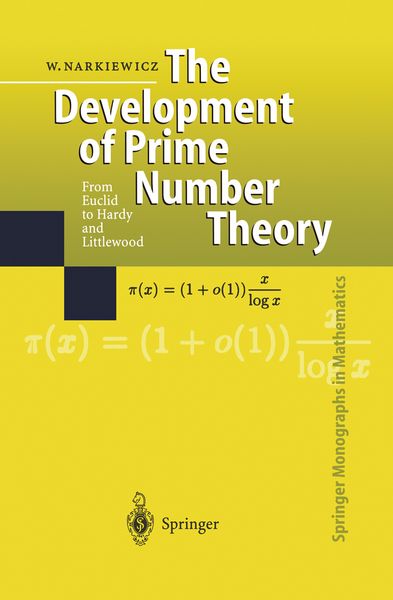
Produktbild: The Development of Prime Number Theory

The Development of Prime Number Theory From Euclid to Hardy and Littlewood

161,99 €

inkl. gesetzl. MwSt., Versandkostenfrei


Beschreibung

1. People were already interested in prime numbers in ancient times, and the first result concerning the distribution of primes appears in Euclid's Elemen ta, where we find a proof of their infinitude, now regarded as canonical. One feels that Euclid's argument has its place in The Book, often quoted...

Beschreibung

1. People were already interested in prime numbers in ancient times, and the first result concerning the distribution of primes appears in Euclid's Elemen ta, where we find a proof of their infinitude, now regarded as canonical. One feels that Euclid's argument has its place in The Book, often quoted by the late Paul ErdOs, where the ultimate forms of mathematical arguments are preserved. Proofs of most other results on prime number distribution seem to be still far away from their optimal form and the aim of this book is to present the development of methods with which such problems were attacked in the course of time. This is not a historical book since we refrain from giving biographical details of the people who have played a role in this development and we do not discuss the questions concerning why each particular person became in terested in primes, because, usually, exact answers to them are impossible to obtain. Our idea is to present the development of the theory of the distribu tion of prime numbers in the period starting in antiquity and concluding at the end of the first decade of the 20th century. We shall also present some later developments, mostly in short comments, although the reader will find certain exceptions to that rule. The period of the last 80 years was full of new ideas (we mention only the applications of trigonometrical sums or the advent of various sieve methods) and certainly demands a separate book.

Rezension

“This is a most welcome addition to the literature on prime numbers, zeta and L-functions and arithmetical functions. … The style is clear, with just the right amount of details. Each chapter closes with carefully chosen Exercises. Novices and experts alike will find that this a book of highest quality, which sets a standard for future works dealing with the history of Mathematics.” (A.Ivić, zbMATH 0942.11002, 2021)

Produktdetails

Einband

Taschenbuch

Erscheinungsdatum

07.12.2010

Abbildungen

XII, 449 p.

Verlag Springer Berlin

Produktdetails

Einband

Taschenbuch

Erscheinungsdatum

07.12.2010

Abbildungen

XII, 449 p.

Verlag Springer Berlin
Seitenzahl

449

Maße (L/B/H)

23,5/15,5/2,5 cm

Gewicht

698 g

Auflage

Softcover reprint of hardcover 1st ed. 2000

Sprache

Englisch

ISBN

978-3-642-08557-4

Herstelleradresse

Springer-Verlag KG
Sachsenplatz 4-6
1201 Wien
AT

Email: ProductSafety@springernature.com

Noch keine Bewertungen vorhanden

Verfassen Sie die erste Bewertung zu diesem Artikel

Helfen Sie anderen Kundinnen und Kunden durch Ihre Meinung.

Kundinnen und Kunden meinen

Bewertungen (0)

  • Produktbild: The Development of Prime Number Theory
  • 1. Early Times.- 2. Dirichlet’s Theorem on Primes in Arithmetic Progressions.- 3. ?ebysev’s Theorem.- 4. Riemann’s Zeta-function and Dirichlet Series.- 5. The Prime Number Theorem.- 6. The Turn of the Century.- References.- Author Index.