KI-Beratung Beta

Gutscheinbedingungen

**Gültig am 27.11.2026 auf Spielzeug, Schreibwaren, Filme, Geschenke & Trends, Musik, tolino eReader & Zubehör, Hörbücher und Hörbuch-Downloads, nicht preisgebundene Bücher und Kalender online auf thalia.at und in der Thalia App. Einzelne Artikel können ausgeschlossen sein. Aufgrund der Buchpreisbindung sind deutschsprachige Bücher und eBooks ausgenommen. Zusätzlich ausgenommen sind Abos & Flatrates, Games, Geschenkkarten/-boxen, Shelfies, Software, Zeitschriften sowie einzelne Artikel von tonies®. Pro Einkauf einmal einlösbar. Click & Collect nur bei Onlinevorabzahlung möglich. Keine Barauszahlung. Nicht kombinierbar mit anderen Aktionen und Gutscheinen. Gutschein wird auf max. 500€ Bestellwert angerechnet. Nicht gültig für Versandkosten und Services.

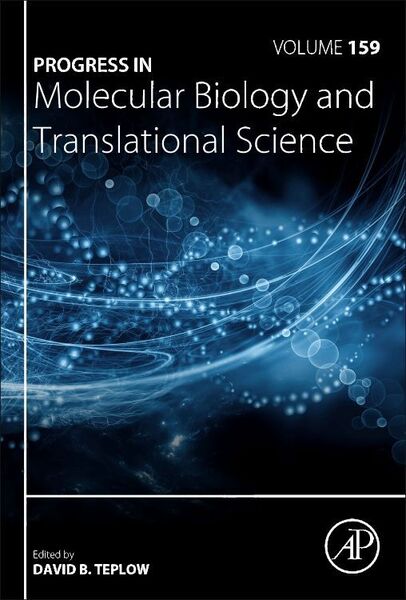
Produktbild: Progress in Molecular Biology and Translational Science
Band 159

Progress in Molecular Biology and Translational Science

129,99 €

inkl. gesetzl. MwSt., Versandkostenfrei


Beschreibung

Progress in Molecular Biology and Translational Science, Volume 159, provides the most topical, informative and exciting monographs available on a wide variety of research topics related to prions, viruses, bacteria and eukaryotes. The series includes in-depth knowledge on molecular biological aspects...

Beschreibung

Progress in Molecular Biology and Translational Science, Volume 159, provides the most topical, informative and exciting monographs available on a wide variety of research topics related to prions, viruses, bacteria and eukaryotes. The series includes in-depth knowledge on molecular biological aspects of organismal physiology, along with insights on how this knowledge may be applied to understand and ameliorate human disease. New chapters in this release discuss timely topics, such as Targeting recently deorphanized GPR83 for the treatment of infection, stress, and drug addiction, Arrestin Structure-Function, Arrestins in the Cardiovascular System, Analysis of biased agonism, and more.

Portrait

David B. Teplow, Ph.D., is a Professor of Neurology, Emeritus, at UCLA and an internationally recognized leader in efforts to understand and treat Alzheimer's disease. Dr. Teplow's group has used a multi-disciplinary approach to determine how neurotoxic peptides, such as the amyloid ?-protein (Alzheimer's disease) and ?-synuclein (Parkinson's disease), form neurotoxic structures that kill neurons and to develop the means to block these processes. Dr. Teplow received undergraduate training at UC Berkeley; a Ph.D. from the University of Washington; and was a postdoctoral scholar at Caltech. Before coming to UCLA, Dr. Teplow was a faculty member in the Department of Neurology, Harvard Medical School. Dr. Teplow has published >250 peer-reviewed articles, books and book chapters, and commentaries, in addition to serving on numerous national and international scientific advisory boards. Dr. Teplow was a founding editor of the Journal of Molecular Neuroscience and Current Chemical Biology, He is Editor-in-Chief of the Elsevier serial Progress in Molecular Biology and Translational Science and is Associate Editor-in-Chief of the American Journal of Neurodegenerative Disease.

Produktdetails

Einband

Gebundene Ausgabe

Erscheinungsdatum

26.10.2018

Herausgeber David B. Teplow
Verlag Elsevier Science & Technology

Produktdetails

Einband

Gebundene Ausgabe

Erscheinungsdatum

26.10.2018

Herausgeber David B. Teplow
Verlag Elsevier Science & Technology
Seitenzahl

218

Maße (L/B/H)

22,9/15,2/1,3 cm

Gewicht

450 g

Sprache

Englisch

ISBN

978-0-12-816235-4

EU-Ansprechpartner

Elsevier B.V.
Radarweg 29
1043 NX Amsterdam
NL
productsafety@elsevier.com

Herstelleradresse

Elsevier Science & Technology
London Wall 125
EC2Y 5AS London
GB
tradeorders@elsevier.com

Noch keine Bewertungen vorhanden

Verfassen Sie die erste Bewertung zu diesem Artikel

Helfen Sie anderen Kundinnen und Kunden durch Ihre Meinung.

Kundinnen und Kunden meinen

Bewertungen (0)

Die Leseprobe wird geladen.
  • Produktbild: Progress in Molecular Biology and Translational Science
  • 1. Targeting recently deorphainzed GPR83 for the treatment of infection, stress, drug addiction
    Lakshmi A. Devi
    2. Arrestin Structure-Function
    Vsevolod V. Gurevich
    3. Arrestins in the Cardiovascular System
    Anastasios Lymperopoulos
    4. Analysis of biased agonism
    Frederick Ehlert
    5. Roles of different subtypes of estrogen receptors in cancer cell metabolism
    Haifei Shi
    6. Arrrestins in cell migration or Arrestins in inflammation
    Kathryn Defea