Gutscheinbedingungen

**Gültig bis 25.06.2026 auf fremdsprachige Bücher online auf thalia.at und in der Thalia App. Einzelne Artikel können ausgeschlossen sein. Ausgenommen sind preisgebundene Artikel & eBooks. Pro Einkauf einmal einlösbar. Click & Collect nur bei Onlinevorabzahlung möglich. Keine Barauszahlung. Nicht kombinierbar mit anderen Aktionen und Gutscheinen. Gutschein wird auf max. 500€ Bestellwert angerechnet. Nicht gültig für Geschenkkarten, Versandkosten und Services.

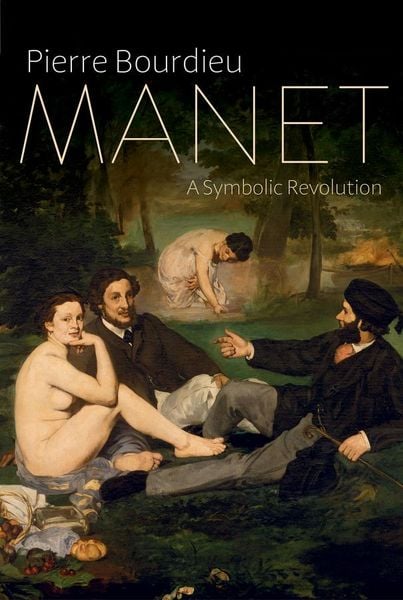
Produktbild: Manet
Band 101

Manet A Symbolic Revolution

Aus der Reihe Miniature

43,99 €

inkl. gesetzl. MwSt., Versandkostenfrei


Beschreibung

Produktdetails

Einband

Gebundene Ausgabe

Erscheinungsdatum

29.09.2017

Verlag

John Wiley & Sons Inc

Seitenzahl

576

Maße (L/B/H)

23,3/15,6/5,5 cm

Gewicht

1134 g

Auflage

1. Auflage

Übersetzt von

Peter Collier + weitere

Sprache

Englisch

ISBN

978-1-5095-0009-3

Beschreibung

Rezension

"When does the publication of a book become an event? When it offers a new perspective that changes our way of thinking and, at the same time, appears at the very moment when it is needed. Manet: A Symbolic Revolution is an event of this kind, an overturning of points of view: a properly subversive and astonishing book."
Libération
 
"These lectures provide the fullest example of what it would take, within Bourdieu's theoretical scheme, to produce a truly sociological explanation of art."
LA Review of Books

Produktdetails

Einband

Gebundene Ausgabe

Erscheinungsdatum

29.09.2017

Verlag

John Wiley & Sons Inc

Seitenzahl

576

Maße (L/B/H)

23,3/15,6/5,5 cm

Gewicht

1134 g

Auflage

1. Auflage

Übersetzt von

  • Peter Collier
  • Margaret Rigaud-Drayton

Sprache

Englisch

ISBN

978-1-5095-0009-3

Herstelleradresse

Libri GmbH
Europaallee 1
36244 Bad Hersfeld
DE

Email: gpsr@libri.de

Kundinnen und Kunden meinen

0 Bewertungen

Informationen zu Bewertungen

Zur Abgabe einer Bewertung ist eine Anmeldung im Konto notwendig. Die Authentizität der Bewertungen wird von uns nicht überprüft. Wir behalten uns vor, Bewertungstexte, die unseren Richtlinien widersprechen, entsprechend zu kürzen oder zu löschen.

Die Bewertungen sind nach Format, Anzahl Sterne und Datum sortiert.

Verfassen Sie die erste Bewertung zu diesem Artikel

Helfen Sie anderen Kund*innen durch Ihre Meinung

Kundinnen und Kunden meinen

0 Bewertungen filtern

Die Leseprobe wird geladen.
  • Produktbild: Manet
  • Acknowledgements

    Editors¿ Note

    Translators¿ Note

    Lectures at the Collège de France 1998-1999: The Manet Effect

    Lecture of 6 January 1999

    Lecture objectives: the symbolic revolution that Manet started Pompier painting Parenthesis: a social problem and a sociological problem State art and avant-garde academicism The mock-revolution Parenthesis on scientific populism An impossible research programme: the space of criticism From the familiar to the scandalous A painting full of incongruity The clash between the noble and the vulgar The affinity between different hierarchies ¿Realism/formalism¿, a false dichotomy.

    Lecture of 13 January 1999

    Question on the revolution in art. The game of the educated guess (¿That makes me think of É¿). Constructing the field of criticism. The effects of the work of art. The ¿intersubjective unconscious¿. The intentionalist theory. Aesthetic transgression and solecisms. The rhetoric of euphemism and the effect of a title. The effects of composition. A symbolic bomb. The rationale of a painting. Using a painting within a painting to question painting. Intention and disposition.

    Lecture of 20 January 1999

    Reply to a question on dialectics. Transgressions of the ethical order. Manet and Monet. The academic eye. Dispositional theory. The philosophy of intention. Intention and disposition. When a habitus come into contact with a space of possibilities. The example of writers. Critique of the notion of sources. The hypothesis of coherence.

    Lecture of 27 January 1999

    Reflexive return to the previous lecture. Pre-constructed objects and technical impeccability. Epistemological breaks and social breaks. The theory of dispositions and scholastic bias. The philosophy of intention and the philosophy of disposition. Critique of genetic criticism. Critique of the iconographic tradition. The hermeneutic posture. Copies, parodies, and pastiches. A very strange exercise. Knowledge through the body.

    Lecture of 3 February 1999

    Replies to two misunderstandings Of the right use of sources Listening to a lecture Internalists and Externalists Youthful works and school exercises The Intelligence of the Body The structural conditions of creation A total social fact An institutional crisis A formalist theory Finishing with the ¿finish¿ of the pompier painters.

    Lecture of 10 February 1999

    Return to a hasty reaction. Limits of the formalist approach. The illusio as metabelief. The trap of dichotomous logics. Questioning the academic system and the historicisation of the work of art. Social history of academic art. Studios as elite schools. Corps and field. The field of publishing.

    Lecture of 17 February 1999

    An academic art. Pompier art, aristocrats and nouveaux riches. The academic aesthetic. An integrated academic institution. Studios and rites of initiation. Portrait of a professor of the Beaux-Arts. On ragging. Consecration and the production of belief. A gradus ad parnassum. The Academy and academic painting. Technical and historical virtuosity. An aesthetic of readability A ¿dehistoricised¿ history. An aesthetic of the finished.

    Lecture of 24 February 1999

    Manet¿s critics. Parenthesis on the line separating the private from the public. Life style and style of the works. The abolition of meaning. The heretics and the orthodox. Nomination. The struggle for monopoly. Exhibition and consecration. The transformation of the school system. The defence of the corps. A crisis of belief. Durkheim¿s morphological model and its limits.

    Lecture of 4 March 1999

    External factors and the logic of fields: the surplus production of diplomas. ¿ The reproduction of differences. ¿ Disciplines and ¿refuge¿ positions. ¿ The weakening of the state monopoly. ¿ The contribution of the public to the revolution. ¿ The sclerosis of the Salon and the generalised crisis of belief. ¿ A comparison of the artistic milieus of Paris and London. ¿ Manet and the Pre-Raphaelites. ¿ Manet seen by Mallarmé.

    Lectures at the Collège de France 1999-2000: Foundations of a Dispositionalist Aesthetic

    Lecture of 12 January 2000

    Doubts and reflexivity. Ð Birth of the artistic field. Ð A commentary of Mallarmé¿s text on Manet. Ð A critique of criticism. Ð The Zola-Manet-Mallarmé paradigm. Ð The inconsistencies of Bar at the Folies-Bergère. Ð Mallarmé on Manet. Ð The structural homology between the artistic and religious fields. Ð Belief and the return to the sources.

    Lecture of 19 January 2000

    Zola and Mallarmé. ¿ Formalism, materialism and symbolism. ¿ ¿Throwing yourself into the water¿ as a philosophy of action. ¿ A practical aesthetic.

    Lecture of 26 January 2000

    A critical look at the previous lecture: the need for a double historicisation. ¿ A parenthesis on art criticism. ¿ Back to Mallarmé¿s article. ¿ Framing to make cutouts out of the world. ¿ A new economy of production. ¿ When two histories meet.

    Lecture of 2 February 2000

    Summary of the previous lecture. ¿ Accounting for artistic forms: the infrastructure/superstructure model. ¿ Models of historical processes. ¿ The approach I take in this lecture: the habitus-field model. ¿ Manet and the challenge to analysis. ¿ Analytical method. ¿ Beyond the continuous/discontinuous alternative.

    Lecture of 9 February 2000

    Breaks v continuity. ¿ The Salon des refusés of 1863. ¿ For a rational form of eclecticism. ¿ The Impressionist break with continuity (1): Impressionism foreshadowed. ¿ The Impressionist break with continuity (2): parody. ¿ The paradox of symbolic revolutionaries. ¿ Accounting for charisma. ¿ Technical factors. ¿ Morphological changes. ¿ Factors linked with demand. ¿ A multifactorial model. ¿ Specificity of the economy of symbolical goods.

    Lecture of 16 February 2000

    The artistic field. ¿ Social transformations and formal transformations. ¿ A parenthesis on being ¿economical¿ with research. ¿ The ¿painter of modern life¿. ¿ The fallacy of the short-circuit. ¿ The gaze in Manet¿s work. ¿ The field as intermediary social space. ¿ Artist societies. ¿ A parenthesis on pseudo-concepts. ¿ Aesthetico-political attitudes and positions in the field of art. ¿ The field of criticism between the literary and the artistic fields. ¿ A revolution in the field of art.

    Lecture of 23 February 2000

    The production of belief. ¿ The usefulness of the notion of field. ¿ The field of criticism: its two dimensions. ¿ Portraits of critics. ¿ How the field of criticism operates. ¿ The principle of competence. ¿ When the notion of field guides the analysis. ¿ Manet, the subject and object of the artistic field.

    Lecture of 1 March 2000

    Mechanistic explanations and structural causality. ¿ Bodily hexis. ¿ Manet¿s cleft habitus. ¿ Manet¿s capital. ¿ The places where Manet accumulated social capital: 1) The Collège Rollin. ¿ 2) The salon of Commandant Lejosne. ¿ 3) The salon held by Manet¿s wife. ¿ 4) The studio of Thomas Couture. ¿ 5) The Louvre Museum. ¿ 6) The cafés and their fashionable bohemian crowd. ¿ 7) Painters¿ studios.

    Lecture of 8 March 2000

    A reminder on my approach. ¿ Art as a ¿pure practice without theory¿. ¿ The author¿s point of view and relationship to the public. ¿ An aesthetic of effects. ¿ Manet understood as a concrete individual. ¿ Form and content. ¿ The Manet effect. ¿ Foils and fulcrums. ¿ Analyses of Manet¿s works.

    Opus Infinitum: Genesis and Structure of a Work Without End (by Christophe Charle)

    Manet the Heresiarch. Genesis of the Artistic and Critical Fields. (Unfinished Manuscript by Pierre and Mari-Christine Bourdieu)

    Introduction

    Chapter 1: Pompier Art as an Academic Universal

    Chapter 2: The Crisis in the Academic Institution

    Chapter 3: Break and Continuity

    Chapter 4: The Field of Criticism and the Artistic Field

    Chapter 5: The Heresiarch and Co.

    Chapter 6: Manet's Aesthetics

    Appendix

    Self-Portrait as a Free Artist: or ¿I Don't Know Why I Am Telling You That¿ (by Pascale Casanova)

    Summaries of the Lectures Published in L'Annuaire du Collège De France

    Notes

    Image Credits

    Index of Paintings Cited

    Index