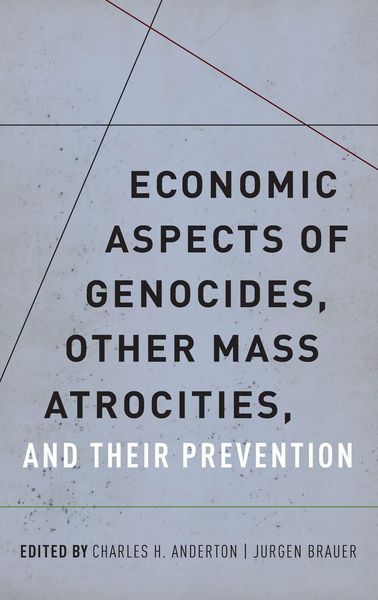
Produktbild: Economic Aspects of Genocides, Other Mass Atrocities, and Their Prevention

Economic Aspects of Genocides, Other Mass Atrocities, and Their Prevention

Aus der Reihe OXFORD UNIV PR

249,99 €

inkl. gesetzl. MwSt., Versandkostenfrei


Beschreibung

Produktdetails

Einband

Gebundene Ausgabe

Erscheinungsdatum

06.06.2016

Herausgeber

Charles H. Anderton + weitere

Verlag

Oxford University Press

Seitenzahl

728

Maße (L/B/H)

23,9/15,7/4,3 cm

Gewicht

1157 g

Sprache

Englisch

ISBN

978-0-19-937829-6

Beschreibung

Produktdetails

Einband

Gebundene Ausgabe

Erscheinungsdatum

06.06.2016

Herausgeber

Verlag

Oxford University Press

Seitenzahl

728

Maße (L/B/H)

23,9/15,7/4,3 cm

Gewicht

1157 g

Sprache

Englisch

ISBN

978-0-19-937829-6

Herstelleradresse

Libri GmbH
Europaallee 1
36244 Bad Hersfeld
DE

Email: gpsr@libri.de

Noch keine Bewertungen vorhanden

Verfassen Sie die erste Bewertung zu diesem Artikel

Helfen Sie anderen Kundinnen und Kunden durch Ihre Meinung.

Kundinnen und Kunden meinen

Bewertungen (0)

Die Leseprobe wird geladen.
  • Produktbild: Economic Aspects of Genocides, Other Mass Atrocities, and Their Prevention
    • PART I - ECONOMICS AND MASS ATROCITIES: OVERVIEW

    • Chapter 1: On the Economics of Genocides, Other Mass Atrocities, and Their Prevention

    • Charles H. Anderton and Jurgen Brauer

    • Chapter 2: "A Crime Without A Name ": Defining Genocide and Mass Atrocity

    • James E. Waller

    • Chapter 3: Datasets and Trends of Genocides, Mass Killings, and Other Civilian Atrocities

    • Charles H. Anderton

    • Chapter 4: The Demography of Genocide

    • Tadeusz Kugler

    • Chapter 5: The Macroeconomic Toll of Genocide and the Sources of Economic Development

    • Dimitrios Soudis, Robert Inklaar, and Robbert Maseland

    • PART II: ECONOMICS AND MASS ATROCITIES: THEORETICAL APPROACHES AND REVIEWS OF EMPIRICAL LITERATURE

    • Chapter 6: Genocide and Mass Killing Risk and Prevention: Perspectives from Constrained Optimization Models

    • Charles H. Anderton and Jurgen Brauer

    • Chapter 7: Incentives and Constraints for Mass Killings: A Game-Theoretic Approach

    • Joan Esteban, Massimo Morelli, and Dominic Rohner

    • Chapter 8: Genocide: From Social Structure to Political Conduct

    • NÃ(c)stor Duch-Brown and Antonio Fonfría

    • Chapter 9: The Microeconomic Causes and Consequences of Genocides and Mass Atrocities

    • Patricia Justino

    • Chapter 10: Development and the Risk of Mass Atrocities: An Assessment of the Empirical Literature

    • Anke Hoeffler

    • Chapter 11: Who Stays and Who Leaves During Mass Atrocities?

    • Ana María Ibáñez and AndrÃ(c)s Moya

    • Chapter 12: Media Persuasion, Ethnic Hatred, and Mass Violence: A Brief Overview of Recent Advances

    • Maria Petrova and David Yanagizawa-Drott

    • PART III - ECONOMICS AND MASS ATROCITIES: CASE STUDIES I

    • Chapter 13: "For Being Aboriginal " - Economic Perspectives on Pre-Holocaust Genocides

    • Jurgen Brauer and Raul Caruso

    • Chapter 14: Identity and Incentives: An Economic Interpretation of the Holocaust

    • Raul Caruso

    • Chapter 15: The Economics of Genocide in Rwanda

    • Willa Friedman

    • Chapter 16: Peace and the Killing: Compatible Logics in the Democratic Republic of the Congo

    • ZoÃ' Marriage

    • Chapter 17: Gender and the Genocidal Economy

    • Elisa von Joeden-Forgey

    • PART IV - ECONOMICS AND MASS ATROCITIES: CASE STUDIES II

    • Chapter 18: On the Logistics of Violence: Evidence from Stalin's Great Terror, Nazi-Occupied Belarus, and Modern African Civil Wars

    • Yuri M. Zhukov

    • Chapter 19: Strategic Atrocities: Civilians under Crossfire - Theory and Evidence from Colombia

    • Juan F. Vargas

    • Chapter 20: From Pax Narcótica to Guerra Pública: Explaining Civilian Violence in Mexico's Illicit Drug Wars

    • Neil T.N. Ferguson, Maren M. Michaelsen, and Topher L. McDougal

    • Chapter 21: Long-Term Economic Development in the Presence of an Episode of Mass Killing: The Case of Indonesia, 1965-1966

    • S. Mansoob Murshed and Mohammad Zulfan Tadjoeddin

    • Chapter 22: Economic Foundations of Religious Killings and Genocide with Special Reference to Pakistan, 1978-2012

    • Partha Gangopadhyay

    • Chapter 23: Understanding Civil War Violence through Military Intelligence: Mining Suspects' Records from the Vietnam War

    • Rex W. Douglass

    • PART V - ECONOMICS AND MASS ATROCITIES: TOWARD PREDICTION AND PREVENTION

    • Chapter 24: Economic Risk Factors and Predictive Modeling of Genocide and Mass Killing

    • Charles R. Butcher and Benjamin E. Goldsmith

    • Chapter 25: Business in Genocide: Understanding and Avoiding Complicity

    • Nora M. Stel and Wim NaudÃ(c)

    • Chapter 26: Valuing Lives You Might Save: Understanding Psychic Numbing in the Face of Genocide

    • Paul Slovic, Daniel Vÿstfjÿll, Robin Gregory, and Kimberly G. Olson

    • Chapter 27: Genocides and Other Mass Atrocities: A Law and Economics Approach

    • Jurgen Brauer, Charles H. Anderton, and David Schap

    • Chapter 28: Local and National Democracy in Political Reconstruction

    • Roger B. Myerson