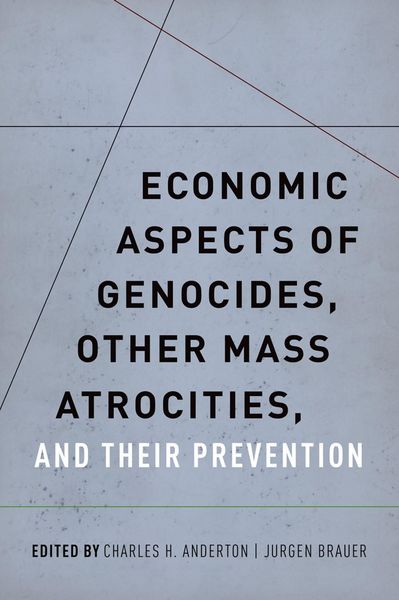
Economic Aspects of Genocides, Other Mass Atrocities, and Their Prevention
-
Form:Einzelkauf Download
-
Sprache:Englisch
-
eBook Format:ePUB
- PDF 126,50 €
- ePUB 126,50 € ausgewählt
126,50 €
inkl. gesetzl. MwSt.Beschreibung
Produktdetails
Format
ePUB
Kopierschutz
Ja
Family Sharing
Nein
Text-to-Speech
Ja
Erscheinungsdatum
09.05.2016
Herausgeber
Charles H. Anderton + weitereVerlag
OUP eBookSeitenzahl
656 (Printausgabe)
Dateigröße
37449 KB
Sprache
Englisch
EAN
9780190606992
Alongside other types of mass atrocities, genocide has received extensive scholarly, policy, and practitioner attention. Missing, however, is the contribution of economists to better understand and prevent such crimes. This edited collection by 41 accomplished scholars examines economic aspects of genocides, other mass atrocities, and their prevention.
Chapters include numerous case studies (e.g., California's Yana people, Australia's Aborigines peoples, Stalin's killing of Ukrainians, Belarus, the Holocaust, Rwanda, DR Congo, Indonesia, Pakistan, Colombia, Mexico's drug wars, and the targeting of suspects during the Vietnam war), probing literature reviews, and completely novel work based on extraordinary country-specific datasets. Also included are chapters on the demographic, gendered, and economic class nature of genocide. Replete with research- and policy-relevant findings, new insights are derived from behavioral economics, law and economics, political economy, macroeconomic modeling, microeconomics, development economics, industrial organization, identity economics, and other fields. Analytical approaches include constrained optimization theory, game theory, and sophisticated statistical work in data-mining, econometrics, and forecasting.
A foremost finding of the book concerns atrocity architects' purposeful, strategic use of violence, often manipulating nonrational proclivities among ordinary people to sway their participation in mass murder. Relatively understudied in the literature, the book also analyzes the options of victims before, during, and after mass violence. Further, the book shows how well-intended prevention efforts can backfire and increase violence, how wrong post-genocide design can entrench vested interests to reinforce exclusion of vulnerable peoples, and how businesses can become complicit in genocide. In addition to the necessity of healthy opportunities in employment, education, and key sectors in prevention work, the book shows why new genocide prevention laws and institutions must be based on reformulated incentives that consider insights from law and economics, behavioral economics, and collective action economics.
Chapters include numerous case studies (e.g., California's Yana people, Australia's Aborigines peoples, Stalin's killing of Ukrainians, Belarus, the Holocaust, Rwanda, DR Congo, Indonesia, Pakistan, Colombia, Mexico's drug wars, and the targeting of suspects during the Vietnam war), probing literature reviews, and completely novel work based on extraordinary country-specific datasets. Also included are chapters on the demographic, gendered, and economic class nature of genocide. Replete with research- and policy-relevant findings, new insights are derived from behavioral economics, law and economics, political economy, macroeconomic modeling, microeconomics, development economics, industrial organization, identity economics, and other fields. Analytical approaches include constrained optimization theory, game theory, and sophisticated statistical work in data-mining, econometrics, and forecasting.
A foremost finding of the book concerns atrocity architects' purposeful, strategic use of violence, often manipulating nonrational proclivities among ordinary people to sway their participation in mass murder. Relatively understudied in the literature, the book also analyzes the options of victims before, during, and after mass violence. Further, the book shows how well-intended prevention efforts can backfire and increase violence, how wrong post-genocide design can entrench vested interests to reinforce exclusion of vulnerable peoples, and how businesses can become complicit in genocide. In addition to the necessity of healthy opportunities in employment, education, and key sectors in prevention work, the book shows why new genocide prevention laws and institutions must be based on reformulated incentives that consider insights from law and economics, behavioral economics, and collective action economics.
Noch keine Bewertungen vorhanden
Verfassen Sie die erste Bewertung zu diesem Artikel
Helfen Sie anderen Kundinnen und Kunden durch Ihre Meinung.
Kurze Frage zu unserer Seite
Vielen Dank für Ihr Feedback
Wir nutzen Ihr Feedback, um unsere Produktseiten zu verbessern. Bitte haben Sie Verständnis, dass wir Ihnen keine Rückmeldung geben können. Falls Sie Kontakt mit uns aufnehmen möchten, können Sie sich aber gerne an unseren Kund*innenservice wenden.
zum Kundenservice