Gutscheinbedingungen

**Gültig bis 17.08.2026 auf Schreibwaren & Office-Artikel online auf thalia.at, in der Thalia App und in teilnehmenden Thalia Buchhandlungen in Österreich mit Schulsortiment. In den Buchhandlungen nur gültig auf lagernde Ware. Einzelne Artikel können ausgeschlossen sein. Ausgenommen sind preisgebundene Artikel. Pro Einkauf einmal einlösbar. Nur gültig gegen Vorlage oder im Onlineshop hinterlegter Bonuscard. Infos zur Einlösung in der Buchhandlung sind auf der Bonuscard-Vorteilspreisseite zu finden. Click & Collect nur bei Onlinevorabzahlung möglich. Keine Einlösung bei Scan & Go-Bezahlung. Keine Barauszahlung. Nicht kombinierbar mit anderen Aktionen und Gutscheinen. Gutschein wird auf max. 500€ Bestellwert angerechnet. Nicht gültig für Geschenkkarten, Versandkosten und Services.

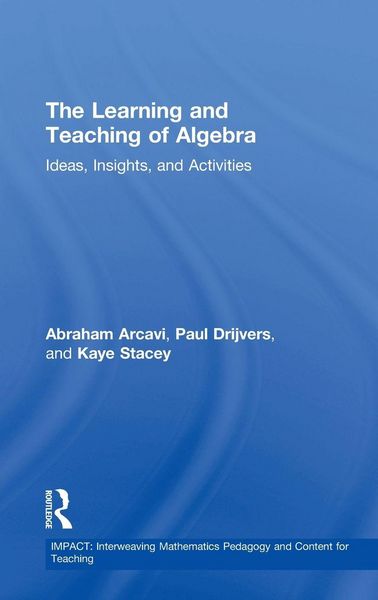
Produktbild: The Learning and Teaching of Algebra

The Learning and Teaching of Algebra Ideas, Insights and Activities

223,99 €

inkl. gesetzl. MwSt., Versandkostenfrei


Beschreibung

Produktdetails

Einband

Gebundene Ausgabe

Erscheinungsdatum

01.07.2016

Verlag

Taylor & Francis

Seitenzahl

144

Maße (L/B/H)

24/16,1/1,3 cm

Gewicht

362 g

Sprache

Englisch

ISBN

978-0-415-74369-3

Beschreibung

Produktdetails

Einband

Gebundene Ausgabe

Erscheinungsdatum

01.07.2016

Verlag

Taylor & Francis

Seitenzahl

144

Maße (L/B/H)

24/16,1/1,3 cm

Gewicht

362 g

Sprache

Englisch

ISBN

978-0-415-74369-3

Herstelleradresse

Libri GmbH
Europaallee 1
36244 Bad Hersfeld
DE

Email: gpsr@libri.de

Noch keine Bewertungen vorhanden

Verfassen Sie die erste Bewertung zu diesem Artikel

Helfen Sie anderen Kundinnen und Kunden durch Ihre Meinung.

Kundinnen und Kunden meinen

Bewertungen (0)

Die Leseprobe wird geladen.
  • Produktbild: The Learning and Teaching of Algebra
  • Preface

    1. Algebra – Setting the scene

    1.1 Introduction

    1.2 Algebra – Aims, actions and entities

    1.2.1 Aims

    1.2.2 Actions

    1.2.3 Entities

    1.3 Why Algebra?

    1.4 Chapter Summary

    1.5 Thinking further

    1.6 References

    2. Some lessons from history

    2.1 Introduction

    2.2 Linear equations in ancient Egypt

    2.3 Quadratic equations in ancient Babylonia

    2.4 A geometric view of algebra from Arabic mathematics

    2.5 Beyond solving equations: The emergence of algebra in Europe

    2.5.1 Some algebraic rules and their explanation

    2.5.2 Negative numbers

    2.6 Chapter summary

    2.7 Thinking further

    2.8 References

    3. Seeing algebra through the eyes of a learner

    3.1 Introduction – putting on teachers’ bifocal spectacles

    3.2 What do algebraic letters represent?

    3.2.1 Fruit salad algebra – misleading teaching with long term consequences

    3.3 The process-object duality

    3.4 The meaning of the equals sign

    3.5 Algebra for recording and revealing mathematical structure

    3.6 Transitions from arithmetic to algebra

    3.6.1 Contrasting arithmetic and algebraic problem solving

    3.6.2 Fundamental ideas of equation solving

    3.6.3 Algebra and creativity

    3.7 The procedures of equation solving

    3.7.1 Process-object distinction in solving simultaneous equations

    3.8 Functions as processes and objects

    3.9 Chapter Summary

    3.10 Thinking Further

    3.11 References

    Chapter 4: Emphases in algebra teaching

    4.1 Introduction

    4.2 Teaching algebra in context

    4.3 Productive practice

    4.4 The reconciliation of routine and insight

    4.5 Exploiting student mistakes

    4.6 Proofs in algebra teaching

    4.7 Chapter summary

    4.8 Thinking further

    4.9 References

    5. Algebra education in the digital era

    5.1 Introduction

    5.2 Digital tools for algebra

    5.2.1 Algebraic functionality of digital tools

    5.2.2 Pedagogical roles of digital tools for algebra

    5.3 Core algebra entities with digital means

    5.3.1 Variable

    5.3.2 Equation and equivalence

    5.3.3 Function

    5.4 Teaching and learning algebra with digital means

    5.5 Chapter summary

    5.6 Thinking further

    5.7 References

    Epilogue