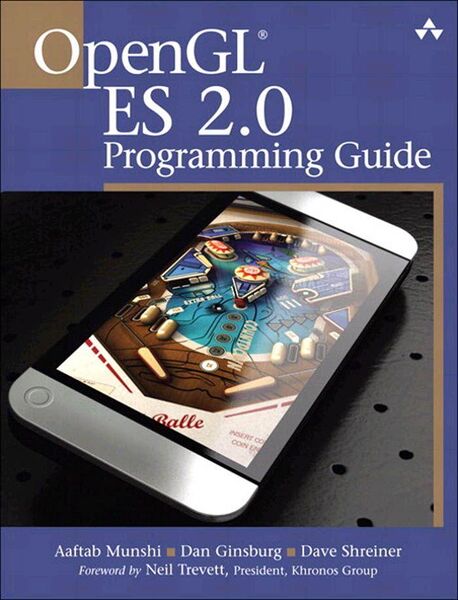
OpenGL ES 2.0 Programming Guide
-
- Einzelkauf Download ausgewählt
-
Sprache:Englisch
-
eBook Format:PDF
- PDF 41,70 € ausgewählt
- ePUB 60,20 €
41,70 €
inkl. gesetzl. MwSt.Beschreibung
Produktdetails
Format
Kopierschutz
Nein
Family Sharing
Nein
Text-to-Speech
Nein
Altersempfehlung
18 - 67 Jahr(e)
Erscheinungsdatum
16.07.2008
Verlag
Pearson ITPSeitenzahl
464 (Printausgabe)
Dateigröße
4776 KB
Auflage
1. Auflage
Sprache
Englisch
EAN
9780321572684
This is the eBook version of the printed book. If the print book includes a CD-ROM, this content is not included within the eBook version.
OpenGL ES 2.0 is the industry's leading software interface and graphics library for rendering sophisticated 3D graphics on handheld and embedded devices. With OpenGL ES 2.0, the full programmability of shaders is now available on small and portable devices-including cell phones, PDAs, consoles, appliances, and vehicles. However, OpenGL ES differs significantly from OpenGL. Graphics programmers and mobile developers have had very little information about it-until now.In the OpenGL® ES 2.0 Programming Guide, three leading authorities on the Open GL ES 2.0 interface-including the specification's editor-provide start-to-finish guidance for maximizing the interface's value in a wide range of high-performance applications. The authors cover the entire API, including Khronos-ratified extensions. Using detailed C-based code examples, they demonstrate how to set up and program every aspect of the graphics pipeline. You'll move from introductory techniques all the way to advanced per-pixel lighting, particle systems, and performance optimization.
Coverage includes:
- Shaders in depth: creating shader objects, compiling shaders, checking for compile errors, attaching shader objects to program objects, and linking final program objects
- The OpenGL ES Shading Language: variables, types, constructors, structures, arrays, attributes, uniforms, varyings, precision qualifiers, and invariance
- Inputting geometry into the graphics pipeline, and assembling geometry into primitives
- Vertex shaders, their special variables, and their use in per-vertex lighting, skinning, and other applications
- Using fragment shaders-including examples of multitexturing, fog, alpha test, and user clip planes
- Fragment operations: scissor test, stencil test, depth test, multisampling, blending, and dithering
- Advanced rendering: per-pixel lighting with normal maps, environment mapping, particle systems, image post-processing, and projective texturing
- Real-world programming challenges: platform diversity, C++ portability, OpenKODE, and platform-specific shader binaries
Noch keine Bewertungen vorhanden
Verfassen Sie die erste Bewertung zu diesem Artikel
Helfen Sie anderen Kundinnen und Kunden durch Ihre Meinung.
Kurze Frage zu unserer Seite
Vielen Dank für Ihr Feedback
Wir nutzen Ihr Feedback, um unsere Produktseiten zu verbessern. Bitte haben Sie Verständnis, dass wir Ihnen keine Rückmeldung geben können. Falls Sie Kontakt mit uns aufnehmen möchten, können Sie sich aber gerne an unseren Kund*innenservice wenden.
zum Kundenservice