Gutscheinbedingungen

**Gültig nur für Bestellungen an die Wunsch-Poststation bis 10.06.2026 auf Spielzeug, Schreibwaren, Filme, Geschenke & Trends, Musik, tolino eReader & Zubehör, Hörbücher und Hörbuch-Downloads (außer Abo), nicht preisgebundene Bücher und Kalender online auf thalia.at und in der Thalia App. Einzelne Artikel können ausgeschlossen sein. Aufgrund der Buchpreisbindung sind deutschsprachige Bücher und eBooks ausgenommen. Zusätzlich ausgenommen sind preisgebundene Artikel, Abos & Flatrates, eBooks, Games, Geschenkkarten/-boxen, Shelfies, Software, Zeitschriften sowie einzelne Artikel von tonies®. Pro Einkauf einmal einlösbar. Kein Click & Collect möglich. Keine Barauszahlung. Nicht kombinierbar mit anderen Aktionen und Gutscheinen. Gutschein wird auf max. 500€ Bestellwert angerechnet. Nicht gültig für Versandkosten und Services.

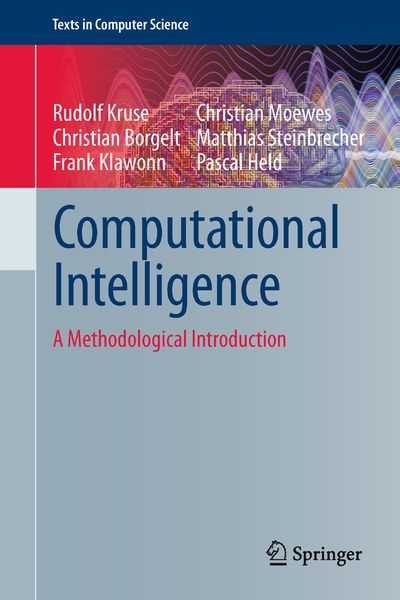
  • Produktbild: Computational Intelligence
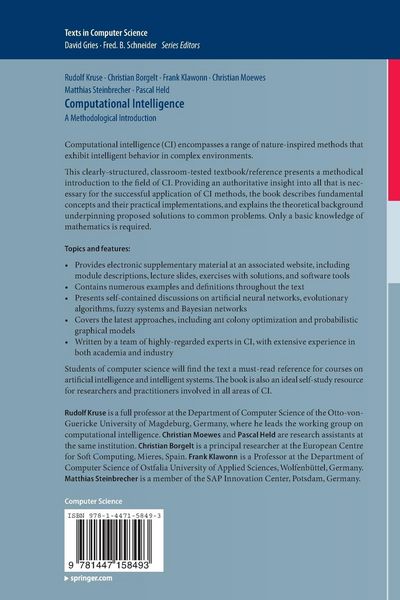
  • Produktbild: Computational Intelligence

Computational Intelligence A Methodological Introduction

59,99 €

inkl. gesetzl. MwSt., Versandkostenfrei


Beschreibung

Produktdetails

Einband

Taschenbuch

Erscheinungsdatum

08.02.2015

Verlag

Springer London

Seitenzahl

492

Maße (L/B/H)

23,5/15,5/2,8 cm

Gewicht

756 g

Auflage

2013

Sprache

Englisch

ISBN

978-1-4471-5849-3

Beschreibung

Rezension

From the reviews:

“This book teaches computational intelligence (CI) in a thorough, methodological manner that is theoretically profound and educationally oriented. … this book is well designed for the independent student who wishes to learn the fundamentals of CI without the need for an instructor. The organization and thorough step-by-step methodology makes it an excellent startup guide for someone who wants to learn CI … . This book is targeted at beginners, students, or professionals who wish to understand CI.” (Mario Antoine Aoun, Computing Reviews, February, 2014)

“The book under review is a textbook that features sub-symbolic approaches developed within the field of Artificial Intelligence … . It can be used as a companion book for lectures, with exercises and slides to be found on the book’s website. With its focus on sub-symbolic approaches, it presents a comprehensive and detailled source of information complementary to other commonly used textbooks in Artificial Intelligence that mostly focus on symbolic approaches.” (Jana Köhler, zbMATH, Vol. 1283, 2014)

“The book is a comprehensive treatise on computational intelligence with a focus on the underlying methodology and algorithms. … The reader can enjoy a comprehensive and systematically arranged exposure of the material. … The references following each chapter can serve as a list of introductory readings on the individual areas of computational intelligence. … the reader gains a good sense of computational intelligence as an important endeavor supporting analysis and synthesis of intelligent systems. … a useful compendium of knowledge for a broad audience.” (Witold Pedrycz, Mathematical Reviews, November, 2013)

Produktdetails

Einband

Taschenbuch

Erscheinungsdatum

08.02.2015

Verlag

Springer London

Seitenzahl

492

Maße (L/B/H)

23,5/15,5/2,8 cm

Gewicht

756 g

Auflage

2013

Sprache

Englisch

ISBN

978-1-4471-5849-3

Herstelleradresse

Springer-Verlag KG
Sachsenplatz 4-6
1201 Wien
AT

Email: ProductSafety@springernature.com

Kundinnen und Kunden meinen

0 Bewertungen

Informationen zu Bewertungen

Zur Abgabe einer Bewertung ist eine Anmeldung im Konto notwendig. Die Authentizität der Bewertungen wird von uns nicht überprüft. Wir behalten uns vor, Bewertungstexte, die unseren Richtlinien widersprechen, entsprechend zu kürzen oder zu löschen.

Die Bewertungen sind nach Format, Anzahl Sterne und Datum sortiert.

Verfassen Sie die erste Bewertung zu diesem Artikel

Helfen Sie anderen Kund*innen durch Ihre Meinung

Kundinnen und Kunden meinen

0 Bewertungen filtern

  • Produktbild: Computational Intelligence
  • Produktbild: Computational Intelligence
  • Introduction

    Part I: Neural Networks

    Introduction

    Threshold Logic Units

    General Neural Networks

    Multi-Layer Perceptrons

    Radial Basis Function Networks

    Self-Organizing Maps

    Hopfield Networks

    Recurrent Networks

    Mathematical Remarks

    Part II: Evolutionary Algorithms

    Introduction to Evolutionary Algorithms

    Elements of Evolutionary Algorithms

    Fundamental Evolutionary Algorithms

    Special Applications and Techniques

    Part III: Fuzzy Systems

    Fuzzy Sets and Fuzzy Logic

    The Extension Principle

    Fuzzy Relations

    Similarity Relations

    Fuzzy Control

    Fuzzy Clustering

    Part IV: Bayes Networks

    Introduction to Bayes Networks

    Elements of Probability and Graph Theory

    Decompositions

    Evidence Propagation

    Learning Graphical Models