KI-Beratung Beta

Gutscheinbedingungen

**Gültig am 20.11.2026 ab einem Mindestbestellwert von 30€ auf Spielzeug, Schreibwaren, Filme, Geschenke & Trends, Musik, tolino eReader & Zubehör, Hörbücher und Hörbuch-Downloads, nicht preisgebundene Bücher und Kalender online auf thalia.at und in der Thalia App. Einzelne Artikel können ausgeschlossen sein. Aufgrund der Buchpreisbindung sind deutschsprachige Bücher und eBooks ausgenommen. Zusätzlich ausgenommen sind Abos & Flatrates, Games, Geschenkkarten/-boxen, Shelfies, Software, Zeitschriften sowie einzelne Artikel von tonies®. Pro Einkauf einmal einlösbar. Click & Collect nur bei Onlinevorabzahlung möglich. Keine Barauszahlung. Nicht kombinierbar mit anderen Aktionen und Gutscheinen. Gutschein wird auf max. 500€ Bestellwert angerechnet. Nicht gültig für Versandkosten und Services. Preisgebundene Artikel sind vom Mindestbestellwert ausgeschlossen.

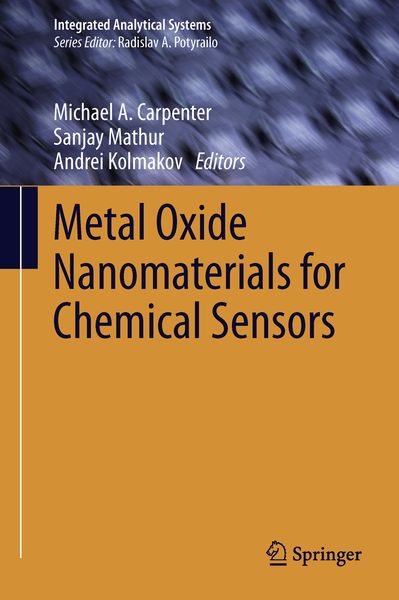
  • Produktbild: Metal Oxide Nanomaterials for Chemical Sensors
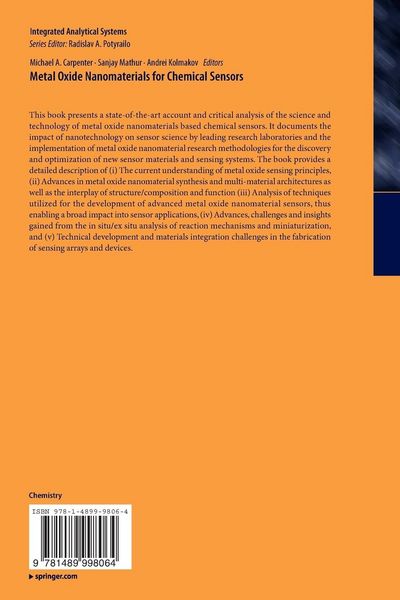
  • Produktbild: Metal Oxide Nanomaterials for Chemical Sensors

Metal Oxide Nanomaterials for Chemical Sensors

144,99 €

inkl. gesetzl. MwSt., Versandkostenfrei


Beschreibung

This book presents a state-of-the-art summary and critical analysis of work recently performed in leading research laboratories around the world on the implementation of metal oxide nanomaterial research methodologies for the discovery and optimization of new sensor materials and sensing systems. The...

Beschreibung

This book presents a state-of-the-art summary and critical analysis of work recently performed in leading research laboratories around the world on the implementation of metal oxide nanomaterial research methodologies for the discovery and optimization of new sensor materials and sensing systems. The book provides a detailed description and analysis of (i) metal oxide nanomaterial sensing principles, (ii) advances in metal oxide nanomaterial synthesis/deposition methods, including colloidal, emulsification, and vapor processing techniques, (iii) analysis of techniques utilized for the development of low temperature metal oxide nanomaterial sensors, thus enabling a broader impact into sensor applications, (iv) advances, challenges and insights gained from the in situ/ex situ analysis of reaction mechanisms, and (v) technical development and integration challenges in the fabrication of sensing arrays and devices.

Rezension

From the reviews:

“Metal Oxide Nanomaterials for Chemical Sensors is a monograph that presents the state of the art in the application of metal oxide nanostructured materials for chemical sensing. The text can be described as the result of the intersection between materials science, surface science, and analytical science, so it can be considered highly recommendable for a broad readership, including academic and industrial researchers in such fields.” (Antonio Doménech-Carbó, Analytical and Bioanalytical Chemistry, Vol. 405, 2013)

Portrait


Michael A. Carpenter is an associate professor at the College of Nanoscale Science and Engineering at the University at Albany-SUNY.

Sanjay Mathur is the Chair of Inorganic and Materials Chemistry at the University of Cologne.

Andrei Kolmakov is an associate professor of physics at Southern Illinois University.

Produktdetails

Einband

Taschenbuch

Erscheinungsdatum

13.12.2014

Abbildungen

XX, 548 p.

Herausgeber Michael A. Carpenter + weitere

Produktdetails

Einband

Taschenbuch

Erscheinungsdatum

13.12.2014

Abbildungen

XX, 548 p.

Herausgeber
Verlag Springer Us
Seitenzahl

548

Maße (L/B/H)

23,5/15,5/3,1 cm

Gewicht

850 g

Sprache

Englisch

ISBN

978-1-4899-9806-4

Herstelleradresse

Springer-Verlag KG
Sachsenplatz 4-6
1201 Wien
AT

Email: ProductSafety@springernature.com

Noch keine Bewertungen vorhanden

Verfassen Sie die erste Bewertung zu diesem Artikel

Helfen Sie anderen Kundinnen und Kunden durch Ihre Meinung.

Kundinnen und Kunden meinen

Bewertungen (0)

  • Produktbild: Metal Oxide Nanomaterials for Chemical Sensors
  • Produktbild: Metal Oxide Nanomaterials for Chemical Sensors
  • Introduction.- Understanding, characterization and synthesis of modern metal oxide nanomaterials.- Novel morphologies and signal transduction principles in metal oxide based sensors.- New device architectures and integration challenges.- Concluding remarks and outlook.