KI-Beratung Beta

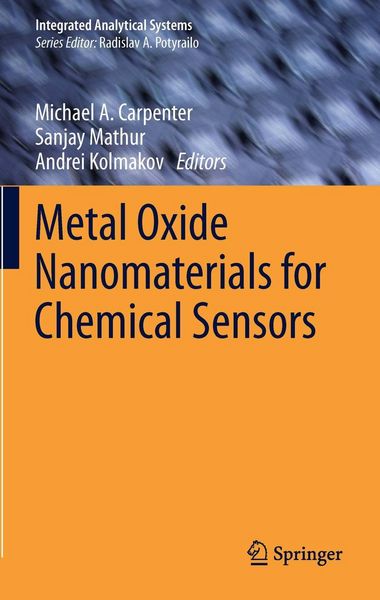
Produktbild: Metal Oxide Nanomaterials for Chemical Sensors

Metal Oxide Nanomaterials for Chemical Sensors

153,99 €

inkl. gesetzl. MwSt.

Beschreibung

This book presents a state-of-the-art summary and critical analysis of work recently performed in leading research laboratories around the world on the implementation of metal oxide nanomaterial research methodologies for the discovery and optimization of new sensor materials and sensing systems. The...

Beschreibung

This book presents a state-of-the-art summary and critical analysis of work recently performed in leading research laboratories around the world on the implementation of metal oxide nanomaterial research methodologies for the discovery and optimization of new sensor materials and sensing systems. The book provides a detailed description and analysis of (i) metal oxide nanomaterial sensing principles, (ii) advances in metal oxide nanomaterial synthesis/deposition methods, including colloidal, emulsification, and vapor processing techniques, (iii) analysis of techniques utilized for the development of low temperature metal oxide nanomaterial sensors, thus enabling a broader impact into sensor applications, (iv) advances, challenges and insights gained from the in situ/ex situ analysis of reaction mechanisms, and (v) technical development and integration challenges in the fabrication of sensing arrays and devices.

Rezension

From the reviews:

“Metal Oxide Nanomaterials for Chemical Sensors is a monograph that presents the state of the art in the application of metal oxide nanostructured materials for chemical sensing. The text can be described as the result of the intersection between materials science, surface science, and analytical science, so it can be considered highly recommendable for a broad readership, including academic and industrial researchers in such fields.” (Antonio Doménech-Carbó, Analytical and Bioanalytical Chemistry, Vol. 405, 2013)

Portrait

Michael A. Carpenter is an associate professor at the College of Nanoscale Science and Engineering at the University at Albany-SUNY.Sanjay Mathur is the Chair of Inorganic and Materials Chemistry at the University of Cologne.Andrei Kolmakov is an associate professor of physics at Southern Illinois University.

Produktdetails

Format

PDF

Kopierschutz

Nein

Family Sharing

Nein

Text-to-Speech

Nein

Produktdetails

Format

PDF

Format

eBooks im PDF-Format haben eine festgelegte Seitengröße und eignen sich daher nur bedingt zum Lesen auf einem tolino eReader oder Smartphone. Für den vollen Lesegenuss empfehlen wir Ihnen bei PDF-eBooks die Verwendung eines Tablets oder Computers.

Kopierschutz

Nein

Kopierschutz

Dieses eBook können Sie uneingeschränkt auf allen Geräten der tolino Familie, allen sonstigen eReadern und am PC lesen. Das eBook ist nicht kopiergeschützt und kann ein personalisiertes Wasserzeichen enthalten. Weitere Hinweise zum Lesen von eBooks mit einem personalisierten Wasserzeichen finden Sie unter Hilfe/Downloads.

Family Sharing

Nein

Family Sharing

Mit Family Sharing können Sie eBooks innerhalb Ihrer Familie (max. sechs Mitglieder im gleichen Haushalt) teilen. Sie entscheiden selbst, welches Buch Sie mit welchem Familienmitglied teilen möchten. Auch das parallele Lesen durch verschiedene Familienmitglieder ist durch Family Sharing möglich. Um eBooks zu teilen oder geteilt zu bekommen, muss jedes Familienmitglied ein Konto bei Thalia oder einem anderen tolino-Buchhändler haben. Weitere Informationen finden Sie unter Hilfe/Family-Sharing.

Text-to-Speech

Nein

Text-to-Speech

Bedeutet Ihnen Stimme mehr als Text? Mit der Funktion Text-to-Speech können Sie sich im tolino webReader und in der aktuellen Thalia – Lesen & Hören App das eBook vorlesen lassen. Weitere Informationen finden Sie unter Hilfe/Text-to-Speech.

Erscheinungsdatum

09.11.2012

Herausgeber
Verlag Springer Us
Seitenzahl

548 (Printausgabe)

Dateigröße

22988 KB

Sprache

Englisch

EAN

9781461453956

Barrierefreiheit
  • keine Information zur Barrierefreiheit bekannt

Noch keine Bewertungen vorhanden

Verfassen Sie die erste Bewertung zu diesem Artikel

Helfen Sie anderen Kundinnen und Kunden durch Ihre Meinung.

Kundinnen und Kunden meinen

Bewertungen (0)

Weitere Artikel finden Sie in

  • Produktbild: Metal Oxide Nanomaterials for Chemical Sensors
  • Preface A) Introduction B) Understanding, characterization and synthesis of modern metal oxide nanomaterials. 1. Insights into the mechanism of gas sensor operation 2. Surface science studies of metal oxide gas sensing materials 3. Design, synthesis and application of metal oxide based sensing elements: A chemical principles approach 4. Combinatorial approaches for synthsis of metal oxides: Processing and sensing application 5. Selective crystal structure synthesis and sensing dependencies 6. Synthesis of metal oxide nanomaterials for chemical sensors by molecular beam epitaxy 7. Atomic layer deposition of metal oxide nanomaterials 8. Microwarve synthesis of metal oxide nanoparticles C) Novel morphologies and signal transduction principles in metal oxide baseds sensors 9. Metal oxide nanowires: Fundamentals and sensor applications 10. ZnO nanowires for gas and bio-chemical sensing 11. Metal oxide nanowire sensors with complex morphologies and compositions 12. Optical sensing methods for metal oxide nanomaterials D) New device architectures and integration challenges 13. Metal oxide nano-architectures and heterostructures for chemical sensors 14. Evaluation of metal oxide nanowire materials with temperature controlled microsensor substrates 15. Multisensor micro-arrays based on metal oxide nanowires for electronic nose applications 16. Microhotplates and integration with metal oxide nanomaterials E) Concluding remarks and outlook