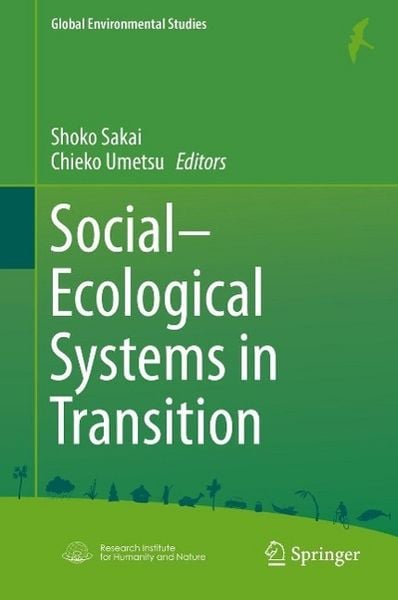
Social-Ecological Systems in Transition
Aus der Reihe
Global Environmental Studies
-
- Hardcover
- Taschenbuch
- eBook ausgewählt
-
Form:Einzelkauf Download
-
Sprache:Englisch
98,99 €
inkl. gesetzl. MwSt.Beschreibung
Produktdetails
Format
Kopierschutz
Nein
Family Sharing
Nein
Text-to-Speech
Nein
Erscheinungsdatum
12.08.2014
Herausgeber
Shoko Sakai + weitereVerlag
Springer JapanSeitenzahl
198 (Printausgabe)
Dateigröße
7090 KB
Sprache
Englisch
EAN
9784431549109
This book presents an overview of current knowledge about social-ecological systems (SESs), a productive new field dedicated to understanding the relationships between human society and nature. To make the reader aware of how SESs are necessary to maintain our society, the book begins with a broad perspective about what social-ecological systems are and what the related research issues in this field are as well. The second part discusses how human activities have changed ecosystems from temperate grasslands to tropical areas. The third part focuses on the adaptability of societies to unpredictable fluctuation in ecosystems, while the last part summarizes factors for the resilience of society against social and ecological shocks. Human activities have severely degraded most natural ecosystems, which are now in critical condition. Various approaches have been developed to improve the SESs, to understand environmental problems and explore better ways to increase the sustainability both of ecosystems and of human societies. However, a clear perspective on how to address such problems is still lacking. Part of the difficulty arises because of the diversity and complexity of ecosystems and human societies. Another important factor is the effect of extremely rapid changes in the social and economic characteristics of social-ecological systems. Consequently, adaptability and resilience clearly are essential for the sustainability of SESs. Although there is no one, direct method to achieve high adaptability and resilience, a possible way is to compare and understand the diverse problems associated with differing social-ecological systems. This published work makes a useful contribution to a greater understanding of the way that essential social responses linked to changes in ecosystems can potentially stimulate further research on this important and interesting subject. The book will attract the attention of scholars in environmental sciences, ecology, andsociology, and indeed of anyone interested in the concept of social-ecological systems.
Noch keine Bewertungen vorhanden
Verfassen Sie die erste Bewertung zu diesem Artikel
Helfen Sie anderen Kundinnen und Kunden durch Ihre Meinung.
Kurze Frage zu unserer Seite
Vielen Dank für Ihr Feedback
Wir nutzen Ihr Feedback, um unsere Produktseiten zu verbessern. Bitte haben Sie Verständnis, dass wir Ihnen keine Rückmeldung geben können. Falls Sie Kontakt mit uns aufnehmen möchten, können Sie sich aber gerne an unseren Kund*innenservice wenden.
zum Kundenservice