Gutscheinbedingungen

**Gültig am 28.09.2026 auf fremdsprachige Bücher online auf thalia.at und in der Thalia App. Einzelne Artikel können ausgeschlossen sein. Ausgenommen sind preisgebundene Artikel & eBooks. Pro Einkauf einmal einlösbar. Click & Collect nur bei Onlinevorabzahlung möglich. Keine Barauszahlung. Nicht kombinierbar mit anderen Aktionen und Gutscheinen. Gutschein wird auf max. 500€ Bestellwert angerechnet. Nicht gültig für Geschenkkarten, Versandkosten und Services.

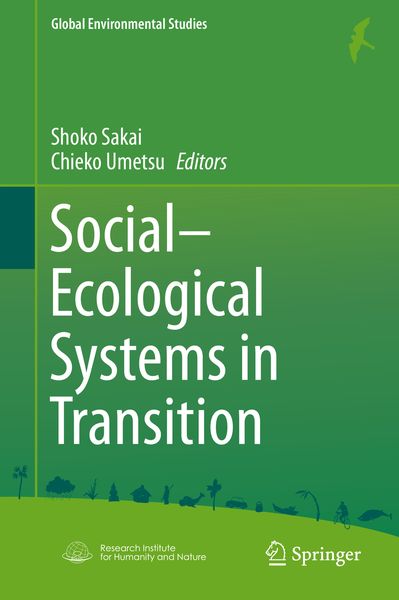
  • Produktbild: Social-Ecological Systems in Transition
  • Produktbild: Social-Ecological Systems in Transition
- 12%

Social-Ecological Systems in Transition

12% sparen

95,99 € UVP 109,99 €

inkl. gesetzl. MwSt., Versandkostenfrei


Beschreibung

Produktdetails

Einband

Gebundene Ausgabe

Erscheinungsdatum

22.08.2014

Abbildungen

XI, 198 p. 75 illus., 36 illus. in color.

Herausgeber

Shoko Sakai + weitere

Verlag

Springer Tokyo

Seitenzahl

198

Maße (L/B/H)

24,1/16/1,8 cm

Gewicht

489 g

Auflage

1. Auflage

Sprache

Englisch

ISBN

978-4-431-54909-3

Beschreibung

Portrait

Shoko SAKAI (Associate Professor, Research Institute for Humanity and Nature) She started her academic career in botany and ecology. She conducted several research projects on plant reproduction and plant-animal interactions in the tropical forests of Borneo and Panama. In recent years, her interests have broadened to include interactions between ecosystems and human societies. She was an associate professor at Center for Ecological Research, Kyoto University from 2004 to 2008 and started to work at RIHN since 2008. She is a leader of the RIHN project “Collapse and restoration Ecosystem Network under human activity”. She is an coeditor of the book “Pollination ecology and forest canopy: Sarawak studies” published from Springer, NY in 2005. Chieko Umetsu (Professor, Nagasaki University) She received her M.A. from the International University of Japan and Ph.D. degree from the University of Hawaii at Manoa, Honolulu, U.S.A. Her publication includes “Basinwide Water Management: A Spatial Model” in Journal of Environmental Economics and Management (2003) with Ujjayant Chakravorty, and “Efficiency and Technical Change in the Philippine Rice Sector: A Malmquist Total Factor Productivity Analysis” in American Journal of Agricultural Economics (2003) with Thamana Lekprichakul and Ujjayant Chakravorty;“Water Allocation Under Distribution Losses: Comparing Alternative Institutions” in Journal of Economic Dynamics and Control (2009) with Ujjayant Chakravorty, Eithan Hochman and David Zilberman. At RIHN, she was a project leader of “Vulnerability and Resilience of Social-Ecological Systems" and conducts research in drought-prone Southern Zambia.

Produktdetails

Einband

Gebundene Ausgabe

Erscheinungsdatum

22.08.2014

Abbildungen

XI, 198 p. 75 illus., 36 illus. in color.

Herausgeber

Verlag

Springer Tokyo

Seitenzahl

198

Maße (L/B/H)

24,1/16/1,8 cm

Gewicht

489 g

Auflage

1. Auflage

Sprache

Englisch

ISBN

978-4-431-54909-3

Herstelleradresse

Springer-Verlag KG
Sachsenplatz 4-6
1201 Wien
AT

Email: ProductSafety@springernature.com

Noch keine Bewertungen vorhanden

Verfassen Sie die erste Bewertung zu diesem Artikel

Helfen Sie anderen Kundinnen und Kunden durch Ihre Meinung.

Kundinnen und Kunden meinen

Bewertungen (0)

Die Leseprobe wird geladen.
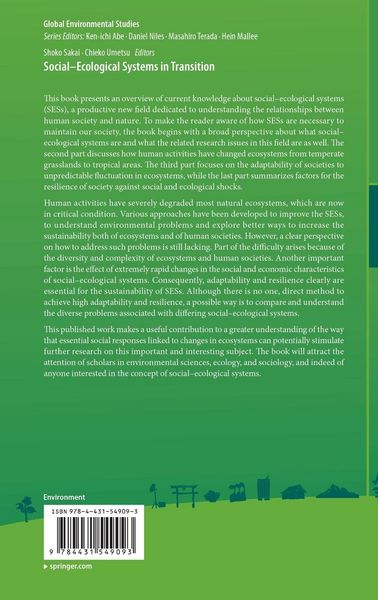
  • Produktbild: Social-Ecological Systems in Transition
  • Produktbild: Social-Ecological Systems in Transition
  • Section 1: Frameworks and concepts1. Theoretical frameworks for the analysis of social-ecological systemsGraeme S. CUMMING (University of Cape Town)Section 2: Ecosystem under human activities2. The recovery of biodiversity after swidden cultivation in the tropical rainforests of Malaysian BorneoTakenaka Kohei TAKANO (RIHN), et al.3. Mongolian nomadism and the relationship among livestock grazing, pasture vegetation, and soil alkalizationRyosuke KODA (RIHN)4. Plant diversity and productivity of Mongolian nomadic pasture in relation to land useNoboru FUJITA (RIHN), Erdenegerel ARIUNBOLD (Institute of Geoecology, Mongolian Academy of Science, Mongolia)5. Reshaping neighborhood parks for biodiversity and people: A case of Unsung Socio-Ecological Systems in Bangalore, IndiaM. Soubadra DEVY (Ashoka Trust for Research in Ecology and the Environment (ATREE), India)Section 3: Adaptation to unpredictability6. Quantitative predictions for ecological and economic sustainability in Mongolian pastoral systems Satoshi TATO (RIHN)7. Trajectories of adaptation: A retrospectus for future dynamicsDonald R. NELSON (University of Georgia) and Timothy J. FINAN (University of Arizona)Section 4: Resilience of social systems8. Ingredients for social-ecological resilience, poverty traps and adaptive social protection in Semi-Arid AfricaPetra TSCHAKERT (Department of Geography, Pennsylvania State University), Jen SHAFFER (Earth and Environmental Systems Institute, Pennsylvania State University)9. Dynamics of social-ecological systems: the case of farmers’ food securityin the semi-arid tropicsChieko UMETSU, Thamana LEKPRICHAKUL, Hidetoshi MIYAZAKI, Yudai ISHIMOTO (RIHN)