KI-Beratung Beta

Gutscheinbedingungen

**Gültig am 27.11.2026 auf Spielzeug, Schreibwaren, Filme, Geschenke & Trends, Musik, tolino eReader & Zubehör, Hörbücher und Hörbuch-Downloads, nicht preisgebundene Bücher und Kalender online auf thalia.at und in der Thalia App. Einzelne Artikel können ausgeschlossen sein. Aufgrund der Buchpreisbindung sind deutschsprachige Bücher und eBooks ausgenommen. Zusätzlich ausgenommen sind Abos & Flatrates, Games, Geschenkkarten/-boxen, Shelfies, Software, Zeitschriften sowie einzelne Artikel von tonies®. Pro Einkauf einmal einlösbar. Click & Collect nur bei Onlinevorabzahlung möglich. Keine Barauszahlung. Nicht kombinierbar mit anderen Aktionen und Gutscheinen. Gutschein wird auf max. 500€ Bestellwert angerechnet. Nicht gültig für Versandkosten und Services.

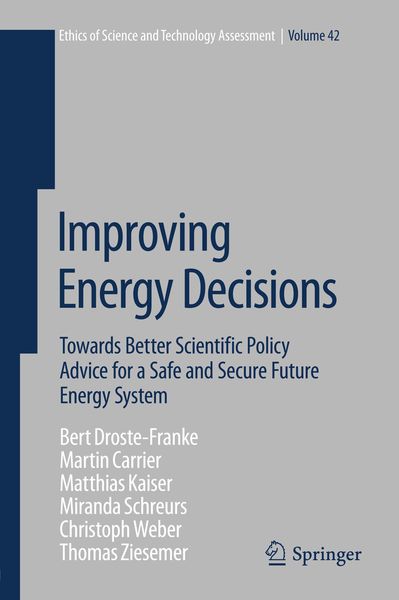
Produktbild: Improving Energy Decisions
Band 42

Improving Energy Decisions Towards Better Scientific Policy Advice for a Safe and Secure Future Energy System

108,99 €

inkl. gesetzl. MwSt., Versandkostenfrei


Beschreibung

Managing a successful transition of the current energy supply system to less carbon emitting options, ensuring a safe and secure supply during the whole process and in the long term, is one of the largest challenges of our time. Various approaches and first implementations show that it is not only technological...

Beschreibung

Managing a successful transition of the current energy supply system to less carbon emitting options, ensuring a safe and secure supply during the whole process and in the long term, is one of the largest challenges of our time. Various approaches and first implementations show that it is not only technological issue, but also a matter of societal acceptance and acceptability, considering basic ethic values of the society.
The main foci of the book are, thus, to develop an understanding about the specific challenges of the scientific policy advice in the area, to explore typical current approaches for the analysis of future energy systems and to develop criteria for the quality assessment and guidelines for the improvement of such studies.
The book provides assistance to the interpretation of existing studies and guidelines for setting up and carrying out new analyses as well as for communicating and applying the results. Thereby, it aims to support the involved actors such as the respective scientific experts and researchers as well as decision makers, energy suppliers, stakeholders and the interested public in designing procedures for a successful transition process. The study elaborates consistent interdisciplinary advice as contribution for realising a continuously safe and secure, long-term viable energy supply in spite of diverse interests, multi-level responsibilities, multi-dimensional processes, large uncertainties and lack of knowledge about future developments.

Produktdetails

Einband

Gebundene Ausgabe

Erscheinungsdatum

11.11.2014

Abbildungen

XLIII, 257 p. 31 illus., 12 illus. in color.

Verlag Springer

Produktdetails

Einband

Gebundene Ausgabe

Erscheinungsdatum

11.11.2014

Abbildungen

XLIII, 257 p. 31 illus., 12 illus. in color.

Verlag Springer
Seitenzahl

257

Maße (L/B/H)

24,1/16/2,2 cm

Gewicht

571 g

Sprache

Englisch

ISBN

978-3-319-11345-6

Herstelleradresse

Springer-Verlag KG
Sachsenplatz 4-6
1201 Wien
AT

Email: ProductSafety@springernature.com

Noch keine Bewertungen vorhanden

Verfassen Sie die erste Bewertung zu diesem Artikel

Helfen Sie anderen Kundinnen und Kunden durch Ihre Meinung.

Kundinnen und Kunden meinen

Bewertungen (0)

Die Leseprobe wird geladen.
  • Produktbild: Improving Energy Decisions
  • Introduction.- The Framework for Developing Long-Term Viable Energy Systems.- Prospects and Limits of Scientific Policy Advice for Future Energy Systems.- Characterisation of Recent Analyses of the Energy System.- Specific Economic Problems and Uncertainties in the Context of Energy Systems.- Energy System 2050 – Impacts of Uncertainties on the Optimal Electricity Generation Mix.- Political Challenges in Managing Transitions of Energy Systems.- Conclusions and Recommendations.