A beautifully designed hardcover box set containing four classic myths and legends of epic poetry composed or translated by J.R.R. Tolkien - Sir Gawain and the Green Knight, The Legend of Sigurd and Gudrún, The Fall of Arthur, and Beowulf.
The fifth set in a series of affordable hardcover box sets celebrating the literary achievement of Christopher Tolkien, featuring double-sided dust jackets. Set 5 contains Sir Gawain and the Green Knight, The Legend of Sigurd and Gudrún, The Fall of Arthur, and Beowulf: A Translation and Commentary.
Sir Gawain and the Green Knight and Pearl are two poems by an unknown author written in about 1400. Sir Gawain is a romance from the world of Arthurian legend, a fairy-tale for adults, full of life and colour; Pearl is apparently an elegy on the death of a child but, like Gawain, it is also a sophisticated and moving debate on much less tangible matters. Sir Orfeo is a slighter romance, belonging to an earlier and different tradition. It was a special favourite of Tolkien's. The three translations are here uniquely accompanied with the complete text of Tolkien's acclaimed 1953 W.P. Ker Memorial Lecture that he delivered on Sir Gawain.
The Legend of Sigurd and Gudrún tells the epic story of the Norse hero, Sigurd, the dragon-slayer, during a time of gods, betrayal and fierce battles; the revenge of his wife, Gudrún; and the Fall of the Nibelungs. Told in verse composed by J.R.R. Tolkien derived from the ancient poetry of the Poetic Edda and the prose Völsunga Saga, this masterful fusion of Norse mythology and poetry is accompanied by notes and commentary by Christopher Tolkien.
The Fall of Arthur tells the extraordinary story of the final days of England's legendary hero, King Arthur. It is the only venture by J.R.R. Tolkien into the legends of Arthur King of Britain, and may well be regarded as his finest and most skilful achievement in the use of the Old English alliterative metre. The long narrative poem is accompanied by significant if tantalising notes, in which can be discerned clear if mysterious associations of the Arthurian conclusion with The Silmarillion.
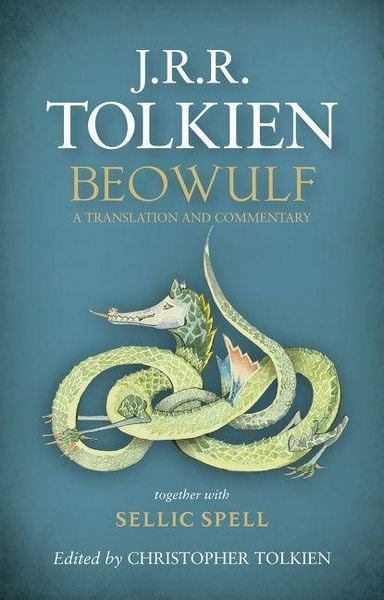
The translation of Beowulf, a cornerstone of Old English literature, by J.R.R. Tolkien was completed in 1926: he returned to it later but seems never to have considered its publication. This edition is twofold, for the translation is here paired with an illuminating written commentary on the great Anglo-Saxon poem by the translator himself, prepared for a series of lectures given at Oxford in the 1930s. From these lectures there arises a sense of the immediacy and clarity of his vision. It is as if Tolkien entered into the imagined past: standing beside Beowulf and his men shaking out their mail-shirts as they beached their ship on the coast of Denmark, listening to the rising anger of Beowulf at the taunting of Unferth, or looking up in amazement at Grendel's terrible hand set under the roof of Heorot.
These are accompanied by Sellic spell, a "marvellous tale" written by Tolkien suggesting what might have been the form and style of an Old English folk-tale of Beowulf, in which there was no association with the "historical legends" of the Northern kingdoms.
Published together for the first time, these four books-all edited by the author's son and literary executor-collect a fascinating period of Christopher Tolkien's forty-year career devoted to presenting his father J.R.R. Tolkien's scholarly writings and literary criticism on the myths and legends of northern Europe, a unique accomplishment that celebrates the academic brilliance and storytelling genius of one of the twentieth century's finest literary pioneers.