Gutscheinbedingungen

**Gültig bis 28.07.2026 auf Spielzeug, Schreibwaren, Filme, Geschenke & Trends, Musik, tolino eReader & Zubehör, Hörbücher und Hörbuch-Downloads (außer Abo), nicht preisgebundene Bücher und Kalender in der Thalia App. Einzelne Artikel können ausgeschlossen sein. Aufgrund der Buchpreisbindung sind deutschsprachige Bücher und eBooks ausgenommen. Zusätzlich ausgenommen sind preisgebundene Artikel, Abos & Flatrates, eBooks, Games, Geschenkkarten/-boxen, Shelfies, Software, Zeitschriften sowie einzelne Artikel von tonies®. Pro Einkauf einmal einlösbar. Click & Collect nur bei Onlinevorabzahlung möglich. Keine Barauszahlung. Nicht kombinierbar mit anderen Aktionen und Gutscheinen. Gutschein wird auf max. 500€ Bestellwert angerechnet. Nicht gültig für Versandkosten und Services.

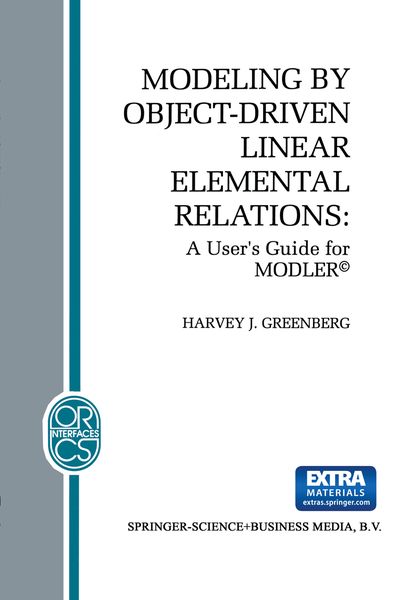
  • Produktbild: Modeling by Object-Driven Linear Elemental Relations
  • Produktbild: Modeling by Object-Driven Linear Elemental Relations
Band 2

Modeling by Object-Driven Linear Elemental Relations A User’s Guide for MODLER©

148,99 €

inkl. gesetzl. MwSt., Versandkostenfrei


Beschreibung

Produktdetails

Einband

Taschenbuch

Erscheinungsdatum

19.04.2013

Verlag

Springer Us

Seitenzahl

163

Maße (L/B/H)

23,5/15,5/1 cm

Gewicht

277 g

Auflage

Softcover reprint of the original 1st ed. 1993

Sprache

Englisch

ISBN

978-1-4613-6388-0

Beschreibung

Produktdetails

Einband

Taschenbuch

Erscheinungsdatum

19.04.2013

Verlag

Springer Us

Seitenzahl

163

Maße (L/B/H)

23,5/15,5/1 cm

Gewicht

277 g

Auflage

Softcover reprint of the original 1st ed. 1993

Sprache

Englisch

ISBN

978-1-4613-6388-0

Herstelleradresse

Springer-Verlag KG
Sachsenplatz 4-6
1201 Wien
AT

Email: GPSR Kontakt

Noch keine Bewertungen vorhanden

Verfassen Sie die erste Bewertung zu diesem Artikel

Helfen Sie anderen Kundinnen und Kunden durch Ihre Meinung.

Kundinnen und Kunden meinen

Bewertungen (0)

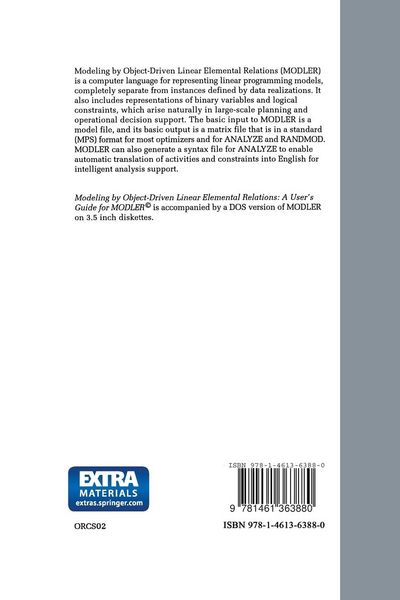
  • Produktbild: Modeling by Object-Driven Linear Elemental Relations
  • Produktbild: Modeling by Object-Driven Linear Elemental Relations
  • Chapter1 Overview, Installation, and Help.- 1.1 What you have and how to begin.- 1.2 Quick installation for DOS environment.- 1.3 Alternative environments.- 1.4 Some interactive language conventions.- 1.5 On-line documentation.- Chapter2 Anatomy of a Linear Program.- 2.1 Algebraic form.- 2.2 Model syntax.- 2.3 Objects and relations.- Chapter3 Preliminaries.- 3.1 The sign-on and basic interactive conventions.- 3.2 Elementary models and query.- 3.3 Randomization by command.- Chapter4 Models and Instances.- 4.1 Some precepts.- 4.2 More examples.- 4.3 Data objects.- 4.4 Randomization options.- Chapter5 Special Structures.- 5.1 Binary variables and logical constraints.- 5.2 Dynamic models.- 5.3 Approximation of nonlinear functions.- 5.4 Elastic programming.- Chapter6 The SUM Expression.- 6.1 Simple examples.- 6.2 Index conditions.- 6.3 Data conditions.- Chapter7 Dependencies.- 7.1 Set maps.- 7.2 Implicit sets.- 7.3 Implicit tables.- 7.4 The SHOW command.- Chapter8 File Interfaces.- 8.1 Environment controls.- 8.2 Dictionaries, documents, help, and keyword files.- 8.3 Execution files.- 8.4 Model files.- 8.5 Data files.- 8.6 Matrix and packed files.- 8.7 Schema and syntax files.- 8.8 Explain files.- Chapter9 More Model Description.- 9.1 Term expressions.- 9.2 A blending model.- 9.3 The REPORT execution file.- 9.4 Attribute inheritance.- 9.5 Equation conditions.- 9.6 Use of set maps.- Chapter10 Model Management.- 10.1 Overview.- 10.2 A case study.- 10.3 Using directories to aid model formulation.