KI-Beratung Beta

  • Produktbild: Modeling by Object-Driven Linear Elemental Relations
  • Produktbild: Modeling by Object-Driven Linear Elemental Relations
- 12%

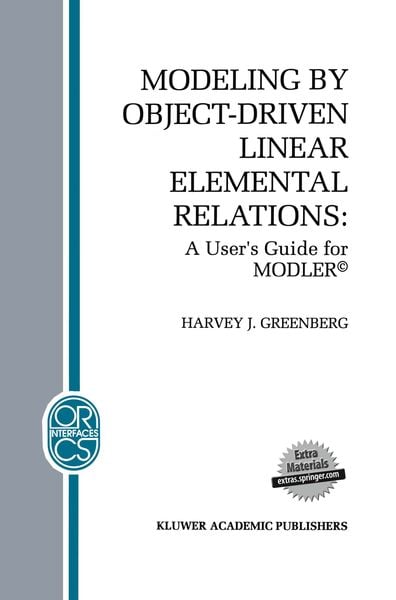
Modeling by Object-Driven Linear Elemental Relations A User’s Guide for MODLER©

12% sparen

144,99 € UVP 164,99 €

inkl. gesetzl. MwSt., Versandkostenfrei


Beschreibung

Modeling by Object-Driven Linear Elemental Relations (MODLER) is a computer language for representing linear programming models, completely separate from instances defined by data realizations. It also includes representations of binary variables and logical constraints, which arise naturally in large-scale...

Beschreibung

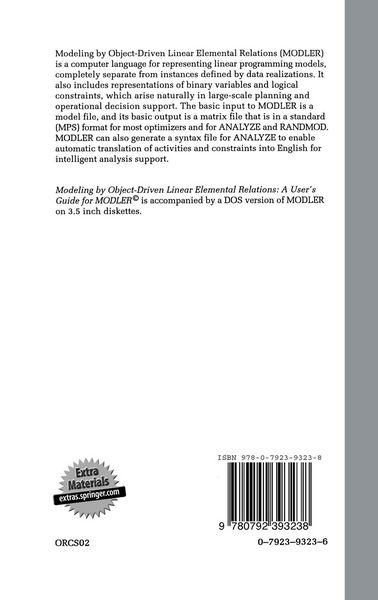
Modeling by Object-Driven Linear Elemental Relations (MODLER) is a computer language for representing linear programming models, completely separate from instances defined by data realizations. It also includes representations of binary variables and logical constraints, which arise naturally in large-scale planning and operational decision support. The basic input to MODLER is a model file, and its basic output is a matrix file that is in a standard (MPS) format for most optimizers and for ANALYZE and RANDMOD. MODLER can also generate a syntax file for ANALYZE to enable automatic translation of activities and constraints into English for intelligent analysis support. The book is accompanied by a DOS version of MODLER on 3.5 inch diskettes and
A Laboratory Manual for Teaching Linear Programming
is available upon request.

Produktdetails

Einband

Gebundene Ausgabe

Erscheinungsdatum

31.03.1993

Abbildungen

X, 163 p.

Verlag Springer Us

Produktdetails

Einband

Gebundene Ausgabe

Erscheinungsdatum

31.03.1993

Abbildungen

X, 163 p.

Verlag Springer Us
Seitenzahl

163

Maße (L/B/H)

23,4/15,6/1,1 cm

Gewicht

426 g

Auflage

1993 edition

Sprache

Englisch

ISBN

978-0-7923-9323-8

Herstelleradresse

Libri GmbH
Europaallee 1
36244 Bad Hersfeld
DE

Email: gpsr@libri.de

Noch keine Bewertungen vorhanden

Verfassen Sie die erste Bewertung zu diesem Artikel

Helfen Sie anderen Kundinnen und Kunden durch Ihre Meinung.

Kundinnen und Kunden meinen

Bewertungen (0)

  • Produktbild: Modeling by Object-Driven Linear Elemental Relations
  • Produktbild: Modeling by Object-Driven Linear Elemental Relations
  • Chapter1 Overview, Installation, and Help.- 1.1 What you have and how to begin.- 1.2 Quick installation for DOS environment.- 1.3 Alternative environments.- 1.4 Some interactive language conventions.- 1.5 On-line documentation.- Chapter2 Anatomy of a Linear Program.- 2.1 Algebraic form.- 2.2 Model syntax.- 2.3 Objects and relations.- Chapter3 Preliminaries.- 3.1 The sign-on and basic interactive conventions.- 3.2 Elementary models and query.- 3.3 Randomization by command.- Chapter4 Models and Instances.- 4.1 Some precepts.- 4.2 More examples.- 4.3 Data objects.- 4.4 Randomization options.- Chapter5 Special Structures.- 5.1 Binary variables and logical constraints.- 5.2 Dynamic models.- 5.3 Approximation of nonlinear functions.- 5.4 Elastic programming.- Chapter6 The SUM Expression.- 6.1 Simple examples.- 6.2 Index conditions.- 6.3 Data conditions.- Chapter7 Dependencies.- 7.1 Set maps.- 7.2 Implicit sets.- 7.3 Implicit tables.- 7.4 The SHOW command.- Chapter8 File Interfaces.- 8.1 Environment controls.- 8.2 Dictionaries, documents, help, and keyword files.- 8.3 Execution files.- 8.4 Model files.- 8.5 Data files.- 8.6 Matrix and packed files.- 8.7 Schema and syntax files.- 8.8 Explain files.- Chapter9 More Model Description.- 9.1 Term expressions.- 9.2 A blending model.- 9.3 The REPORT execution file.- 9.4 Attribute inheritance.- 9.5 Equation conditions.- 9.6 Use of set maps.- Chapter10 Model Management.- 10.1 Overview.- 10.2 A case study.- 10.3 Using directories to aid model formulation.