Gutscheinbedingungen

**Gültig am 28.06.2026 auf Spielzeug, Schreibwaren, Filme, Geschenke & Trends, Musik, tolino eReader & Zubehör, Hörbücher und Hörbuch-Downloads (außer Abo), nicht preisgebundene Bücher und Kalender online auf thalia.at und in der Thalia App. Einzelne Artikel können ausgeschlossen sein. Aufgrund der Buchpreisbindung sind deutschsprachige Bücher und eBooks ausgenommen. Zusätzlich ausgenommen sind preisgebundene Artikel, Abos & Flatrates, eBooks, Games, Geschenkkarten/-boxen, Shelfies, Software, Zeitschriften sowie einzelne Artikel von tonies®. Pro Einkauf einmal einlösbar. Click & Collect nur bei Onlinevorabzahlung möglich. Keine Barauszahlung. Nicht kombinierbar mit anderen Aktionen und Gutscheinen. Gutschein wird auf max. 500€ Bestellwert angerechnet. Nicht gültig für Versandkosten und Services.

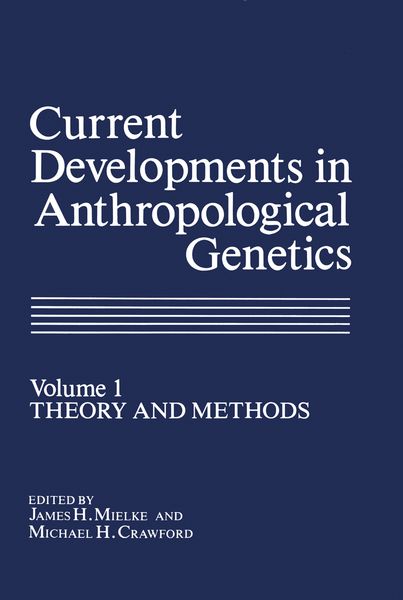
Produktbild: Current Developments in Anthropological Genetics
Band 2 - 12%

Current Developments in Anthropological Genetics Volume 1 Theory and Methods

12% sparen

95,99 € UVP 109,99 €

inkl. gesetzl. MwSt., Versandkostenfrei


Beschreibung

Produktdetails

Einband

Taschenbuch

Erscheinungsdatum

12.10.2011

Herausgeber

James H. Mielke

Verlag

Springer Us

Seitenzahl

436

Maße (L/B/H)

23,5/15,5/2,5 cm

Gewicht

686 g

Auflage

Softcover reprint of the original 1st ed. 1980

Sprache

Englisch

ISBN

978-1-4613-3086-8

Beschreibung

Produktdetails

Einband

Taschenbuch

Erscheinungsdatum

12.10.2011

Herausgeber

James H. Mielke

Verlag

Springer Us

Seitenzahl

436

Maße (L/B/H)

23,5/15,5/2,5 cm

Gewicht

686 g

Auflage

Softcover reprint of the original 1st ed. 1980

Sprache

Englisch

ISBN

978-1-4613-3086-8

Herstelleradresse

Libri GmbH
Europaallee 1
36244 Bad Hersfeld
DE

Email: GPSR Kontakt

Kundinnen und Kunden meinen

0 Bewertungen

Informationen zu Bewertungen

Zur Abgabe einer Bewertung ist eine Anmeldung im Konto notwendig. Die Authentizität der Bewertungen wird von uns nicht überprüft. Wir behalten uns vor, Bewertungstexte, die unseren Richtlinien widersprechen, entsprechend zu kürzen oder zu löschen.

Die Bewertungen sind nach Format, Anzahl Sterne und Datum sortiert.

Verfassen Sie die erste Bewertung zu diesem Artikel

Helfen Sie anderen Kund*innen durch Ihre Meinung

Kundinnen und Kunden meinen

0 Bewertungen filtern

  • Produktbild: Current Developments in Anthropological Genetics
  • I: Historical Approaches to Anthropological Genetics.- 1. Voices of Our Ancestors.- 1. Introduction.- 2. Basic Questions.- 3. Methodological Approaches.- 3.1. Aging and Sexing of Skeletal Material.- 3.2. Improved Life Tables.- 3.3. Locational and Distributional Aspects of Prehistoric Populations.- 3.4. Social Stratification.- 3.5. Signal vs. Noise.- 3.6. On the Possible Action of Natural Selection, and Population Control Mechanisms.- 3.7. General Results.- 4. Implications for Modern Genetic Studies.- 5. Summary and Concluding Remarks.- References.- 2. Historical Demography: Applications in Anthropological Genetics.- 1. Introduction.- 2. Data Sets.- 3. Research Problems.- 3.1. Population Structure.- 3.2. Selection.- 4. Alternative Approaches for Historical Populations.- 5. Summary and Conclusions.- References.- II: Evolutionary Perspectives.- 3. Perspectives on the Theory of Social Evolution.- 1. Introduction.- 2. Theory in Sociobiology.- 3. Inbreeding and Relationship.- 4. Gene Frequency Change.- 5. Hamilton’s Inequality.- 6. Nonlinear Relationships between Resources and Fitness.- 7. Population Structure and Group Selection.- 8. Population Genetics and Culture.- 8.1. Ease of Learning.- 8.2. Father Absence.- 9. Concluding Remarks.- References.- 4. The Anthropological Usefulness of Highly Polymorphic Systems: HLA and Immunoglobulin Allotypes.- 1. Introduction.- 2. Materials and Methods.- 3. Results and Discussion.- References.- Additional References.- 5. Natural Selection and Random Variation in Human Evolution.- 1. Variation and Selection.- 2. Simulation.- 3. Conclusions.- References.- 6. The Simulation of Human Fertility: Strategies in Demographic Modeling.- 1. Introduction.- 2. Computer Simulation of Fertility.- 2.1. KINSIM.- 2.2. POPSIM.- 2.3. CHOREA.- 2.4. FERTSIM.- 3. Some Fertility Simulation Experiments.- 3.1. Experiment 1.- 3.2. Experiment 2.- 4. Discussion.- 5. Summary and Conclusions.- References.- III: Analytical Theory.- 7. The Genetic Structure of Subdivided Human Populations: A Review.- 1. Introduction.- 2. Methods of Genetic Analysis.- 2.1. Genetic Distance Measures.- 2.2. Measures of Population Differentiation: F Statistics.- 2.3. Clines.- 3. Migration Models.- 3.1. Discrete Models.- 3.2. Continuous Models.- 4. Display Methods.- 4.1. Topology.- 4.2. Trees.- 5. Other Types of Subdivision.- 5.1. Hierarchical Subdivision.- 5.2. Temporal Subdivision.- 6. Discussion.- 6.1. Concordance of Data Types.- 6.2. Determinants of Population Structure.- 7. Conclusions.- References.- 8. Distance Analysis and Multidimensional Scaling.- 1. Introduction.- 1.1. Population Structure.- 1.2. The Concept of Distance.- 1.3. The Scope of This Chapter.- 2. Distance Analysis.- 2.1. Quantitative Traits.- 2.2. Qualitative Traits.- 3. Multidimensional Scaling.- 3.1. Multidimensional Scaling of Symmetric Matrices of Similarities or Dissimilarities.- 3.2. Multidimensional Scaling of Asymmetric Matrices.- 3.3. Simultaneous Analysis of Several Matrices of Similarity or Dissimilarity.- 3.4. Cluster Analysis.- 4. Envoi.- References.- 9. Pedigree Analysis of Complex Models.- 1. Introduction.- 2. Synopsis.- 3. General Theory.- 4. Specific Models.- 4.1. Transmission Functions.- 4.2. Penetrance Functions.- 4.3. Population Frequencies for Individuals.- 4.4. Assortative Mating.- 4.5. Linear Models.- 4.6. The Observation.- 5. Recursions.- 5.1. Major Gene.- 5.2. Major Gene with Assortative Mating.- 5.3. Polygenic with Assortative Mating and Common-Sib Environment.- 5.4. General Mixed Model.- 5.5. Looped Pedigrees.- 5.6. An Uncle—Nephew Common Environment.- 5.7. Analytic Recursions.- 6. Practical Aspects and Miscellaneous Problems.- 6.1. Optimization of Algorithms.- 6.2. Pedigree Structure and Sampling Procedures.- 6.3. Comparison of Models through Likelihood Analysis.- 6.4. Miscellaneous Problems.- (a) Twins.- (b) Sequential phenomena.- 7. Summary.- References.- 10. Current Directions in Genetic Epidemiology.- 1. Introduction.- 2. The Heterogeneity Problem.- 3. Some Common Mechanisms.- 4. Detecting Major Loci.- 4.1. Segregation Analysis.- 4.2. Linkage Analysis.- 5. Resolution of Polygenic and Cultural Inheritance.- 5.1. History of the Path Analytic Models.- 5.2. The TAU Model.- 5.3. The BETA Model.- 5.4. Statistical Estimation and Hypothesis Testing.- 5.5. Variable Family Structure.- 5.6. Future Direction of Research.- 6. Discussion.- References.- IV: Analytical Theory: illustrated by Example.- 11. Segregation Analysis.- 1. Introduction.- 2. Mathematical Formulation of Genetic Models.- 2.1. Joint Genotypic Distribution of Mating Individuals.- 2.2. Relationship between Phenotype and Genotype.- 2.3. Mode of Inheritance.- 2.4. Sampling Scheme.- 3. The Likelihood Method.- 3.1. Likelihood of Randomly Sampled Data.- 3.2. Likelihood when Sampling via Selected Probands.- 3.3. Parameter Estimation and Testing Hypotheses.- 4. Examples of Segregation Analysis.- 4.1. Segregation of Hypercholesterolemia in a Large Pedigree.- 4.2. Segregation of Phenylthiocarbamide (PTC) Taste Sensitivity.- 5. Conclusion.- References.- 12. Path Analysis of Quantitative Inheritance.- 1. Introduction.- 2. The Linear Model.- 3. Social Homogamy.- 4. Phenotypic Homogamy.- 5. Mixed Homogamy.- 6. Nuclear Families.- 7. Other Relatives.- 8. Statistical Analysis.- 9. Examples.- 9.1. Palmar Ridge Counts.- 9.2. Skin Color.- 9.3. Periodontal Health.- 9.4. Human IQ.- 10. Discussion.- References.- 13. Half-Sib Analysis of Quantitative Data.- 1. Introduction.- 2. Variables and Notation.- 3. Correlation between Half-Sibs.- 4. Estimation of Parameters.- 5. Models and Populations.- 6. Half-Sib Analysis.- 7. Summary and Conclusion.- 8. Appendix: Hierarchical Classification and Intraclass Correlation.- 8.1. The Linear Model.- 8.2. Analysis of Variance.- 8.3. Expected Values of Mean Squares.- 8.4. Intraclass Correlation.- 8.5. The Genetics Connection.- 8.6. Genetic Variance between and within Sibships.- References.- 14. Mental Abilities: A Family Study.- 1. Introduction.- 2. Historical Developments.- 3. Previous Family Studies.- 4. Genetics of Spatial Ability.- 5. Hawaii Family Study of Cognition.- 5.1. Factor Structure.- 5.2. Age and Sex Differences.- 5.3. Assortative Marriage.- 5.4. Regression of Midchild on Midparent.- 5.5. Spatial Ability.- 6. Summary and Conclusions.- References.- 15. Current Developments in Anthropological Genetics: Achievements and Gaps.- 1. Introduction.- 2. Historical Material.- 3. Evolution.- 4. Analytical Theory.- 5. Overview.- 5.1. New Polymorphisms.- 5.2. Ecogenetic Studies.- 5.3. Some Gaps.- 6. Conclusion.- References.