
Gutscheinbedingungen

**Gültig nur für Bestellungen an die Wunsch-Poststation bis 10.06.2026 auf Spielzeug, Schreibwaren, Filme, Geschenke & Trends, Musik, tolino eReader & Zubehör, Hörbücher und Hörbuch-Downloads (außer Abo), nicht preisgebundene Bücher und Kalender online auf thalia.at und in der Thalia App. Einzelne Artikel können ausgeschlossen sein. Aufgrund der Buchpreisbindung sind deutschsprachige Bücher und eBooks ausgenommen. Zusätzlich ausgenommen sind preisgebundene Artikel, Abos & Flatrates, eBooks, Games, Geschenkkarten/-boxen, Shelfies, Software, Zeitschriften sowie einzelne Artikel von tonies®. Pro Einkauf einmal einlösbar. Kein Click & Collect möglich. Keine Barauszahlung. Nicht kombinierbar mit anderen Aktionen und Gutscheinen. Gutschein wird auf max. 500€ Bestellwert angerechnet. Nicht gültig für Versandkosten und Services.

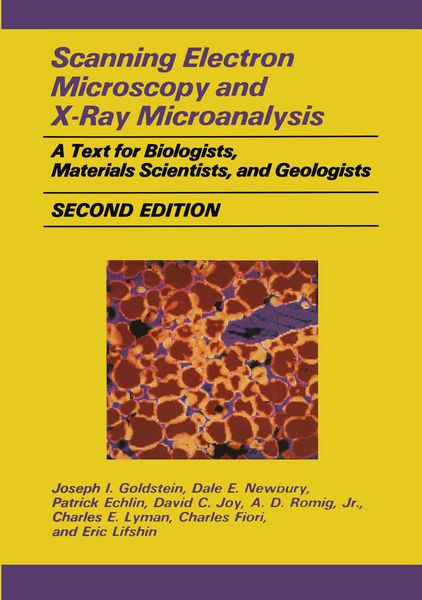
  • Produktbild: Scanning Electron Microscopy and X-Ray Microanalysis
  • Produktbild: Scanning Electron Microscopy and X-Ray Microanalysis
  • Produktbild: Scanning Electron Microscopy and X-Ray Microanalysis
- 12%

Scanning Electron Microscopy and X-Ray Microanalysis A Text for Biologists, Materials Scientists, and Geologists

12% sparen

95,99 € UVP 109,99 €

inkl. gesetzl. MwSt., Versandkostenfrei


Beschreibung

Produktdetails

Einband

Taschenbuch

Erscheinungsdatum

28.09.2011

Verlag

Springer Us

Seitenzahl

840

Maße (L/B/H)

25,4/17,8/4,5 cm

Gewicht

1550 g

Auflage

Second Edition 1992

Sprache

Englisch

ISBN

978-1-4612-7653-1

Beschreibung

Rezension

From a review of the first edition:

`
The emphasis throughout has been on practical aspects ... that approach, plus the comprehensiveness of the material covered, makes this a valuable, virtually indispensible, reference work.
'

Microscope Journal

Produktdetails

Einband

Taschenbuch

Erscheinungsdatum

28.09.2011

Verlag

Springer Us

Seitenzahl

840

Maße (L/B/H)

25,4/17,8/4,5 cm

Gewicht

1550 g

Auflage

Second Edition 1992

Sprache

Englisch

ISBN

978-1-4612-7653-1

Herstelleradresse

Springer-Verlag GmbH
Tiergartenstr. 17
69121 Heidelberg
DE

Email: ProductSafety@springernature.com

Kundinnen und Kunden meinen

0 Bewertungen

Informationen zu Bewertungen

Zur Abgabe einer Bewertung ist eine Anmeldung im Konto notwendig. Die Authentizität der Bewertungen wird von uns nicht überprüft. Wir behalten uns vor, Bewertungstexte, die unseren Richtlinien widersprechen, entsprechend zu kürzen oder zu löschen.

Die Bewertungen sind nach Format, Anzahl Sterne und Datum sortiert.

Verfassen Sie die erste Bewertung zu diesem Artikel

Helfen Sie anderen Kund*innen durch Ihre Meinung

Kundinnen und Kunden meinen

0 Bewertungen filtern

  • Produktbild: Scanning Electron Microscopy and X-Ray Microanalysis
  • Produktbild: Scanning Electron Microscopy and X-Ray Microanalysis
  • Produktbild: Scanning Electron Microscopy and X-Ray Microanalysis
  • 1. Introduction.- 1.1. Evolution of the Scanning Electron Microscope.- 1.2. Evolution of the Electron Probe Microanalyzer.- 1.3. Outline of This Book.- 2. Electron Optics.- 2.1. How the SEM Works.- 2.2. Electron Guns.- 2.3. Electron Lenses.- 2.4. Electron Probe Diameter versus Electron Probe Current.- 2.5. Summary of SEM Microscopy Modes.- 3. Electron-Specimen Interactions.- 3.1. Introduction.- 3.2. Electron Scattering.- 3.3. Interaction Volume.- 3.4. Signals from Elastic Scattering.- 3.5. Signals from Inelastic Scattering.- 3.6. Summary.- 4. Image Formation and Interpretation.- 4.1. Introduction.- 4.2. The Basic SEM Imaging Process.- 4.3. Detectors.- 4.4. Image Contrast at Low Magnification (100,000x).- 4.7. Image Processing for the Display of Contrast Information.- 4.8. Defects of the SEM Imaging Process.- 4.9. Special Topics in SEM Imaging.- 4.10. Developing a Comprehensive Imaging Strategy.- 5. X-Ray Spectral Measurement: WDS and EDS.- 5.1. Introduction.- 5.2. Wavelength-Dispersive Spectrometer.- 5.3. Energy-Dispersive X-Ray Spectrometer.- 5.4. Comparison of WDS and EDS.- Appendix: Initial Detector Setup and Testing.- 6. Qualitative X-Ray Analysis.- 6.1. Introduction.- 6.2. EDS Qualitative Analysis.- 6.3. WDS Qualitative Analysis.- 6.4. Automatic Qualitative EDS Analysis.- 7. X-Ray Peak and Background Measurements.- 7.1. General Considerations for X-Ray Data Handling.- 7.2. Background Correction.- 7.3. Peak Overlap Correction.- 8. Quantitative X-Ray Analysis: The Basics.- 8.1. Introduction.- 8.2. Advantages of Quantitative X-Ray Microanalysis in the SEM/EPMA.- 8.3. Quantitative Analysis Procedures.- 8.4. The Approach to X-Ray Quantitation: The Need for Matrix Corrections.- 8.5. The Physical Origin of Matrix Effects.- 8.6. X-Ray Production.- 8.7. ZAF Factors in Microanalysis.- 8.8. Types of Matrix Correction Schemes.- 8.9. Caveats.- 9. Quantitative X-Ray Analysis: Theory and Practice.- 9.1. Introduction.- 9.2. ZAF Technique.- 9.3. ø; (?z) Technique.- 9.8. Special Sample Analysis.- 9.9. Precision and Sensitivity in X-Ray Analysis.- 9.10. Light-Element Analysis.- Appendix 9.1. Equations for the ?, ?, ?, and ø(0) Terms of the Packwood-Brown ø (?z) Equation.- Appendix 9.2. Solutions for the Atomic Number and Absorption Corrections.- 10. Compositional Imaging.- 10.1. Introduction.- 10.2. Analog X-Ray Area Scanning (Dot Mapping).- 10.3. Digital Compositional Mapping..- 11. Specimen Preparation for Inorganic Materials: Microstructural and Microchemical Analysis.- 11.1. Metals.- 11.2. Ceramics and Geological Specimens.- 11.3. Electronic Devices and Packages.- 11.4. Semiconductors.- 11.5. Sands, Soils, and Clays.- 11.6. Particles and Fibers.- 12. Sample Preparation for Biological, Organic, Polymeric, and Hydrated Materials.- 12.1. Introduction.- 12.2. Compromising the Electron-Beam Instrument.- 12.3. Compromising the Sample.- 12.4. Correlative Microscopy.- 12.5. Techniques for Structural Studies.- 12.6. Specimen Preparation for Localization of Metabolic Activity and Chemical Specificity.- 12.7 Preparative Procedures for Organic Samples Such as Polymers, Plastics, and Paints.- 12.8. Low-Temperature Specimen Preparation for Structural and Analytical Studies.- 12.9. Damage, Artifact, and Interpretation.- 12.10. Specific Preparative Procedures: A Bibliography.- 13. Coating and Conductivity Techniques for SEM and Microanalysis.- 13.1. Introduction.- 13.2. Specimen Characteristics.- 13.3. Untreated Specimens.- 13.4.Bulk Conductivity Staining Methods.- 13.5. Specimen Mounting Procedures.- 13.6. Thin-Film Methods.- 13.7. Thermal Evaporation.- 13.8. Sputter Coating.- 13.9. Specialized Coating Methods.- 13.10. Determination of Coating Thickness.- 13.11. Artifacts Related to Coating and Bulk-Conductivity Procedures.- 13.12. Conclusions.- 14 Data Base.- Table 14.1. Atomic Number, Atomic Weight, and Density of Elements.- Table 14.2. Common Oxides of the Elements.- Table 14.3. Mass Absorption Coefficients for ? Lines.- Table 14.4. Mass Absorption Coefficients for ? Lines.- Table 14.5. Mass Absorption Coefficients for ? Lines.- Table 14.6. K Series X-Ray Wavelengths and Energies.- Table 14.7. L Series X-Ray Wavelengths and Energies !.- Table 14.8. M Series X-Ray Wavelengths and Energies.- Table 14.9. J and Fluorescent Yield (?) by Atomic Number.- Table 14.10. Important Properties of Selected Coating Elements.- References.