KI-Beratung Beta

Gutscheinbedingungen

**Gültig am 27.11.2026 auf Spielzeug, Schreibwaren, Filme, Geschenke & Trends, Musik, tolino eReader & Zubehör, Hörbücher und Hörbuch-Downloads, nicht preisgebundene Bücher und Kalender online auf thalia.at und in der Thalia App. Einzelne Artikel können ausgeschlossen sein. Aufgrund der Buchpreisbindung sind deutschsprachige Bücher und eBooks ausgenommen. Zusätzlich ausgenommen sind Abos & Flatrates, Games, Geschenkkarten/-boxen, Shelfies, Software, Zeitschriften sowie einzelne Artikel von tonies®. Pro Einkauf einmal einlösbar. Click & Collect nur bei Onlinevorabzahlung möglich. Keine Barauszahlung. Nicht kombinierbar mit anderen Aktionen und Gutscheinen. Gutschein wird auf max. 500€ Bestellwert angerechnet. Nicht gültig für Versandkosten und Services.

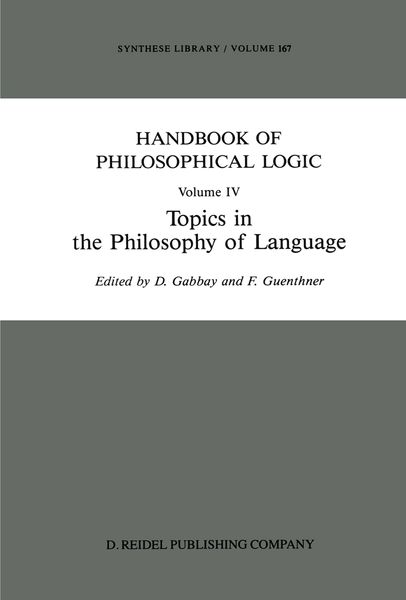
Produktbild: Handbook of Philosophical Logic
Band 167

Handbook of Philosophical Logic Volume IV: Topics in the Philosophy of Language

Aus der Reihe Synthese Library

49,99 €

inkl. gesetzl. MwSt., Versandkostenfrei


Beschreibung

conceptual, realist) theories of predication. Chapter IV.4 centers on an important class of expressions used for predication in connection with quantities: mass expressions. This chapter reviews the most well-known approaches to mass terms and the ontological proposals related to them. In addition to...

Beschreibung

conceptual, realist) theories of predication. Chapter IV.4 centers on an important class of expressions used for predication in connection with quantities: mass expressions. This chapter reviews the most well-known approaches to mass terms and the ontological proposals related to them. In addition to quantification and predication, matters of reference have constituted the other overriding theme for semantic theories in both philosophical logic and the semantics of natural languages. Chapter IV.5 of how the semantics of proper names and descrip presents an overview tions have been dealt with in recent theories of reference. Chapter IV.6 is concerned with the context-dependence of reference, in particular, with the semantics of indexical expressions. The topic of Chapter IV.7 is related to predication as it surveys some of the central problems of ascribing propositional attitudes to agents. Chap ter IV.8 deals with the analysis of the main temporal aspects of natural language utterances. Together these two chapters give a good indication of the intricate complexities that arise once modalities of one or the other sort enter on the semantic stage. in philosophical Chapter IV.9 deals with another well-known topic logic: presupposition, an issue on the borderline of semantics and prag matics. The volume closes with an extensive study of the Liar paradox and its many implications for the study of language (as for example, self reference, truth concepts and truth definitions).

Rezension

`This volume is a very important one as it covers many interesting topics ... and must be considered central to the field of semantics. ... The different chapters each elucidate their respective topic and with the historical overviews the reader gets the entire development in each subarea up to 1985.'
Studia Linguistica, 44 (2) 1990

Produktdetails

Einband

Taschenbuch

Erscheinungsdatum

26.09.2011

Abbildungen

733 p.

Herausgeber Dov M. Gabbay + weitere

Produktdetails

Einband

Taschenbuch

Erscheinungsdatum

26.09.2011

Abbildungen

733 p.

Herausgeber
Verlag Springer Netherland
Seitenzahl

733

Maße (L/B/H)

22,3/15,2/4 cm

Gewicht

1019 g

Auflage

Softcover reprint of the original 1st ed. 1989

Sprache

Englisch

ISBN

978-94-010-7021-8

Herstelleradresse

Springer-Verlag KG
Sachsenplatz 4-6
1201 Wien
AT

Email: ProductSafety@springernature.com

Noch keine Bewertungen vorhanden

Verfassen Sie die erste Bewertung zu diesem Artikel

Helfen Sie anderen Kundinnen und Kunden durch Ihre Meinung.

Kundinnen und Kunden meinen

Bewertungen (0)

  • Produktbild: Handbook of Philosophical Logic
  • to Volume IV.- IV.I Quantifiers in Formal and Natural Languages.- IV.2 Property Theories.- IV.3 Philosophical Perspectives on Formal Theories of Predication.- IV.4 Mass Expressions.- IV.5 Reference and Information Content: Names and Descriptions.- IV.6 Indexicals.- IV.7 Propositional Attitudes.- IV.8 Tense and Time.- IV.9 Presupposition.- IV.10 Semantics and the Liar Paradox.- Name Index.- Table of Contents to Volume I, II, and III.