KI-Beratung Beta

Gutscheinbedingungen

**Gültig am 27.11.2026 auf Spielzeug, Schreibwaren, Filme, Geschenke & Trends, Musik, tolino eReader & Zubehör, Hörbücher und Hörbuch-Downloads, nicht preisgebundene Bücher und Kalender online auf thalia.at und in der Thalia App. Einzelne Artikel können ausgeschlossen sein. Aufgrund der Buchpreisbindung sind deutschsprachige Bücher und eBooks ausgenommen. Zusätzlich ausgenommen sind Abos & Flatrates, Games, Geschenkkarten/-boxen, Shelfies, Software, Zeitschriften sowie einzelne Artikel von tonies®. Pro Einkauf einmal einlösbar. Click & Collect nur bei Onlinevorabzahlung möglich. Keine Barauszahlung. Nicht kombinierbar mit anderen Aktionen und Gutscheinen. Gutschein wird auf max. 500€ Bestellwert angerechnet. Nicht gültig für Versandkosten und Services.

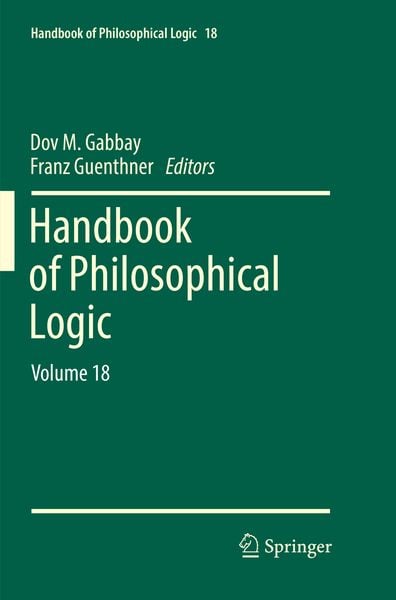
Produktbild: Handbook of Philosophical Logic
Band 18 - 15%

Handbook of Philosophical Logic Volume 18

15% sparen

83,99 € UVP 98,99 €

inkl. gesetzl. MwSt., Versandkostenfrei


Beschreibung

This eighteenth volume of the acclaimed Handbook of Philosophical Logic includes many contributors who are among the most famous leading figures of applied philosophical logic of our time. Coverage includes deontic logic, practical reasoning, homogeneous and heterogeneous logical proportion, and talmudic...

Beschreibung

This eighteenth volume of the acclaimed Handbook of Philosophical Logic includes many contributors who are among the most famous leading figures of applied philosophical logic of our time. Coverage includes deontic logic, practical reasoning, homogeneous and heterogeneous logical proportion, and talmudic logic. Overall, it will appeal to students, practitioners, and researchers looking for an authoritative resource in these areas.


The contributors first explore models in terms of dynamic logics for information-driven agency. The paradigm they use is dynamic-epistemic logics for knowledge and belief and their current extensions to the statics and dynamics of agents’ preferences. Next, in the presentation of preference based agency, coverage examines a large number of themes, including interactive social agents and scenarios with long term patterns emerging over time. From here, the book moves on to offer an introduction to homogeneous and heterogeneous logical proportions.


Readers will also learn more about the general challenge that the problem of formalizing practical reasoning presents to logical theory. The contributors survey the existing resources that might contribute to the development of such a formalization. They conclude that, while a robust, adequate logic of practical reasoning is not yet in place, the materials for developing such a logic are now available.

The last chapter explores topics that deal with the logic of Jewish law and the logic of the Talmud. This includes obligations and prohibitions in Talmudic deontic logic, the handling of loops in Talmudic logic, Temporal Talmudic logic, and quantum states and disjunctive attacks in Talmudic logic. The Talmudic logic system presented are also exported to general logic and to Artificial Intelligence.

Portrait

DOV M. GABBAY FRSC FAvH FRSA FBCS, Augustus De Morgan Professor of Logic (Emeritus), King's College London and Visiting Professor, University of Luxembourg. Dov Gabbay is one of the world’s most active and influential researchers in logic.  He has been active in the logic landscape for over 50 years. He  authored / co-authored over five hundred and fifty research papers and over thirty research monographs.He has initiated several new and active research areas. He is editor of several international Journals, and over 50 Handbooks of Logic. Gabbay is Chairman and founder of several international conferences, Executive of the European Foundation of  Logic Language and Information and President of the International IGPL Logic Group .Founder, Executive and Vice President of the International Federation of Computational Logic, (UK Charity, Number 1112512 ). He is one of the four founders and council member for many years of FoLLI, the Association of Logic, Language and Information. Now retired and a Life Member.

Franz Guenthner is a professor of Computational Linguistics at the Centre for Information and Language Processing (CIS) at the Ludwig-Maximilians-Universitaet (LMU) in Munich, Germany. His background is in philosophy and linguistics.Guenthner's research interests include computational linguistics, and has collaborated to the development of a number of online search platforms since 1996: AltaVista, Fast Search and Transfer (now purchased by Microsoft), RealNames, JobaNova, Exorbyte, and All The Web. He was a professor of General and Computational Linguistics at the University of Tübingen (1977–1989) before joining the LMU in 1990. His research interests include all areas of text processingand in particular the transformation of textual corpora in lexical and grammatical representations (i.e. computationally deployable electronic dictionaries and local grammars). His present work concerns the use of linguistic techniques in page and link analysis on the web, especially for the construction of vertical search engines.

Produktdetails

Einband

Taschenbuch

Erscheinungsdatum

19.01.2019

Abbildungen

XIII, 377 p.

Herausgeber Dov M. Gabbay + weitere

Produktdetails

Einband

Taschenbuch

Erscheinungsdatum

19.01.2019

Abbildungen

XIII, 377 p.

Herausgeber
Verlag Springer
Seitenzahl

377

Maße (L/B/H)

23,5/15,5/2,2 cm

Gewicht

593 g

Auflage

Softcover reprint of the original 1st ed. 2018

Sprache

Englisch

ISBN

978-3-030-07399-2

Herstelleradresse

Springer-Verlag KG
Sachsenplatz 4-6
1201 Wien
AT

Email: ProductSafety@springernature.com

Noch keine Bewertungen vorhanden

Verfassen Sie die erste Bewertung zu diesem Artikel

Helfen Sie anderen Kundinnen und Kunden durch Ihre Meinung.

Kundinnen und Kunden meinen

Bewertungen (0)

  • Produktbild: Handbook of Philosophical Logic

  • Chapter 1. Deontic Logic and Changing Preferences (Johan van Benthem and Fenrong Liu).- Chapter 2. Homogeneous and heterogeneous logical proportions: An introduction (Henri Prade and Gilles Richard).- Chapter 3. The Formalization of Pratical Reasoning: Problems and Prospects (Richmond H. Thomason).- Chapter 4. Principles of Talmudic Logic (M. Abraham, D. M. Gabbay and U. Schild).