KI-Beratung Beta

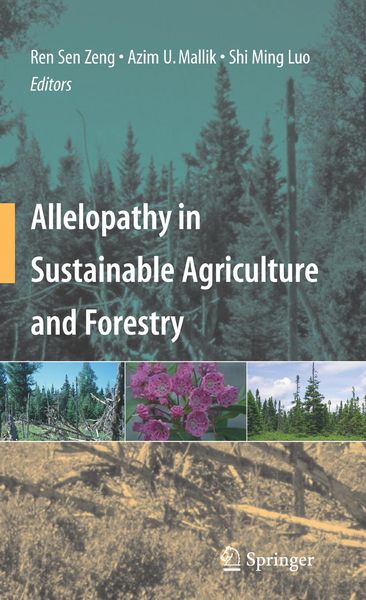
Produktbild: Allelopathy in Sustainable Agriculture and Forestry

Allelopathy in Sustainable Agriculture and Forestry

219,99 €

inkl. gesetzl. MwSt.

Beschreibung

Simply put, allelopathy refers to an ecological phenomenon of plant-plant interference through release of organic chemicals (allelochemicals) in the environment. These chemicals can be directly and continuously released by the donor plants in their immediate environment as volatiles in the air or root...

Beschreibung

Simply put, allelopathy refers to an ecological phenomenon of plant-plant interference through release of organic chemicals (allelochemicals) in the environment. These chemicals can be directly and continuously released by the donor plants in their immediate environment as volatiles in the air or root exudates in soil or they can be the microbial degradation products of plant residues. The chemicals may interfere with survival and growth of neighboring or succeeding plants. Black walnut, eucalyptus, sunflower, sorghum, sesame and alfalfa are common examples of plants with allelopathic property as well as some staple crops such as rice, wheat, barley and sorghum. Plants can emit chemicals that also discourage insects and pathogens. To maintain sustained productivity, knowledge of this form of plant interference on other plants and on disease causing organisms has been used in agriculture since prehistoric time by manipulating cropping pattern and sequence such as mixed cropping and crop rotation. However, use of numerous agrochemicals including a wide range of herbicides, pesticides, fertilizers and genetically modified high yielding crops has become the characteristic feature of modern industrial agriculture. Not only the sustainability of crop yield is called into question in this form of agriculture, the extensive long-term and often irreversible environmental degradation including ground water contamination and food safety associated with industrial agriculture are now of serious concern worldwide.

The objective is to report on the latest advances in allelopathy by inviting leading scientists to contribute in specific fields. The volume is organized under three major subsections: History of allelopathy, Allelochemicals, allelopathic mechanisms, and bioassays, and Application of allelopathy in agriculture and forestry. An emphasis is place on methodology and application, making it a truly practical reference.

Produktdetails

Format

PDF

Kopierschutz

Nein

Family Sharing

Nein

Text-to-Speech

Nein

Produktdetails

Format

PDF

Format

eBooks im PDF-Format haben eine festgelegte Seitengröße und eignen sich daher nur bedingt zum Lesen auf einem tolino eReader oder Smartphone. Für den vollen Lesegenuss empfehlen wir Ihnen bei PDF-eBooks die Verwendung eines Tablets oder Computers.

Kopierschutz

Nein

Kopierschutz

Dieses eBook können Sie uneingeschränkt auf allen Geräten der tolino Familie, allen sonstigen eReadern und am PC lesen. Das eBook ist nicht kopiergeschützt und kann ein personalisiertes Wasserzeichen enthalten. Weitere Hinweise zum Lesen von eBooks mit einem personalisierten Wasserzeichen finden Sie unter Hilfe/Downloads.

Family Sharing

Nein

Family Sharing

Mit Family Sharing können Sie eBooks innerhalb Ihrer Familie (max. sechs Mitglieder im gleichen Haushalt) teilen. Sie entscheiden selbst, welches Buch Sie mit welchem Familienmitglied teilen möchten. Auch das parallele Lesen durch verschiedene Familienmitglieder ist durch Family Sharing möglich. Um eBooks zu teilen oder geteilt zu bekommen, muss jedes Familienmitglied ein Konto bei Thalia oder einem anderen tolino-Buchhändler haben. Weitere Informationen finden Sie unter Hilfe/Family-Sharing.

Text-to-Speech

Nein

Text-to-Speech

Bedeutet Ihnen Stimme mehr als Text? Mit der Funktion Text-to-Speech können Sie sich im tolino webReader und in der aktuellen Thalia – Lesen & Hören App das eBook vorlesen lassen. Weitere Informationen finden Sie unter Hilfe/Text-to-Speech.

Erscheinungsdatum

03.04.2008

Herausgeber
Verlag Springer Us
Seitenzahl

412 (Printausgabe)

Dateigröße

10457 KB

Sprache

Englisch

EAN

9780387773377

Barrierefreiheit
  • keine Information zur Barrierefreiheit bekannt

Noch keine Bewertungen vorhanden

Verfassen Sie die erste Bewertung zu diesem Artikel

Helfen Sie anderen Kundinnen und Kunden durch Ihre Meinung.

Kundinnen und Kunden meinen

Bewertungen (0)

Weitere Artikel finden Sie in

  • Produktbild: Allelopathy in Sustainable Agriculture and Forestry
  • History.- Historical Examples of Allelopathy and Ethnobotany from the Mediterranean Region.- Allelopathy: Advances, Challenges and Opportunities.- Allelopathy in Chinese Ancient and Modern Agriculture.- Allelochemicals and Allelopathic Mechanisms.- Allelochemicals in Plants.- Allelopathy: Full Circle from Phytotoxicity to Mechanisms of Resistance.- Allelopathic Mechanisms and Experimental Methodology.- Indirect Effects of Phenolics on Plant Performance by Altering Nitrogen Cycling: Another Mechanism of Plant-Plant Negative Interactions.- Genomic Approaches to Understanding Allelochemical Effects on Plants.- Allelopathy from a Mathematical Modeling Perspective.- Application of Allelopathy in Agriculture and Forestry.- Progress and Prospect of Rice Allelopathy Research.- Rice Allelopathy Research in China.- Recent Advances in Wheat Allelopathy.- Sorghum Allelopathy for Weed Management in Wheat.- Allelochemicals in Pre-cowing Soils of Continuous Soybean Cropping and Their Autointoxication.- Autotoxicity in Agriculture and Forestry.- Black Walnut Allelopathy: Implications for Intercropping.- Plant Growth Promoting Rhizobacteria and Mycorrhizal Fungi in Sustainable Agriculture and Forestry.- Utilization of Stress Tolerant, Weed Suppressive Groundcovers for Low Maintenance Landscape Settings.- Allelopathy in Forested Ecosystems.