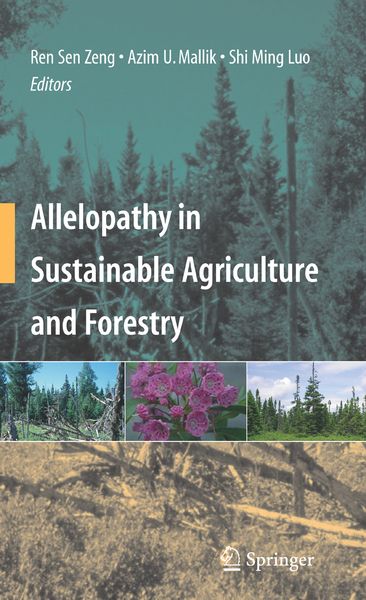
Allelopathy in Sustainable Agriculture and Forestry
-
- Hardcover ausgewählt
- Taschenbuch
- eBook
-
Sprache:Englisch
189,99 €
UVP
219,99 €
inkl. gesetzl. MwSt.,
Beschreibung
Produktdetails
Einband
Gebundene Ausgabe
Erscheinungsdatum
03.04.2008
Abbildungen
XIV, 76 schwarzweisse Abbildungen 235 mm
Herausgeber
Ren Sen Zeng + weitereVerlag
Springer UsSeitenzahl
412
Maße (L/B/H)
24,3/16,6/3,8 cm
Gewicht
776 g
Auflage
2008 edition
Sprache
Englisch
ISBN
978-0-387-77336-0
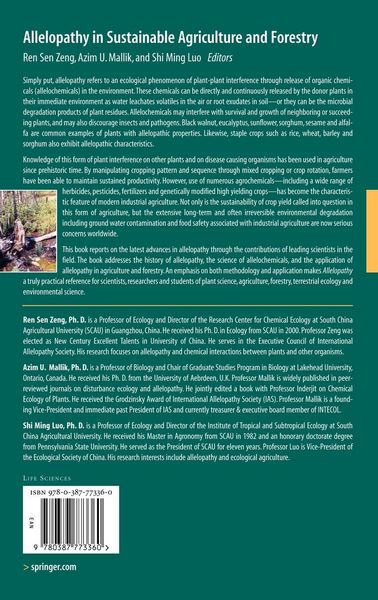
Simply put, allelopathy refers to an ecological phenomenon of plant-plant interference through release of organic chemicals (allelochemicals) in the environment. These chemicals can be directly and continuously released by the donor plants in their immediate environment as volatiles in the air or root exudates in soil or they can be the microbial degradation products of plant residues. The chemicals may interfere with survival and growth of neighboring or succeeding plants. Black walnut, eucalyptus, sunflower, sorghum, sesame and alfalfa are common examples of plants with allelopathic property as well as some staple crops such as rice, wheat, barley and sorghum. Plants can emit chemicals that also discourage insects and pathogens. To maintain sustained productivity, knowledge of this form of plant interference on other plants and on disease causing organisms has been used in agriculture since prehistoric time by manipulating cropping pattern and sequence such as mixed cropping and crop rotation. However, use of numerous agrochemicals including a wide range of herbicides, pesticides, fertilizers and genetically modified high yielding crops has become the characteristic feature of modern industrial agriculture. Not only the sustainability of crop yield is called into question in this form of agriculture, the extensive long-term and often irreversible environmental degradation including ground water contamination and food safety associated with industrial agriculture are now of serious concern worldwide.
The objective is to report on the latest advances in allelopathy by inviting leading scientists to contribute in specific fields. The volume is organized under three major subsections: History of allelopathy, Allelochemicals, allelopathic mechanisms, and bioassays, and Application of allelopathy in agriculture and forestry. An emphasis is place on methodology and application, making it a truly practical reference.
Noch keine Bewertungen vorhanden
Verfassen Sie die erste Bewertung zu diesem Artikel
Helfen Sie anderen Kundinnen und Kunden durch Ihre Meinung.
Kurze Frage zu unserer Seite
Vielen Dank für Ihr Feedback
Wir nutzen Ihr Feedback, um unsere Produktseiten zu verbessern. Bitte haben Sie Verständnis, dass wir Ihnen keine Rückmeldung geben können. Falls Sie Kontakt mit uns aufnehmen möchten, können Sie sich aber gerne an unseren Kund*innenservice wenden.
zum Kundenservice