
Beschreibung

Produktdetails

Einband

Taschenbuch

Erscheinungsdatum

25.10.2012

Herausgeber

Lawrence J. Berliner + weitere

Verlag

Springer Us

Seitenzahl

440

Maße (L/B/H)

22,9/15,2/2,5 cm

Gewicht

656 g

Auflage

Softcover reprint of the original 1st ed. 1993

Sprache

Englisch

ISBN

978-1-4613-6250-0

Beschreibung

Portrait

Dr. Lawrence J. Berliner is currently Professor and Chair of the Department of Chemistry and Biochemistry at the University of Denver after retiring from Ohio State University, where he spent a 32-year career in the area of biological magnetic resonance (EPR and NMR). He is the Series Editor for Biological Magnetic Resonance , which he launched in 1979.

Produktdetails

Einband

Taschenbuch

Erscheinungsdatum

25.10.2012

Herausgeber

Verlag

Springer Us

Seitenzahl

440

Maße (L/B/H)

22,9/15,2/2,5 cm

Gewicht

656 g

Auflage

Softcover reprint of the original 1st ed. 1993

Sprache

Englisch

ISBN

978-1-4613-6250-0

Herstelleradresse

Springer-Verlag KG
Sachsenplatz 4-6
1201 Wien
AT

Email: GPSR Kontakt

Noch keine Bewertungen vorhanden

Verfassen Sie die erste Bewertung zu diesem Artikel

Helfen Sie anderen Kundinnen und Kunden durch Ihre Meinung.

Kundinnen und Kunden meinen

Bewertungen (0)

  • Produktbild: NMR of Paramagnetic Molecules
  • Produktbild: NMR of Paramagnetic Molecules
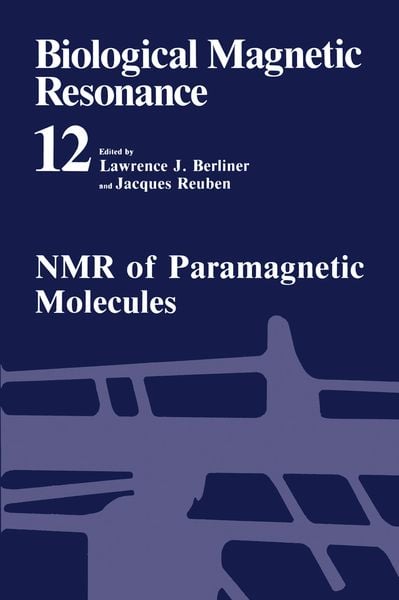
  • 1 NMR Methodology for Paramagnetic Proteins.- 1. Introduction.- 2. Paramagnetic Relaxation.- 3. 1D Correlation.- 4. 2D Correlation.- References.- 2 Nuclear Relaxation in Paramagnetic Metalloproteins.- 1. Why do Nuclei Relax Faster in the Presence of Unpaired Electrons?.- 2. Correlation Time for the Nucleus—Unpaired Electron Coupling.- 3. Contributions to Nuclear Relaxation Due to Coupling with Unpaired Electrons.- 4. A Comment on Electron Relaxation Times.- 5. Electron Relaxation in Magnetic Exchange—Coupled Systems.- 6. Effect of Fast Relaxation on NOE Experiments.- 7. Effect of Fast Relaxation on 2D Experiments.- 8. General Strategy for NMR Analysis in Paramagnetic Metalloproteins.- References.- 3 Paramagnetic Relaxation of Water Protons: Effects of Nonbonded Interactions, Electron Spin Relaxation, and Rotational Immobilization.- 1. Introduction.- 2. Outersphere Relaxation.- 3. The Electron Relaxation Rate.- 4. Effects of Rotational Mobility on Solvent Relaxation.- References.- 4 Proton NMR Spectroscopy of Model Hemes.- 1. Introduction and Background.- 2. Proton NMR Studies of Various Iron Oxidation and Spin States of Porphyrins and Reduced Hemes.- 3. The Use of NMR Spectroscopy to Investigate Chemical Reactions of Model Hemes.- References.- 5 Proton NMR Studies of Selected Paramagnetic Heme Proteins.- 1. Introduction.- 2. Background.- 3. Assignments.- 4. Relative Attributes of Selected 1D and 2D Methods with CcP: Cytochrome c Complexes as Examples.- 5. Illustrative Applications.- References.- 6 Heteronuclear Magnetic Resonance: Applications to Biological and Related Paramagnetic Molecules.- 1. Introduction.- 2. 13C NMR of Paramagnetic Molecules.- References.- 7 NMR of Polymetallic Systems in Proteins.- 1. Occurrence and Role of Polymetallic Systems in BiologicalMolecules.- 2. Paramagnetism in Magnetically Coupled Systems.- 3. NMR Parameters in Exchange-Coupled Dimetallic Systems.- 4. Exploitation of Weak Exchange Coupling in Dimetallic Systems: Cu2M2 Superoxide Dismutase (M = Co, Ni).- 5. Exploitation of Strong Exchange Coupling in Dimetallic Systems: Fe2S2 Ferredoxins.- 6. Exchange-Coupled Polymetallic Systems.- 7. NMR of Fe4S4 High-Potential Iron-Sulfur Proteins.- 8. NMR of 2[Fe4S4] Ferredoxins.- 9. Cobalt(II)-Substituted Thioneins.- 10. Concluding Remarks.- References.- of Previous Volumes.