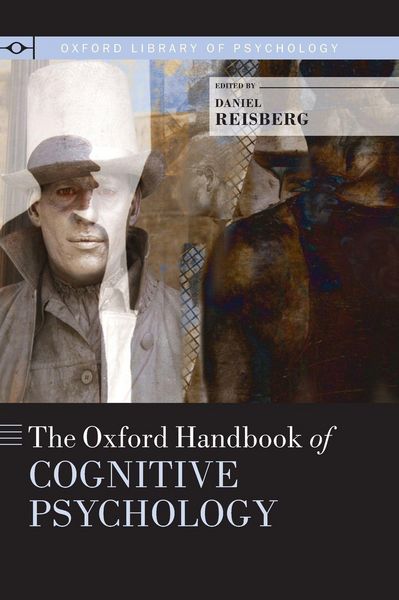

• Produktbild: Ohb Cognitive Psychology Olop C
  • Produktbild: Ohb Cognitive Psychology Olop C

Ohb Cognitive Psychology Olop C

413,99 €

inkl. gesetzl. MwSt., Versandkostenfrei


Beschreibung

Produktdetails

Einband

Gebundene Ausgabe

Erscheinungsdatum

04.04.2013

Herausgeber

Reisberg Daniel

Verlag

Oxford Academic

Seitenzahl

1106

Maße (L/B/H)

26/18,3/6,3 cm

Gewicht

2112 g

Sprache

Englisch

ISBN

978-0-19-537674-6

Beschreibung

Zitat

This handbook, part of the Oxford Library of Psychology, explores the many facets of cognitive psychology including attention, memory, language, emotion, and judgment, among others. It is full of research and authored by an international group of experts... The chapters are organized fairly uniformly with abstract, key words, text, conclusion, future directions, and references. The many figures help clarify the concepts, and the 20-page index is helpful... This is a comprehensive, yet readable, exploration of cognitive psychology, covering 65 different topics. It is a great reference for both students and clinicians. Gary B. Kaniuk, Cermac Health Services, for Doody's, July 2013

Produktdetails

Einband

Gebundene Ausgabe

Erscheinungsdatum

04.04.2013

Herausgeber

Reisberg Daniel

Verlag

Oxford Academic

Seitenzahl

1106

Maße (L/B/H)

26/18,3/6,3 cm

Gewicht

2112 g

Sprache

Englisch

ISBN

978-0-19-537674-6

Herstelleradresse

Libri GmbH
Europaallee 1
36244 Bad Hersfeld
DE

Email: gpsr@libri.de

Kundinnen und Kunden meinen

0 Bewertungen

Informationen zu Bewertungen

Zur Abgabe einer Bewertung ist eine Anmeldung im Konto notwendig. Die Authentizität der Bewertungen wird von uns nicht überprüft. Wir behalten uns vor, Bewertungstexte, die unseren Richtlinien widersprechen, entsprechend zu kürzen oder zu löschen.

Die Bewertungen sind nach Format, Anzahl Sterne und Datum sortiert.

Verfassen Sie die erste Bewertung zu diesem Artikel

Helfen Sie anderen Kund*innen durch Ihre Meinung

Kundinnen und Kunden meinen

0 Bewertungen filtern

  • Produktbild: Ohb Cognitive Psychology Olop C
  • Produktbild: Ohb Cognitive Psychology Olop C
    • 1. Introduction to the Handbook

    • Daniel Reisberg

    • Part One: Gaining Information about the Visual World

    • 2. Perceptual Organization in Vision

    • Mary A. Peterson and Ruth Kimchi

    • 3. Object Recognition

    • John E. Hummel

    • 4. Face Recognition

    • Gillian Rhodes

    • 5. Eye Movements

    • John M. Henderson

    • 6. Event Perception

    • Barbara Tversky and Jeffrey M. Zacks

    • Part Two: Attention and Awareness

    • 7. Perception and Attention

    • Ronald A. Rensink

    • 8. Spatial Attention

    • Kyle R. Cave

    • 9. Disorders of Attention

    • Robert H Logie

    • 10. The Nature and Status of Visual Resources

    • Steven L. Franconeri

    • 11. Automaticity

    • Agnes Moors

    • 12. Unconscious Processes

    • John F. Kihlstrom

    • Part Three: Memory

    • 13. Episodic Memory

    • David A. Gallo and Mark E. Wheeler

    • 14. Semantic Memory

    • Ken McRae and Michael Jones

    • 15. Implicit Memory

    • Neil W. Mulligan and Miri Besken

    • 16. The Sources of Memory Errors

    • Cara Laney

    • 17. Through the SCAPE Looking-Glass: Sources of Performance and Sources of Attribution

    • Jason P. Leboe and Bruce W. A. Whittlesea

    • 18. Event-Based Prospective Remembering: An Integration of Prospective Memory and Cognitive Control Theories

    • Julie M. Bugg, Mark A. McDaniel, and Gilles O. Einstein

    • 19. Metamemory

    • John Dunlosky and Keith W. Thiede

    • 20. Memory in Educational Settings

    • Elizabeth J. Marsh and Andrew C. Butler

    • Part Four: Knowledge and mental representation

    • 21. The Nature of Mental Concepts

    • Arthur B. Markman and Jonathan R. Rein

    • 22. Culture, Expertise, and Mental Categories

    • Kathy E. Johnson

    • 23. Models of Categorization

    • Andy J. Wills

    • 24. The Perceptual Representation of Mental Categories

    • Diane Pecher

    • 25. Mental Images

    • Daniel Reisberg

    • Part Five: Text and Language

    • 26. Speech Perception

    • Sven L. Mattys

    • 27. Spoken Word Perception

    • James S. Magnuson, Daniel Mirman, and Emily Myers

    • 28. Basic Processes in Reading

    • Keith Rayner and Alexander Pollatsek

    • 29. Text Comprehension

    • Morton Ann Gernsbacher and Michael P. Kaschak

    • 30. Discourse Comprehension

    • Arthur C. Graesser and Carol Forsyth

    • 31. Early Word Learning

    • Melissa Koenig and Caitlin Cole

    • 32. Relations between Language and Thought

    • Lila Gleitman and Anna Papafragou

    • 33. The Evolution of Language

    • Derek Bickerton

    • Part Six: The Role for Emotion

    • 34. Emotion Perception: Putting the Face in Context

    • Maria Gendron, Batja Mesquita, and Lisa Feldman Barrett

    • 35. Emotion, Stress, and Memory

    • Siobhan M. Hoscheidt, Bhaktee Dongaonkar, Jessica Payne, and Lynn Nade

    • 36. Emotion-Cognition Interaction

    • Jeffrey R. Huntsinger and Simone Schnall

    • 37. An Emotion Regulation Perspective on Belief Change

    • Matthew Tyler Boden and James J. Gross

    • Part Seven: Judgment, Reasoning, and Choice

    • 38. Judgment under Uncertainty

    • Ben R. Newell

    • 39. Induction

    • Brett K. Hayes and Evan Heit

    • 40. Reasoning

    • Jonathan St T Evans

    • 41. The Mental Models Perspective

    • Philip N. Johnson-Laird

    • 42. Analogical Learning and Reasoning

    • Dedre Gentner and Linsey A. Smith

    • 43. Decision Making

    • Maarten Speekenbrink and David R. Shanks

    • 44. Affective Forecasting and Well Being

    • Barry Schwartz and Roseanna Sommers

    • Part Eight: Thinking in Specialized Domains

    • 45. Spatial Reasoning

    • Holger Schultheis and Laura A. Carlson

    • 46. Causal Reasoning

    • Michael R. Waldmann and York Hagmayer

    • 47. Moral Thinking

    • Liane L. Young

    • Part Nine: Problem Solving and Creativity

    • 48. Problem Solving

    • Richard E. Mayer

    • 49. Insight

    • Jessica I. Fleck, Mark Beeman, and John Kounios

    • 50. Creativity

    • Dean Keith Simonton and Rodica Ioana Damian

    • Part X: How Do We Differ?

    • 51. Contemporary Theories of Intelligence

    • James C. Kaufman, Scott Barry Kaufman, and Jonathan A. Plucker

    • 52. Genes and Intelligence

    • Thais S. Rizzi and Danielle Posthuma

    • 53. Cognitive Style

    • Maria Kozhevnikov

    • Part Eleven: Practice and Skilled Performance

    • 54. Planning and Performing Physical Actions

    • David A. Rosenbaum

    • 55. The Psychology of Practice: Lessons from Spatial Cognition

    • David H. Uttal and Nathaniel G. Meadow

    • 56. Experts and Their Superior Performance

    • K. Anders Ericsson and Tyler J. Towne

    • Part Twelve: The Social and Cultural Context

    • 57. Self-Knowledge

    • Isabelle M. Bauer and Roy F. Baumeister

    • 58. Person Perception

    • Gordon B. Moskowitz and Michael J. Gill

    • 59. Theory of Mind

    • Dana Samson

    • 60. Attitude Change

    • Galen V. Bodenhausen and Bertram Gawronski

    • 61. Cultural Differences and Their Mechanisms

    • Yuri Miyamoto and Brooke Wilken

    • Part Thirteen: A Developmental Perspective

    • 62. The Development of Cognitive Control from Infancy through Childhood

    • Katherine C. Morasch, Vinaya Raj, and Martha Ann Bell

    • 63. The Development of Attention

    • Greg D. Reynolds, Mary L. Courage, and John E. Richards

    • 64. Cognitive Aging

    • Paul Verhaeghen

    • 65. Epilogue: Looking Forward

    • Daniel J. Reisberg