KI-Beratung Beta

Gutscheinbedingungen

**Gültig bis 30.11.2026 auf Spielzeug, Schreibwaren, Filme, Geschenke & Trends, Musik, tolino eReader & Zubehör, Hörbücher und Hörbuch-Downloads, nicht preisgebundene Bücher und Kalender online auf thalia.at und in der Thalia App. Einzelne Artikel können ausgeschlossen sein. Aufgrund der Buchpreisbindung sind deutschsprachige Bücher und eBooks ausgenommen. Zusätzlich ausgenommen sind Abos & Flatrates, Games, Geschenkkarten/-boxen, Shelfies, Software, Zeitschriften sowie einzelne Artikel von tonies®. Pro Einkauf einmal einlösbar. Nur gültig mit im Onlineshop hinterlegter Bonuscard. Click & Collect nur bei Onlinevorabzahlung möglich. Keine Barauszahlung. Nicht kombinierbar mit anderen Aktionen und Gutscheinen. Gutschein wird auf max. 500€ Bestellwert angerechnet. Nicht gültig für Versandkosten und Services.

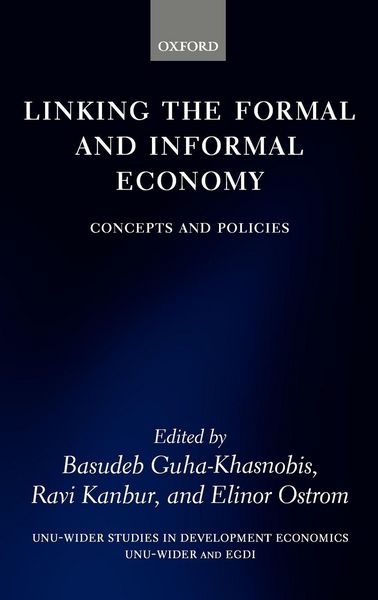
Produktbild: Linking the Formal and Informal Economy

Linking the Formal and Informal Economy Concepts and Policies

232,99 €

inkl. gesetzl. MwSt., Versandkostenfrei


Beschreibung

The concepts of formal and informal remain central to the theory and practice of development more than half a century after they were introduced into the debate. They help structure the way that statistical services collect data on the economies of developing countries, the development of theoretical...

Beschreibung

The concepts of formal and informal remain central to the theory and practice of development more than half a century after they were introduced into the debate. They help structure the way that statistical services collect data on the economies of developing countries, the development of theoretical and empirical analysis, and, most important, the formulation and implementation of policy.
This volume brings together a significant new collection of studies on formality and informality in developing countries. The volume is multidisciplinary in nature, with contributions from anthropologists, economists, sociologists, and political scientists. It contains contributions from among the very best analysts in development studies.
Between them the chapters argue for moving beyond the formal-informal dichotomy. Useful as it has proven to be, a more nuanced approach is needed in light of conceptual and empirical advances, and in light of the policy failures brought about by a characterization of the 'informal' as 'disorganized'. The wealth of empirical information in these studies, and in the literature more widely, can be used to develop guiding principles for intervention that are based on ground level reality.

Rezension

No matter how you divide up the developing world -- 'formal-informal',' legal -- 'extra-legal' --(my preference)one thing is not debatable: most people are poor, on the outside of the system looking in, and getting angrier every day. The message of this book is its time to stop talking and start designing reforms -- based on the informal practices and organizations that poor entrepreneurs already use. I second that motion. If you rebuild the system from the bottom-up, they will come -- with their enterprise, creativity, and piles of potential capital. Hernando de Soto, President, Institute for Liberty and Democracy, Peru

Produktdetails

Einband

Gebundene Ausgabe

Erscheinungsdatum

21.09.2006

Abbildungen

35 line figures and tables

Herausgeber Basudeb Guha-Khasnobis + weitere

Produktdetails

Einband

Gebundene Ausgabe

Erscheinungsdatum

21.09.2006

Abbildungen

35 line figures and tables

Herausgeber
Verlag Oxford University Press
Seitenzahl

316

Maße (L/B/H)

24/16,1/2,2 cm

Gewicht

590 g

Sprache

Englisch

ISBN

978-0-19-920476-2

Herstelleradresse

Libri GmbH
Europaallee 1
36244 Bad Hersfeld
DE

Email: gpsr@libri.de

Noch keine Bewertungen vorhanden

Verfassen Sie die erste Bewertung zu diesem Artikel

Helfen Sie anderen Kundinnen und Kunden durch Ihre Meinung.

Kundinnen und Kunden meinen

Bewertungen (0)

  • Produktbild: Linking the Formal and Informal Economy
    • 1: Basudeb Guha-Khasnobis, Ravi Kanbur, and Elinor Ostrom: Beyond Formality and Informality

    • Concepts and Measurement

    • 2: Keith Hart: Bureaucratic Form and the Informal Economy

    • 3: Robert K. Christensen: The Global Path: Soft Law and Non-sovereigns Formalizing the Potency of the Informal Sector

    • 4: Alice Sindzingre: The Relevance of the Concepts of Formality and Informality: A Theoretical Appraisal

    • 5: Martha Alter Chen: Rethinking the Informal Economy: Linkages with the Formal Economy and the Formal Regulatory Environment

    • 6: M. R. Narayana: Formal and Informal Enterprises: Concept, Definition, and Measurement Issues in India

    • Empirical Studies of Policies and Interlinking

    • 7: Norman V. Loayza, Ana María Oviedo, and Luis Servén: The Impact of Regulation on Growth and Informality: Cross-Country Evidence

    • 8: Robert Lensink, Mark McGillivray, and Pham Thi Thu Trà: Financial Liberalization in Vietnam: Impact on Loans from Informal, Formal, and Semi-formal Providers

    • 9: Fredrik Söderbaum: Blocking Human Potential: How Formal Policies Block the Informal Economy in the Maputo Corridor

    • 10: Basudeb Guha-Khasnobis and Rajeev Ahuja: Microinsurance for the Informal Economy Workers in India

    • 11: Krister Andersson and Diego Pacheco: Turning to Forestry for a Way Out of Poverty: Is Formalizing Property Rights Enough?

    • 12: Jeffrey B. Nugent and Shailender Swaminathan: Voluntary Contributions to Informal Activities Producing Public Goods: Can These be Induced by Government and other Formal Sector Agents? Some Evidence from Indonesian Posyandus

    • 13: Amos Sawyer: Social Capital, Survival Strategies, and their Potential for Post-Conflict Governance in Liberia

    • 14: Sally Roever: Enforcement and Compliance in Lima's Street Markets: The Origins and Consequences of Policy Incoherence Toward Informal Traders

    • 15: Liz Alden Wily: Formalizing the Informal: Is There a Way to Safely Unlock Human Potential Through Land Entitlement? A Review of Changing Land Administration in Africa