KI-Beratung Beta

Gutscheinbedingungen

**Gültig bis 05.10.2026 ab einem Mindestbestellwert von 30€ auf Spielzeug, Schreibwaren, Filme, Geschenke & Trends, Musik, tolino eReader & Zubehör, Hörbücher und Hörbuch-Downloads, nicht preisgebundene Bücher und Kalender online auf thalia.at und in der Thalia App. Einzelne Artikel können ausgeschlossen sein. Aufgrund der Buchpreisbindung sind deutschsprachige Bücher und eBooks ausgenommen. Zusätzlich ausgenommen sind Abos & Flatrates, Games, Geschenkkarten/-boxen, Shelfies, Software, Zeitschriften sowie einzelne Artikel von tonies®. Pro Einkauf einmal einlösbar. Nur gültig mit im Onlineshop hinterlegter Bonuscard. Click & Collect nur bei Onlinevorabzahlung möglich. Keine Barauszahlung. Nicht kombinierbar mit anderen Aktionen und Gutscheinen. Gutschein wird auf max. 500€ Bestellwert angerechnet. Nicht gültig für Versandkosten und Services. Preisgebundene Artikel sind vom Mindestbestellwert ausgeschlossen.

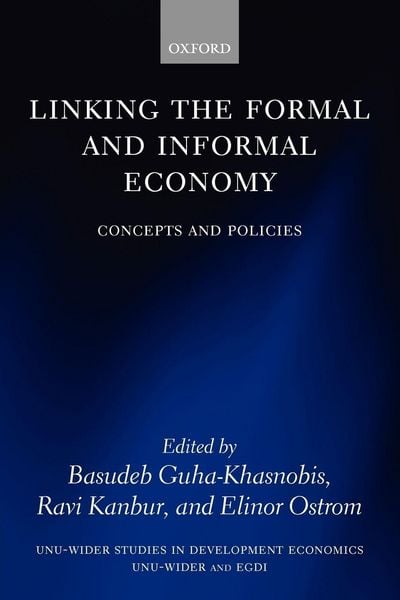
Produktbild: Linking the Formal and Informal Economy

Linking the Formal and Informal Economy Concepts and Policies

97,99 €

inkl. gesetzl. MwSt., Versandkostenfrei


Beschreibung

Produktdetails

Einband

Taschenbuch

Erscheinungsdatum

01.12.2007

Abbildungen

numerous tables and figures

Herausgeber

Guha-Khasnobis Basudeb + weitere

Verlag

Oxford University Press

Seitenzahl

314

Maße (L/B/H)

23,4/15,6/1,7 cm

Gewicht

480 g

Sprache

Englisch

ISBN

978-0-19-923729-6

Beschreibung

Produktdetails

Einband

Taschenbuch

Erscheinungsdatum

01.12.2007

Abbildungen

numerous tables and figures

Herausgeber

Verlag

Oxford University Press

Seitenzahl

314

Maße (L/B/H)

23,4/15,6/1,7 cm

Gewicht

480 g

Sprache

Englisch

ISBN

978-0-19-923729-6

Herstelleradresse

Libri GmbH
Europaallee 1
36244 Bad Hersfeld
DE

Email: gpsr@libri.de

Noch keine Bewertungen vorhanden

Verfassen Sie die erste Bewertung zu diesem Artikel

Helfen Sie anderen Kundinnen und Kunden durch Ihre Meinung.

Kundinnen und Kunden meinen

Bewertungen (0)

  • Produktbild: Linking the Formal and Informal Economy

    • 1: Basudeb Guha-Khasnobis, Ravi Kanbur, and Elinor Ostrom: Beyond Formality and Informality


    • Concepts and Measurement


    • 2: Keith Hart: Bureaucratic Form and the Informal Economy


    • 3: Robert K. Christensen: The Global Path: Soft Law and Non-sovereigns Formalizing the Potency of the Informal Sector


    • 4: Alice Sindzingre: The Relevance of the Concepts of Formality and Informality: A Theoretical Appraisal


    • 5: Martha Alter Chen: Rethinking the Informal Economy: Linkages with the Formal Economy and the Formal Regulatory Environment


    • 6: M. R. Narayana: Formal and Informal Enterprises: Concept, Definition, and Measurement Issues in India


    • Empirical Studies of Policies and Interlinking


    • 7: Norman V. Loayza, Ana María Oviedo, and Luis Servén: The Impact of Regulation on Growth and Informality: Cross-Country Evidence


    • 8: Robert Lensink, Mark McGillivray, and Pham Thi Thu Trà: Financial Liberalization in Vietnam: Impact on Loans from Informal, Formal, and Semi-formal Providers


    • 9: Fredrik Söderbaum: Blocking Human Potential: How Formal Policies Block the Informal Economy in the Maputo Corridor


    • 10: Basudeb Guha-Khasnobis and Rajeev Ahuja: Microinsurance for the Informal Economy Workers in India


    • 11: Krister Andersson and Diego Pacheco: Turning to Forestry for a Way Out of Poverty: Is Formalizing Property Rights Enough?


    • 12: Jeffrey B. Nugent and Shailender Swaminathan: Voluntary Contributions to Informal Activities Producing Public Goods: Can These be Induced by Government and other Formal Sector Agents? Some Evidence from Indonesian Posyandus


    • 13: Amos Sawyer: Social Capital, Survival Strategies, and their Potential for Post-Conflict Governance in Liberia


    • 14: Sally Roever: Enforcement and Compliance in Lima's Street Markets: The Origins and Consequences of Policy Incoherence Toward Informal Traders


    • 15: Liz Alden Wily: Formalizing the Informal: Is There a Way to Safely Unlock Human Potential Through Land Entitlement? A Review of Changing Land Administration in Africa