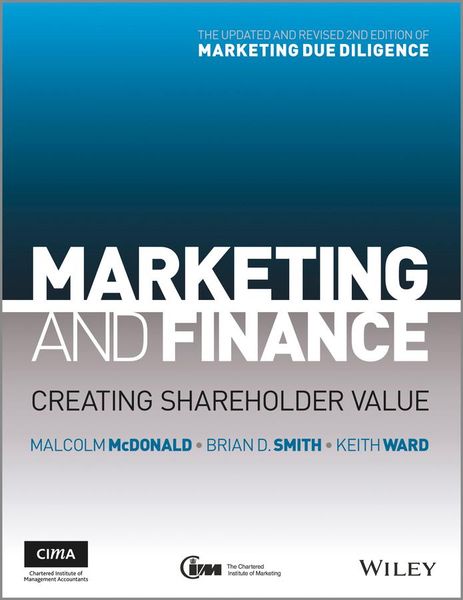
Produktbild: Marketing and Finance

Marketing and Finance Creating Shareholder Value

51,99 €

inkl. gesetzl. MwSt., Versandkostenfrei


Beschreibung

Produktdetails

Einband

Taschenbuch

Erscheinungsdatum

01.10.2013

Verlag

John Wiley & Sons

Seitenzahl

280

Maße (L/B/H)

24,6/18,4/2 cm

Gewicht

567 g

Auflage

2. Auflage

Sprache

Englisch

ISBN

978-1-119-95338-8

Beschreibung

Produktdetails

Einband

Taschenbuch

Erscheinungsdatum

01.10.2013

Verlag

John Wiley & Sons

Seitenzahl

280

Maße (L/B/H)

24,6/18,4/2 cm

Gewicht

567 g

Auflage

2. Auflage

Sprache

Englisch

ISBN

978-1-119-95338-8

Kundinnen und Kunden meinen

0 Bewertungen

Informationen zu Bewertungen

Zur Abgabe einer Bewertung ist eine Anmeldung im Konto notwendig. Die Authentizität der Bewertungen wird von uns nicht überprüft. Wir behalten uns vor, Bewertungstexte, die unseren Richtlinien widersprechen, entsprechend zu kürzen oder zu löschen.

Die Bewertungen sind nach Format, Anzahl Sterne und Datum sortiert.

Verfassen Sie die erste Bewertung zu diesem Artikel

Helfen Sie anderen Kund*innen durch Ihre Meinung

Kundinnen und Kunden meinen

0 Bewertungen filtern

Die Leseprobe wird geladen.
  • Produktbild: Marketing and Finance
  • Foreword by Anne Godfrey, Chief Executive, CIM xi

    Foreword by Charles Tilley, Chief Executive, CIMA xiii

    Foreword from the First Edition by Sir Michael Perry, GBE xv

    A note for busy people: How to get the best out of this book xix

    List of figures xxi

    List of tables xxv

    Part 1 What is Marketing Due Diligence? 1

    Chapter 1 The lessons of experience 3

    Fast track 3

    Introduction 3

    Success stories 5

    Starbucks: A holistic offer based on insight and culture 5

    The Economist: Side stepping in time to the future 6

    Yamazaki Mazak: Matching itself to the market 7

    Essilor: Growing the pie 8

    Failure stories 9

    Blockbuster: Left behind 9

    Gateway: Playing a zero-sum game 10

    Microsoft's Zune: So what's better? 11

    Nortel: Playing the wrong game 12

    Woolworth's: Failure to focus 13

    Seeing a pattern 14

    Financial smoke and mirrors 14

    Share and share alike 16

    Marketing accountability 16

    A new approach 18

    Chapter 2 A process of Marketing Due Diligence 21

    Fast track 21

    What is marketing? 22

    What is the connection between marketing and shareholder value? 23

    What is the Marketing Due Diligence diagnostic process? 25

    Explicating the strategy 27

    Assessing the risks 29

    Assessing shareholder value creation 34

    What is the Marketing Due Diligence therapeutic process? 39

    Implications of the Marketing Due Diligence process 41

    Chapter 3 The implications of implementing Marketing Due Diligence 43

    Fast track 43

    The linkage to shareholder value 44

    The risk and return relationship 45

    A focus on absolute returns rather than risk 48

    Using probability estimates to adjust for risk 51

    Alignment with capital markets 56

    Turning Marketing Due Diligence into a financial value 57

    Adjusting marketing planning outcomes 57

    Placing the adjusted fi nancial return into context 58

    Allowing for 'capital at risk' 60

    Highlighting deficiencies and key risks 62

    Implications for users 63

    Part 2 The Marketing Due Diligence Diagnostic Process 65

    Chapter 4 Assessing market risk 67

    Fast track 67

    Some important background to what constitutes 'success' 68

    Short-term success 68

    Strategy and tactics 70

    The strategic marketing plan 71

    Market risk 71

    The meaning of 'product' and 'market' 72

    Combining product and market 77

    Product/market growth or decline 78

    Product and market combined 82

    Market risk assessment 86

    Conclusion 93

    Chapter 5 Assessing share risk 97

    Fast track 97

    What do we mean by share risk? 98

    How do we assess share risk? 100

    Assessing target market risk 101

    Assessing proposition risk 103

    Assessing SWOT risk 106

    Assessing uniqueness risk 108

    Assessing future risk 110

    Assessing other sources of share risk 113

    Aggregating and applying share risk 116

    Step 1: Explicate the marketing strategy 117

    Step 2: Assess the explicated strategy against the sub-components of share risk 117

    Step 3: Aggregate the sub-components into an overall assessment of share risk 119

    Step 4: Identify the growth component of the strategy 120

    Step 5: Moderate the growth component of the strategy to allow for risk 121

    Step 6: Allow for complex strategies 122

    The outcomes of share risk assessment 122

    Chapter 6 Assessing profit risk 125

    Fast track 125

    Introduction 126

    Profit pool risk 129

    Profit sources risk 135

    Competitor impact risk 138

    Internal gross margin risk 142

    Other costs risks 144

    Summary 148

    What do weak marketing strategies look like? 148

    Part 3 The Marketing Due Diligence

    Therapeutic Process 151

    Chapter 7 The key role of market defi nition and segmentation 153

    Fast track 153

    Introduction 154

    Correct market definition 155

    A crucial business discipline, not just a philosophical argument 155

    Market mapping 158

    Leverage points 162

    Market segmentation 165

    How customers vary: Needs-based segmentation 170

    Some final thoughts 178

    Chapter 8 Creating strategies that create shareholder value 181

    Fast track 181

    Starting from where we are 181

    Understanding and managing market risk 183

    Understanding and managing product category and market existence risk 183

    Understanding and managing sales volume, forecast and pricing risks 189

    Understanding and managing share risk 191

    Reducing target market risk 192

    Reducing proposition risk 192

    Reducing SWOT alignment risk 196

    Reducing uniqueness risk 198

    Reducing future risk 199

    Other components of share risk 200

    Understanding and managing profit risk 203

    Reducing profit pool risk 203

    Reducing profit source risk 205

    Reducing competitor impact risk 206

    Reducing internal gross margin risk 207

    Reducing other costs risk 209

    Summary and conclusions 210

    Chapter 9 Managing high-risk marketing strategies 211

    Fast track 211

    Allowing for risk 212

    Risk equals volatility 213

    Controllable versus uncontrollable volatility 214

    Using real option analysis 219

    Real option example 223

    Summary 228

    Chapter 10 Fast track: A summary and reminder of the marketing and finance interface 229

    The lessons of experience 229

    A process of Marketing Due Diligence 229

    The implications of implementing Marketing Due Diligence 231

    Assessing market risk 232

    Assessing share risk 233

    Assessing profit risk 234

    The key role of market definition and segmentation 236

    Creating strategies that create shareholder value 237

    Managing high-risk marketing strategies 238

    Afterword: What to do now 241

    References and further reading 243

    Index 245